

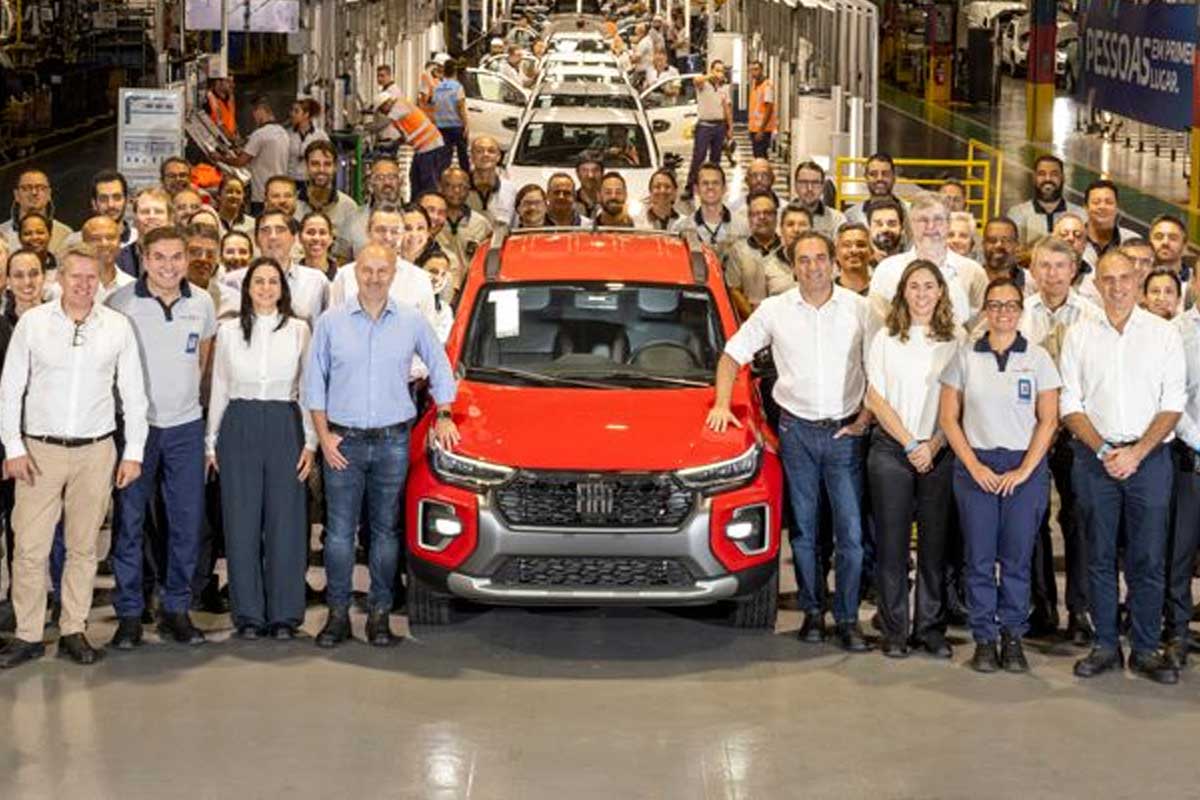
After striking a major blow in North America with more than $13 billion in announced investments in the United States, Stellantis is now turning its attention to the other pillar of its global empire: South America, and Brazil in particular. At its traditional year-end meeting in São Paulo, the Group confirmed a colossal industrial plan worth 32 billion reais, or around 5.8 billion euros. A sum that repositioned the country at the heart of the Italian-French-American giant's global priorities.
Brazil: an indispensable part of Stellantis' global strategy
While Fiat is still holding its own in Europe thanks to the Panda and an encouraging start to the career of the Grande Panda, the figures published by the between January and November 2025 show that the brand's true stability lies elsewhere. Brazil remains its absolute bedrock, with 520,000 registrations expected by 2025, growth that is still positive and volumes that overwhelm the Group's global portfolio. The strength of the South American market continues to compensate for persistent weaknesses in Europe. This dependence is no coincidence: Stellantis sees Brazil not only as a mature market, but also as a technological laboratory, a regional industrial hub, and now a key player in its energy transition.

Goiana, Porto Real and Betim
The industrial plan unveiled transforms several South American plants into veritable strongholds of Stellantis' future strategy. In Goiana, in the state of Pernambuco, the Group will produce four new models equipped with Bio-Hybrid technology, a lightweight hybrid system designed locally and already used on the Fiat Pulse and Fastback, as well as the Peugeot 208 and 2008 Hybrid. The arrival of Leapmotor production at the same plant confirms the Group's move upmarket and its role as a regional incubator.
At Porto Real, in the state of Rio de Janeiro, the acceleration will materialize as early as 2026 with the introduction of a second production plant. The objective is clear: to absorb the launch of the new Jeep Avenger and future Citroën models, while creating skilled jobs in the southern Fluminense region.
But it's Betim, Fiat's historic plant in Brazil, that embodies the most symbolic move. As the site prepares to celebrate its fiftieth anniversary in 2026, having produced more than 18 million vehicles, Stellantis will assemble a brand-new Fiat model based on the CMP platform. The model will be the South American version of the future Fiat Grande Pandato replace the Argo.
A regional plan that goes beyond Brazil
This record investment of 5.8 billion euros is also irrigating the rest of the continent. In Argentina, the Córdoba plant will launch production of the new Ram Dakota, celebrating thirty years in business. In Uruguay, Stellantis will consolidate its role in light commercial vehicles with new lines dedicated to the Jumpy, Expert and next-generation Ducato. South America thus becomes a coherent, structured entity, essential to the Group's overall performance. It's a strategy not unlike that already underway in North America, where Stellantis recently put over $13 billion on the table to secure the industrial future of Jeep, Ram and Dodge.
The message is clear: Stellantis invests where there is growth
Between the US announcements and this massive plan for Brazil, Stellantis is sending out a clear signal: profitability and growth potential are no longer to be found solely in Europe's historic markets.
The Group's center of gravity is shifting, with South America becoming one of its major pillars. Meanwhile, Europe ponders its future...
 English
  French
  Italian
  Spanish
  Portuguese
  German
  Japanese
  Turkish
  Dutch
Dutch
Europe is small and overpopulated with cars. It's time to think differently than always replacing your car with a bigger panzer! In the Americas, they don't really have space problems...and pollution isn't their problem!
Why invest in Europe, when the automotive industry is crumbling under ecological standards and manufacturers are obliged to produce electric cars that Europeans don't want?
Speak for yourself. I want more thermal... like 20% of people already .
Not everyone has the budget to pay for and amortize an electric vehicle. 20%, where did you get that?
North and South America are "old-fashioned" markets, lagging behind Europe and China/Japan/Korea in terms of technology, where irrationality (especially marketing) makes the difference. But how long will consumers be willing to buy products with lower technological content in an ultra-connected world?
Stellantis, your not getting the message. We don't want ITALIAN VEHICLES. More CHRYSLER, DODGE, JEEPS products. We also want better quality built car's. By the way; where is our CUDA?