

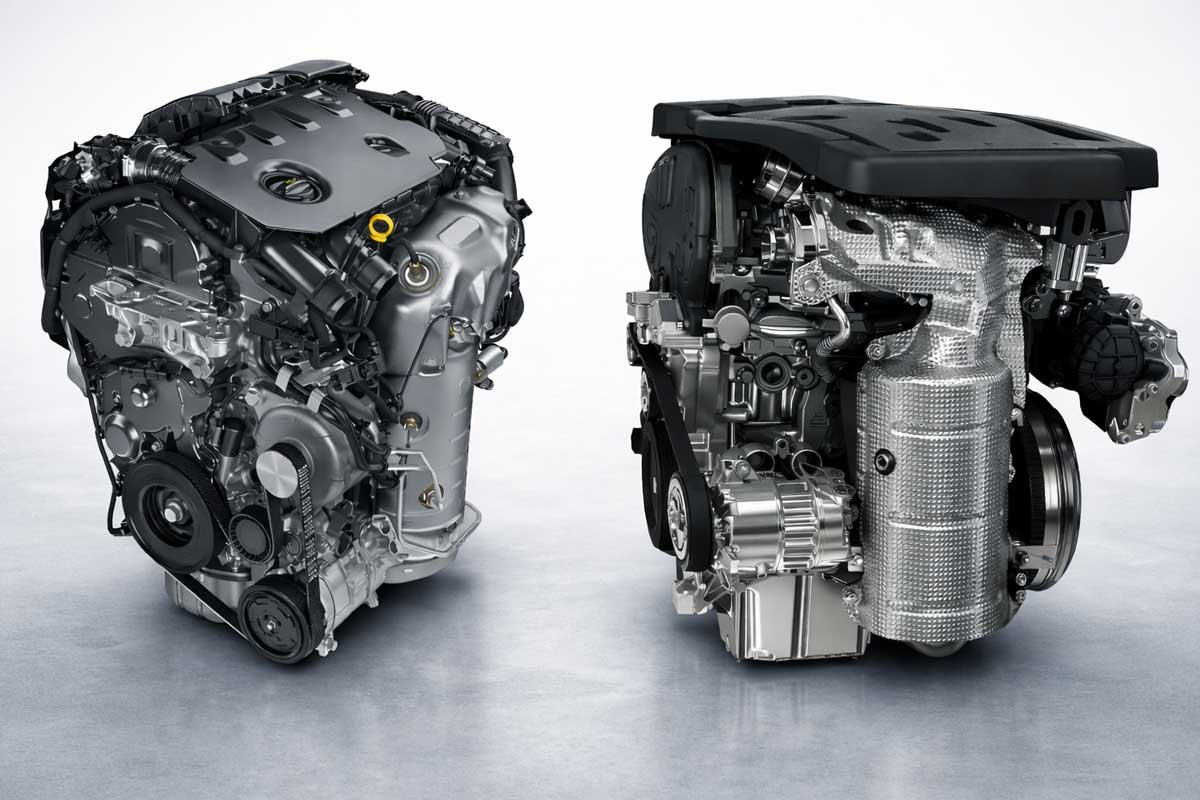
While Stellantis has just made official the return of diesel in several European modelsnew information has already been added to the picture. And it's important. For behind this simple return to diesel may in fact lie a major technical change: the gradual end of the French BlueHDi engine in favor of an Italian Fiat base. Nothing has yet been officially confirmed, but several concordant sources describe an industrial strategy that goes much deeper than a simple catalog adjustment. Stellantis would not be content to simply reintroduce diesel engines. The group is said to be preparing its new generation.
From BlueHDi to Multijet
Since the creation of the Group, most compact and family models have been based on the 1.5 BlueHDi developed historically by PSA. This was the benchmark diesel for Peugeot, Citroën, DS and Opel. But this engine has come in for criticism, particularly concerning its reliability. Officially, it was to remain in production until the end of the decade. Unofficially, Stellantis decided to shorten its future.
The replacement has already been chosen: an evolution of the Italian 1.6L and 2.2L Multijet, an architecture well known to the Fiat group and renowned for its robustness. This new version would be entirely redesigned to meet future Euro 7 standards, and would become the common diesel base for all the Group's European brands. In other words, the Group's internal balance would change: the diesel benchmark would no longer come from France, but from Italy.
A diesel... hybrid!
But it's not just the engine's origin that's most interesting. It's its philosophy. Future 1.6L and 2.2L Multijet engines will no longer be traditional diesels. They would be systematically electrified. Stellantis is said to be preparing a 48-volt mild-hybrid system combined with the eDCT6 dual-clutch gearbox already used on Peugeot's petrol hybrid engines.
The principle is simple: a small electric motor integrated into the transmission, capable of assisting the internal combustion engine, recovering energy during braking and even enabling short trips in electric mode. The expected result: lower fuel consumption, reduced CO₂ emissions and compliance with Euro 7 standards. It would therefore be an intermediate technology between conventional combustion and hybrid, perfectly suited to long trips and professional fleets, precisely where electrics are still struggling to convince.
Towards a range-wide rollout
According to this information, these new diesels will not be reserved for a few specific models. They could become the Group's transversal engine in Europe. There's talk of their arrival as early as 2026 on new models, possibly family SUVs, including the Lancia Gamma and DS7, and large sedans, before much wider distribution. This also explains why Stellantis is relaunching the diesel today: it's a transition to a new generation rather than a simple step backwards.
A market-driven strategy
The context helps to understand this turnaround. The growth of electric vehicles is slowing down, corporate fleets are still driving a lot, and Chinese competition remains focused on zero-emission vehicles. As a result, diesel still has an economic advantage in certain applications. Stellantis therefore seems to be adopting a pragmatic stance. Rather than imposing a single technology, the group is preparing a sustainable coexistence of electric and hybrid vehicles.
If confirmed, this would be more than just the return of the diesel: it would be the birth of a new-generation diesel: electrified, Euro 7 compliant and industrialized on a large scale. A strong industrial choice, and also a symbol. After several years dominated by French engines within the group, Stellantis could now draw on its Italian technical heritage to ensure the energy transition. All that remains now is to await official confirmation.
 English
  French
  Italian
  Spanish
  Portuguese
  German
  Japanese
  Turkish
  Dutch
Dutch
The very good news is that Tavares should have done something right from the start of the PSA-FCA merger. He should have kept the Firefly and Multijet diesel engines to replace the Puretech and Hdi engines, and mixed the FCA engines with the PSA platform.
The best of both worlds and continue to invest in hybridization and electrics.
Lol
PSA platform... no rear-wheel drive, no all-wheel drive, no longitudinal block...
And the Giorgio platform is available in rear-wheel drive, as is the Stla large in front-wheel drive, rear-wheel drive and all-wheel drive,
which can accommodate the 1.6 l and 2.0 l transverse, the 2.0 l in-line 6-cylinder hurricane and the V6 Nettuno.
STLA Large is an evolution of the Giorgio. Nothing to do with PSA's basic platforms...
Who cares, Potté?
It's important to understand that everything at Stellantis is pooled for synergy!
For your information, PSA's basic platforms... Are multi-energy!
Not bad for basic!
Giorgio and Stla wide-based rear-wheel drive and all-wheel drive are planned for categories D and E, while categories B and C have CMP , Stla small and Stla medium transverse engines.
Karuk is right.
When it comes to city car and sedan segment platforms, there's no contest: those of the former PSA are much further ahead and sharper than those of FCA. In fact, the press has always praised them. In the higher segments, on the other hand, PSA has nothing to offer. So the Giorgio is very welcome.
As far as engines are concerned, apart from the 2.0 HDi, which was a good choice but has recently been discontinued, the rest were not the best in terms of reliability. The 2.2 has recently taken its place under the hoods of the Expert/Jumpy/Zafira etc...
But small cars are only sold in Europe, and also in South America. It's all very well to use CMP for 90hp tractions, but that doesn't make PSA a serious group on which to base all its models...
"When it comes to city car and sedan segment platforms, there's no contest: those of the former PSA are much further ahead and sharper than FCA's."
At the same time, there's nothing of the kind from ex-FCA, so these platforms shouldn't be replaced. Note the STLA City, which is none other than that of the current 500 and will serve as the basis for the next one, as well as the next Pandina and a hypothetical Citroën small car.
Except that the fireflies weren't available quickly or in large numbers - FCA obliges.
The Polish factory that made the 1.0 Firefly was available, as was the Italian factory that still makes the 1.3 l and 1.5 l Firefly. Tavares wanted to rationalize the engines, preferring to impose the Puretech in favor of the Firefly for industrial and economic reasons, in order to make a profit, and he thought he could only sell electric models.
The Firefly was available, it's the stingy Tavares who wanted to impose the 1.2 puretech exclusively on all brands for economic reasons and rationalization when he could have made them comply with euro 7 standards to at least adapt them to the Italian ranges and allowed the manufacturing plants to run, while he wanted to turn them into gigafactories to manufacture batteries for electric cars that customers don't buy, it's a mistake of vision on the part of this one who believed too much in him.
The Firefly was already available since the 1.0 l Turbo was manufactured in a Polish factory in Bielo and the 1.3 l and 1.5 l are manufactured in Italy, it was enough to make them evolve towards the new standards then to adapt them to Avenger, 600 and Junior andcc to the less Italian ranges and that made it possible to make turn the Italian factories.
Probably more available than the laughable reliability of French production... PsA obliges.
The problem is that engines are linked to platforms, and changing an engine means passing crash certification tests again, plus buying new tools for the factories. What's more, you're forgetting one point: despite its shortcomings, the Puretech emits less CO2 than its Firefly equivalent. When you're counting to the nearest gram, don't forget that.
Finally no more adblue pump problems and a new engine sound on the Peugeots Tavares should have foreseen this from the start. After the reset good start driver A.Filosa
Good technical news. The 1.5l is the same crap as the 1.2 petrol. However, I don't know of any factory that is already preparing this "new engine". So late 26 seems optimistic. More like late 27.
The new engine we're talking about is an evolution of Fiat's 1.6l multijet, which is much more reliable than the 1.5 HDi, to adapt it to Euro 7.
Yes, since it's an evolution of the 1.6 multijet Fca, much more reliable than the 1.5 HDi PSA.
Inside info....
It's already a done deal!
The 1.6 jtd ( to be called jtd) will be launched on 208/308/4008/3008/5008/2008
And Corsa/ Astra/Grandland/Mokka/Fontera and I won't do all the Citroëns.
A 2.0 and 2.2 are also ready.... Ironic... The 2.2-liter is a PSA/FCA collaboration....
And to take things a step further, the Peugeot family withdrew from the business, proposing that the BPI take over its shares so that the brand would remain Franco-Italian.
And yes, the puremerde is out.....
It's internal! Have a nice day!
No, the 2.2 multijet is not a collaboration with Peugeot. This engine was already introduced on the jeep Cherokee, with a cubic capacity of 2184 cm, derived from the 2.0-liter 1956-cubic-cm Fiat models, including the new Titano , Toro , Ram Rampage pickup sold in South America .
The 2.2 is nonetheless an engine of the boxer, jumper and ducato.... Originally designed for utility vehicles and derived from the 2.2 hdi of the late 607!
Except that fiat has never stopped developing it.
I work and have worked on these engine blocks.... I think I'm in a good position to confirm this...and the jeep cherokee got the engine....from the 607!
Also available from iveco and renault e 2.8 l
Termoli in all logic.
The 1.5 HDI has been reliable since they switched to the 8mm chain in 2021, and even before that there were cases of breakage, but nothing compared to the Puretech.