

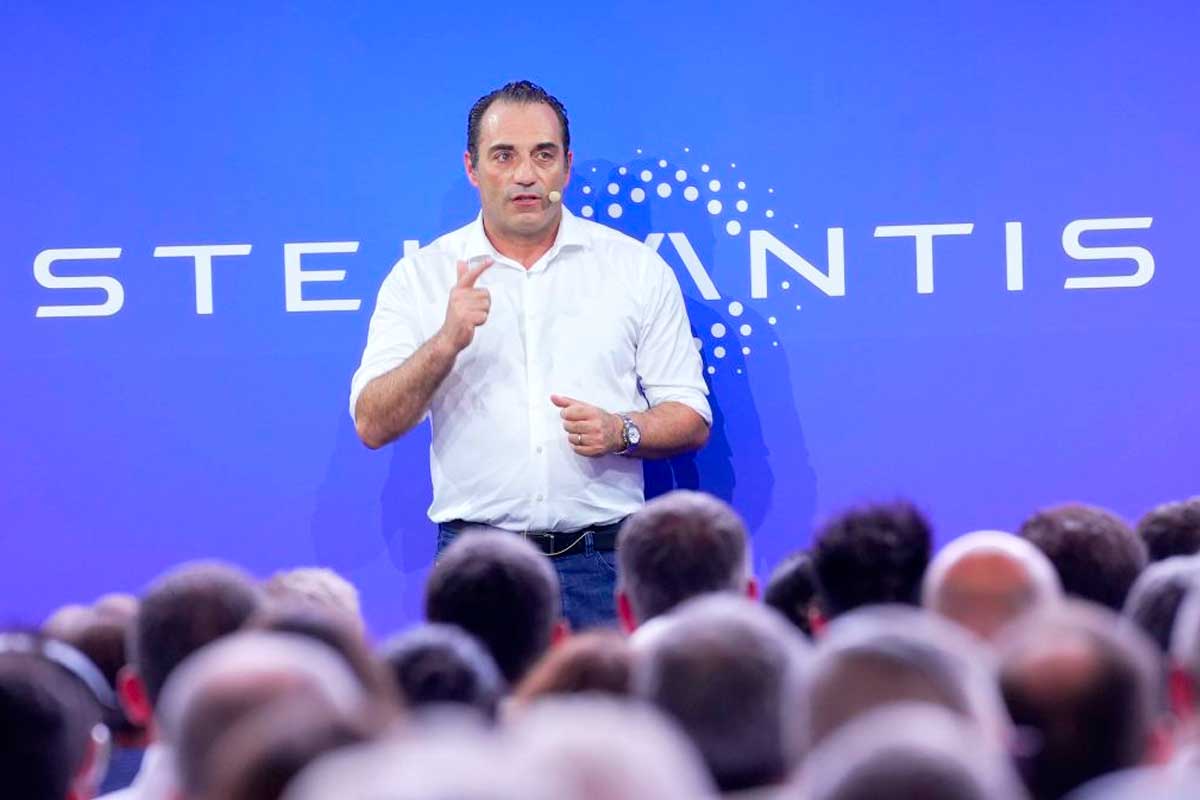
For several months now, the Stellantis in Europe is getting tougher. Behind the figures, the provisions and the theoretical fines that are piling up, one idea comes back insistently from the mouth of its CEO, Antonio Filosa: the money swallowed up in CO₂ penalties would be much better used to invest in industrial plant, innovation and employment. A message now taken publicly to Brussels, alongside Volkswagen, at a time when European regulations are increasingly perceived as a structural brake on competitiveness.
A European industry under regulatory pressure
In a joint article published at the beginning of February, Antonio Filosa and Volkswagen boss Oliver Blume call for a real change in European industrial policy. They agree that the current framework for the energy transition is creating a growing imbalance between European producers and players already positioned in the pure electric sector, often from outside Europe. The two leaders are calling for a "Made in Europe" strategy that would make access to public aid, markets and CO₂ bonuses conditional on precise local production criteria. Batteries, powertrains, electronics, assembly: the aim is clear, to relocate added value and secure industrial jobs on the continent, without falling into closed protectionism.
Billions of euros up in smoke
This debate is not theoretical for Stellantis. In 2025, the group came very close to a massive financial penalty. Without the last-minute easing of European rules, the bill would have exceeded 800 million euros on the Italian market alone. A sum narrowly avoided, but which illustrates the scale of the problem. For Antonio Filosa, the reasoning is simple: these amounts, if they become real, serve neither the environment nor the industry. "These are resources we could be turning into investments," he explains, pointing out that Stellantis has already had to set aside almost half a billion euros in 2025 just to cover the risk of penalties on light commercial vehicles.
Utilities: Stellantis' Achilles heel
It is precisely in this segment that the situation is becoming critical. Electric commercial vehicles are struggling to win over craftsmen and professional fleets, held back by price, range and recharging constraints. Yet European regulations apply with the same severity as for passenger cars. With a market share of almost 30 % in Europe, Stellantis is mechanically one of the most exposed manufacturers. Internally, the figure has been circulating for several months: up to 2.6 billion euros in potential fines by 2027 if current targets remain unchanged. A systemic risk for a major industrial group.
"We've cut too much in the past
Beyond the figures, Antonio Filosa also acknowledges strategic errors. In an interview with the Italian press, he admits that Stellantis has sometimes cut costs excessively, notably by parting with key engineers. A decision he now describes as counter-productive in a context where innovation is vital. Since he took office, the Group has already recruited some 2,000 engineers, mainly in the United States, and relaunched several industrial sites, such as the Serbian plant that was shut down for three years. But in Europe, the potential remains under-exploited. Not for lack of will, according to Filosa, but because of a regulatory framework deemed too vague, too ambitious and penalizing for local producers.
A "Made in Europe" label
This is where the proposal for a "Made in Europe" label comes into its own. The idea is not to erect barriers, but to create positive incentives. A CO₂ bonus for vehicles produced predominantly in Europe would enable manufacturers to avoid colossal fines while maintaining production, employment and R&D on the continent. For Filosa and Blume, the stakes go far beyond the fate of Stellantis or Volkswagen. The automotive industry accounts for almost 8 % of European GDP and provides a livelihood for some 13 million people. The question posed to Brussels is now a head-on one: does Europe want to remain an industrial power or content itself with being a market for others?
In the short term, Stellantis gained time. The fines have been postponed, the calculations smoothed out, the immediate pressure eased. But the fundamental problem remains. Without a thorough overhaul of the rules, the billions of euros that are now theoretical could quickly become very real.
 English
  French
  Italian
  Spanish
  Portuguese
  German
  Japanese
  Turkish
  Dutch
Dutch
Ultimately, Europe is shooting itself in the foot to the benefit of Chinese manufacturers.
Given the lack of choice for engines, it's safe to say they've narrowed it down 😡
What he doesn't say is that a number of managers have also left over the last 10 years, first to FCA and PSa, then to Stellantis, and even more so!