

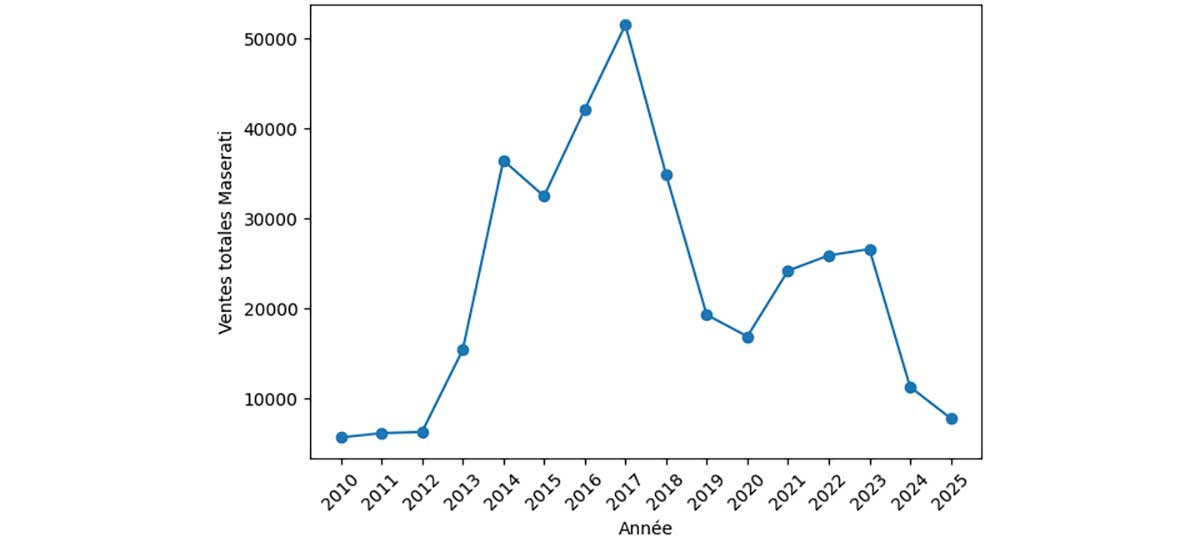
Stellantis has published its results for the fourth quarter of 2025, and they confirm what registrations had already been hinting at for months: Maserati is going through one of the worst sales crises in its modern history. With just 1,900 cars sold in the last quarter, the trident brand ended 2025 at 7,800 units. A figure not seen since the early 2010s, when Maserati was still a niche manufacturer before the Ghibli and Levante era.
The contrast is stark: in 2017, Maserati exceeded 51,000 annual sales. Eight years later, the brand is selling almost seven times fewer cars.
A precipitous fall in three years
The trajectory is all the more striking for being so recent. In 2023, Maserati was still selling 26,600 cars. By 2024, the brand had fallen to 11,300, and by 2025, it had collapsed to 7,800 units. In just two years, Maserati has lost more than two-thirds of its worldwide volumes. The quarterly breakdown confirms the total absence of recovery: 1,700 cars in the first quarter, 2,500 in the second, then 1,700 again and finally 1,900. No sales momentum, no product effect, no year-end rebound. The curve is flat... but at an extremely low level.
This official confirmation gives particular weight to registration data already observed in major markets. The United States, long an absolute pillar of Maserati, has collapsed by more than 40 %. Italy itself is in steep decline, while most European countries are no longer compensating. Even markets traditionally favorable to luxury goods, such as Switzerland and Japan, are plunging.
The symbol of a structural problem
What's striking about these results is not just the decline, but its global nature. Maserati is not suffering from a specific market. The contraction is affecting almost every region of the world at the same time. In other words, this is no longer a simple product cycle. The brand has lost its positioning.
While Maserati is falling, its rivals are evolving in another universe. Ferrari sells slightly fewer cars but boosts profits thanks to highly exclusive models and a value strategy. Lamborghini, despite a reduced range during its product transition, continues to set records around 10,700 annual units.
The end of an industrial model
The 2025 figures probably mark the end of the model established in the 2010s: produce more to make the industrial tool profitable. The Ghibli and Levante had multiplied volumes, but also diluted the brand's image. Today, Maserati finds itself without volume... and without sufficient aura to compensate. Only the Maserati MCXtrema can be an exception.
The new management team led by Jean-Philippe Imparato now wants to produce as closely as possible to demand, drastically reduce inventories and rebuild desirability. A strategy inspired by Ferrari and Lamborghini, but one that requires a profound transformation: range, communication, product consistency and perceived value.
2026-2030: the last chance cycle
With 7,800 sales worldwide, Maserati is almost back to the level of the early 2010s, but in an infinitely more challenging context: electrification, increased competition from luxury cars and the rise of ultra-exclusive brands. The period 2026-2030 will therefore be much more than a simple product plan. It will be a complete repositioning. The brand must become desirable again, even before it becomes profitable again.
 English
  French
  Italian
  Spanish
  Portuguese
  German
  Japanese
  Turkish
  Dutch
Dutch
!!!" The brand must become desirable again even before it becomes profitable again."!!!!
That's exactly what Alfa started with the Giulia and the Stelvio, and that's how Lexus started, so Maserati has to go that way, just like Alfa, Lancia, Citroën, Chrysler, Dodge and Abarth.
Fiat, Peugeot Opel are in it for the volume and shouldn't apply to the rest. They should divide the world market into 3 for that.
The others mentioned above only have to make cars on demand, hyper-reliable with a royal after-sales service and keep their prices high.
I'm not optimistic about Maserati's future. Targeting ultra-luxury seems risky to me, as making a profit with less than 10k sales/year implies very high prices. I'm not sure that, given the brand's loss of prestige, it will be possible to sell enough Maseratis at +200k€. Even Aston can't do it.
Maserati showed its potential under Ferrari. Under FCA, it was mistaken for Lancia, even with the Grecale. Under Stellantis, it's a sure death.
Autonomy while sharing with Alfa and Lancia (or Citroën) is THE solution.
And above all, a return to endurance racing instead of PSA or F1.
A royal sav. Start by knowing how to write before organizing the future of stellantis (crappy car manufacturer).
51000 under FCA, 7800 under PSA uh Stellantis... but Tavares saved the Italian brands it seems...
He saved his wallet... that's all he saved Tavares.
Funny to be short-sighted to see the sales curves.
Sales collapsed BEFORE the Stellantis era!!!!
By the way, Imparato has absolutely no business being at the helm of Maserati. He comes from Peugeot... and has made a mess of things at Alfa Romeo.
To the best of my knowledge, Porsche's managers don't come from Opel...
I wonder how many dealers there are, how easy is it to buy a maserati?
Hello ! Owner of a Ghibi SQ4 that I loved, powerful and comfortable.
I had to decide to part with it because there was no dealership to service it or it was very far from where I live. Maserati doesn't help their partners so no one will take back the brand's sign. Used car prices are plummeting and personally, even though my car had very low mileage, I had a very hard time getting it back.
So if you're buying a Maserati, make sure you have a Maserati-approved dealership to service your car.
It's not a problem of brand image dilution: above all, there should be models to sell; no Quattroporte, no Ghibli, no Levante.... It's hard
Incoherent
Thanks again to the FCA era... and the move to Stellantis is the cherry on the cake. Who wants a Stellantis at 150,000 euros? Already, no one dreams of an Alfa at 50,000. It's reminiscent of the GM era with Cadillac or Corvette ... as it is now. Buy a GM! 😳 no way 🤣
totally false, because we've bought Alfa's for €100,000 and we're still buying them, and we can see how well the GTA versions have sold.
Last time I checked, the Granturismo and Cabrio were well worth their price and far better than the competition.
It's not the kind of product you find in the Teutons or the Britons!
Some brands are simply disappearing in Europe. I can't remember ever seeing a new Volvo, or a Jaguar, or a Range... it's frightening. Even Opels are very rare. Fiat has disappeared. Lancia has disappeared. Alfa one a day, and the same goes for Mini. Something really serious is going on. On the other hand, Geely, Byd, Kia and MG are on the increase....
Do you live in Haute Ardeche or Mongolia?
It's normal for KIA, who took the Toyota method as an example to relaunch themselves several years ago, as with Hyundai and Genesis, to deserve their success.
Maserati needs to come under the Ferrari umbrella to get its head above water.
Otherwise, the carrots will be cooked
I totally agree
Till about the 90s there was an idea of what Maserati should be, however vague it was the Maserati brand was something with its own gravity.
Then FCA thought Maserati could be Porsche, but unfortunately no brand will ever be able to become that anymore.
Today, people talk of making Maserati a Ferrari. That in thought makes sense, but does the world need another Ferrari? No, if you are think in a brand with an autonomous brand value. You become an Alfa in a world that is already satisfied with BMW and Audi.