

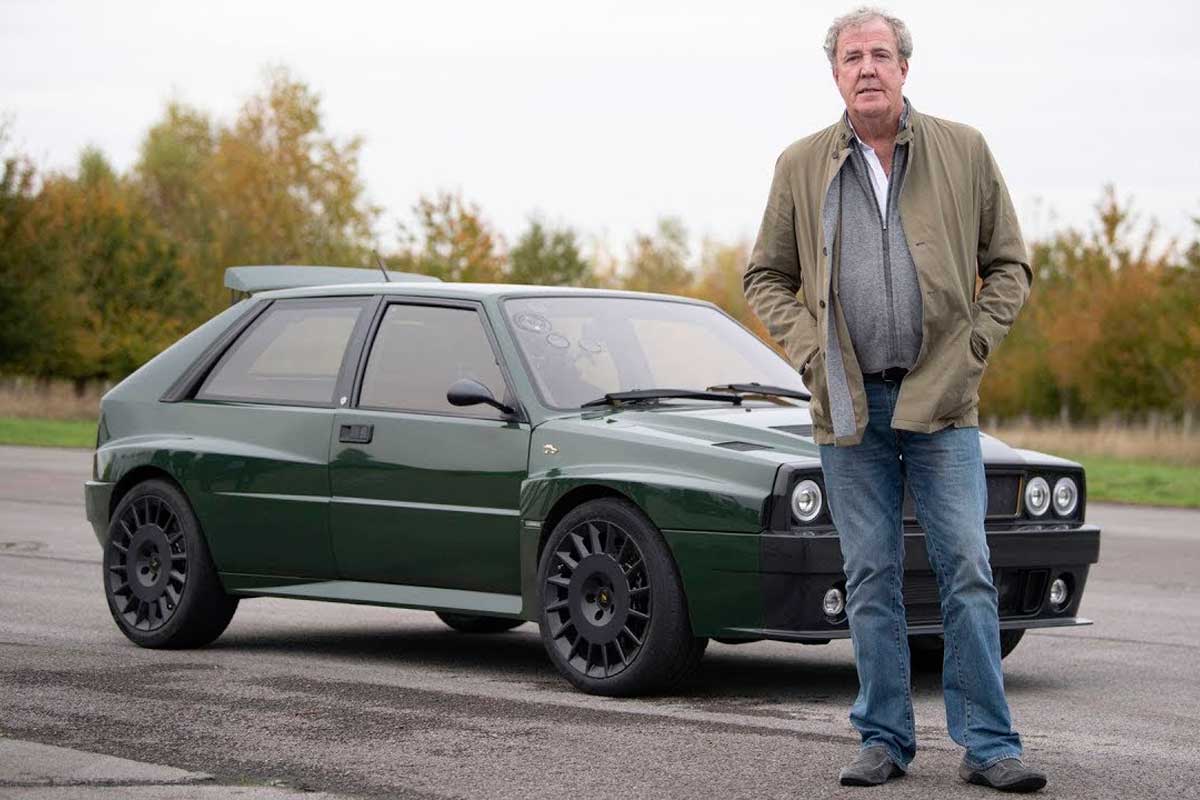
Jeremy Clarkson has never been kind to the British car industry. But in his latest column, the English journalist delivered a declaration of love... to Italy. And more particularly to a brand that many thought had long been doomed: Lancia. At the turn of a Maserati MC20 Cielo test drive, Jeremy Clarkson has embarked on a much broader reflection than a simple review of a supercar. An almost philosophical comparison between two visions of the automobile: the British and the Italian.
England has lost its marks... Italy has kept them alive
For Clarkson, the story speaks for itself. Humber, Riley, Wolseley, Austin, Morris, Triumph and TVR all disappeared. MG and Rover ended up in China. As for Jaguar, its future is in doubt. By contrast, Italy has retained virtually all its icons: Lancia, Alfa Romeo, Ferrari, Fiat, Maserati, Lamborghini and De Tomaso. How can such a difference be explained?
According to him, the British love mechanics, parts and technology. Italians, on the other hand, love cars as living beings. There, a car is not just a rational or profitable object: it's part of the culture. Jeremy Clarkson sums it up with his usual brutality: closing down Lancia for financial reasons would, in Italy, be like getting rid of your dog because its food is too expensive.
Lancia, a history impossible to erase
This is where the most powerful sentence in his column comes in:
«It's probably true to say that Lancia has produced more truly exceptional cars than any other company.»
He naturally cites the legends: Stratos, 037, Delta Integrale, Aprilia... But also the major technical innovations. Lancia introduced independent front suspension, the V6 engine, the five-speed gearbox, the monocoque structure and even the first aerodynamic research applied to automobiles.
For Jeremy Clarkson, you can't do away with a brand with such a heritage, even if it hardly sells anything today. He compares it to destroying the Colosseum to widen a traffic circle: economically logical perhaps, culturally absurd. And that's precisely what differentiates Italy from the UK: here, the automobile remains a heritage.
If Lancia disappeared, it wouldn't just be the closure of a company. It would be the loss of a piece of culture, comparable to the destruction of an Italian museum. In the end, it doesn't matter that these brands are sometimes economically irrational. For Jeremy Clarkson, their survival simply proves that Italy remains a country of automobiles... while others have become countries of industry. And that, he believes, is precisely why Lancia still exists today.

 English
  French
  Italian
  Spanish
  Portuguese
  German
  Japanese
  Turkish
  Dutch
Dutch
As a fourth-generation Lancista, I couldn't agree more. Lancia has always produced exceptional cars, 30 years ahead of the competition. I'm thinking of the Lambda, the Aurelia, but also the Delta integrale, of which I have the privilege of owning one.
LANCIA - storia dell'arte automobilistica italiana, dell'innovazione e dell'avanguardia, come mai viene menzionata ed apprezzata dagli altri mentre non viene nemmeno ricordata dagli italiani????? Lo stato dovrebbe salvare questo tesoro invece di venderlo per sbarazzarsi! Salviamo quello che hanno costruito e lasciato in eredità da custodire e sviluppare per le future generazioni!!!!
The Lancias of the 90s and 2000s weren't all successes... and the fake Chryslers were the end of everything!
And let's not forget the styling effect and aero research on the Y10, with a record Cx for the 80s.
I own a 1991 1.1ie 4WD 38000km original.
The volumex of the Trevi with its airplane-style dashboard. The Thema, with its exceptional comfort and spaciousness, was no match for the Germans.
Y10 Cx record??!! Ah and what value? I had 2 Ys by the way . The finish for the time was really nice .
By the way, can the Y10 be considered a Lancia? When it was launched, it was an Autobianchi🙂
Quando la Lancia montava i motori ad iniezione l'Audi,sulle vetture, montava ancora motori a miscela.
We've had more Lancias than any other car , Integrales , Delta Hf Turbos , Dedra Turbos , Delta Martini Special Edition and a Beta.....all excellent brilliantly enginered .Above all else rare in the UK .