


When you think "scissor doors", you immediately think Lamborghini. So much so that, at the end of the 1990s, the Italian automaker, which had just come under the control of the Volkswagen group via Audi, tried something rather audacious: to obtain European legal protection for... the opening movement of its doors. Legally, it wasn't a question of registering a patent, but rather a trademark, a rare attempt to protect not a logo or a name, but a movement that had become iconic.
A Lamborghini... recognizable even before reading the badge
On November 26, 1999, Automobili Lamborghini Holding S.p.A. filed a trademark application. The timing is interesting: Audi bought Lamborghini in 1998, and the Italian brand is now part of the Volkswagen Group. The application concerns neither a word nor an emblem. It's a sequence of images depicting the silhouette of a car whose doors gradually move from closed to open position.
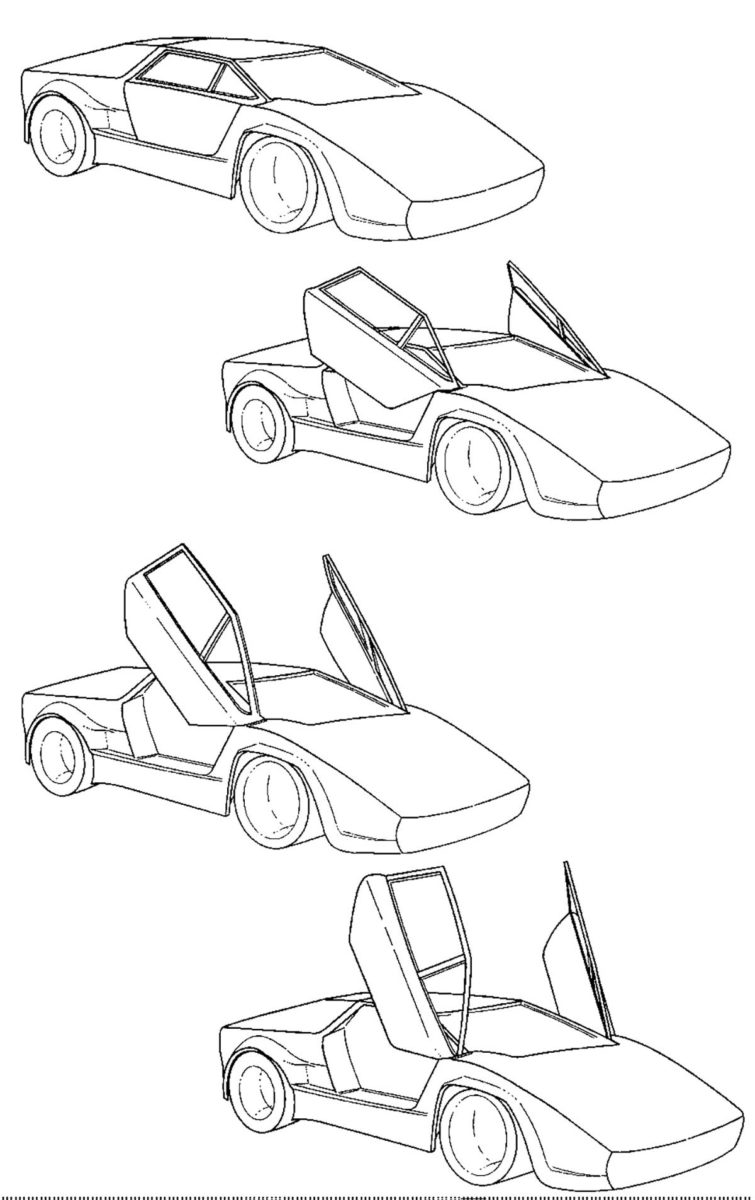
The description is explicit: the trademark is aimed at "a typical and characteristic arrangement of vehicle doors", which open "upwards", around an axis that is "essentially horizontal and transverse to the driving direction". In other words, Lamborghini is seeking to protect one of its most famous stage effects: the spectacular vertical opening of its doors.
A brand of movement?
In its argument, Lamborghini, via the Audi Group's legal department, insists on a key point: it's not the shape of the door that's being claimed, but the movement itself. A "brand of movement", a concept that was still very marginal at the time. The manufacturer also emphasized a technical detail intended to reinforce the originality of the gesture: the axis of rotation is arranged transversely to the direction of travel, unlike historic butterfly doors such as those on the Mercedes 300 SL of the 1950s. The idea is simple: if the public instantly recognizes a Lamborghini by this precise movement, why not register it as a trademark, in the same way as a bottle shape or a sound signature? On paper, the argument is sound.
First refusal
After several exchanges, the European Trademark Office refused the application in 2001. First reason: lack of distinctive character. In the very specific market of top-of-the-range sports cars, opening the doors upwards is not exclusive to Lamborghini. The Office cites several manufacturers, including Saleen, Vector, Bugatti, McLaren, Ultima and Mercedes, which use or have used similar systems.
Conclusion: this type of opening is perceived as a styling characteristic specific to a car category, not as a sign identifying the commercial origin of a vehicle.
But the second reason is even more decisive: functionality. For the Office, trademark law cannot be used to lock in a technical solution. Never mind the spectacular effect or the associated image: this movement serves above all to open a door. Trademark law is not intended to grant a potentially unlimited monopoly on a mechanical mechanism. If it's technical, it's a matter for a patent, not for an indefinitely renewable trademark.
Volkswagen-Audi tries the appeal
The group did not concede defeat. On August 22, 2001, an appeal was lodged, again on behalf of Lamborghini, but led by the German legal services of the Audi group, which explains why the entire procedure was conducted in German.
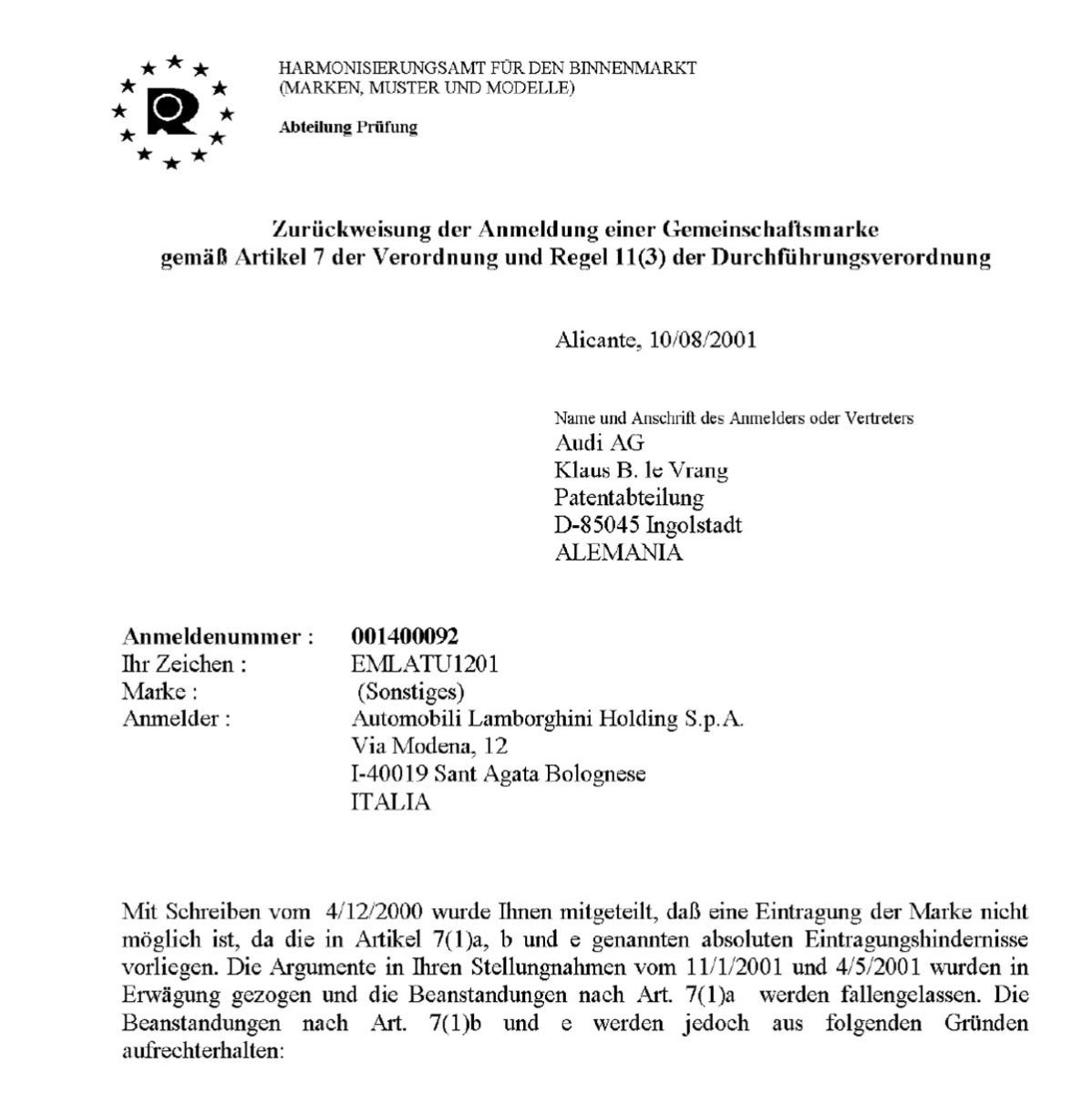
The argument is refined: the movement is not imposed by an absolute technical necessity, since there are many other ways of opening a door. Above all, the choice was guided by an aesthetic and identity-related intention, not by a quest for mechanical efficiency. In the dossier, Lamborghini insists on the visual effect, the spectacular nature of the gesture, and on the fact that the public doesn't see a hinge or a pin, but immediately... a Lamborghini.
2003: Europe makes the final decision
On September 23, 2003, the First Board of Appeal handed down its decision. It confirmed the refusal. On the merits, the position was clear: even when presented as a "movement", the sign was tantamount to protecting the mechanical operation of a car door. Granting a trademark on this point would limit competitors' freedom to use comparable technical solutions. European law is firmly opposed to this. As for distinctiveness, the Chamber considers that the public perceives above all a spectacular effect, not an indicator of commercial origin. In other words: it's striking, impressive, identifiable... but not a trademark in the legal sense.
As a result, neither Lamborghini nor the Volkswagen-Audi group were able to obtain a European trademark for the scissor door movement. More than twenty years later, despite the legal setback, the association remains intact. In automotive culture, this type of opening is still spontaneously referred to as... "Lamborghini doors".

 English
  French
  Italian
  Spanish
  Portuguese
  German
  Japanese
  Turkish
  Dutch
Dutch
Lamborghini door? No, vertically opening doors, or "scissor" doors. I've never heard of "Lamborghini door." Anyway, German s**t. They pretend to have everything, to want everything, They claim to be the "best," but in reality... Well, they want to patent something made by Italians who, for 50 years, refused to patent (with good reason). Then they wonder why everyone hates them? 🤷🏻♂️
Instead of thinking about these things, they should think about repaying the "diesel gate" that they "forgot". Or repaying damages from the 2nd World Cup to Poland and Greece (approximately €1,000 billion). But here too they have " Forgotten. " Or why not, repay the debts of private German banks, but with European public money? Only when it suits them...
Bravissimo.viva Italia👍😄