

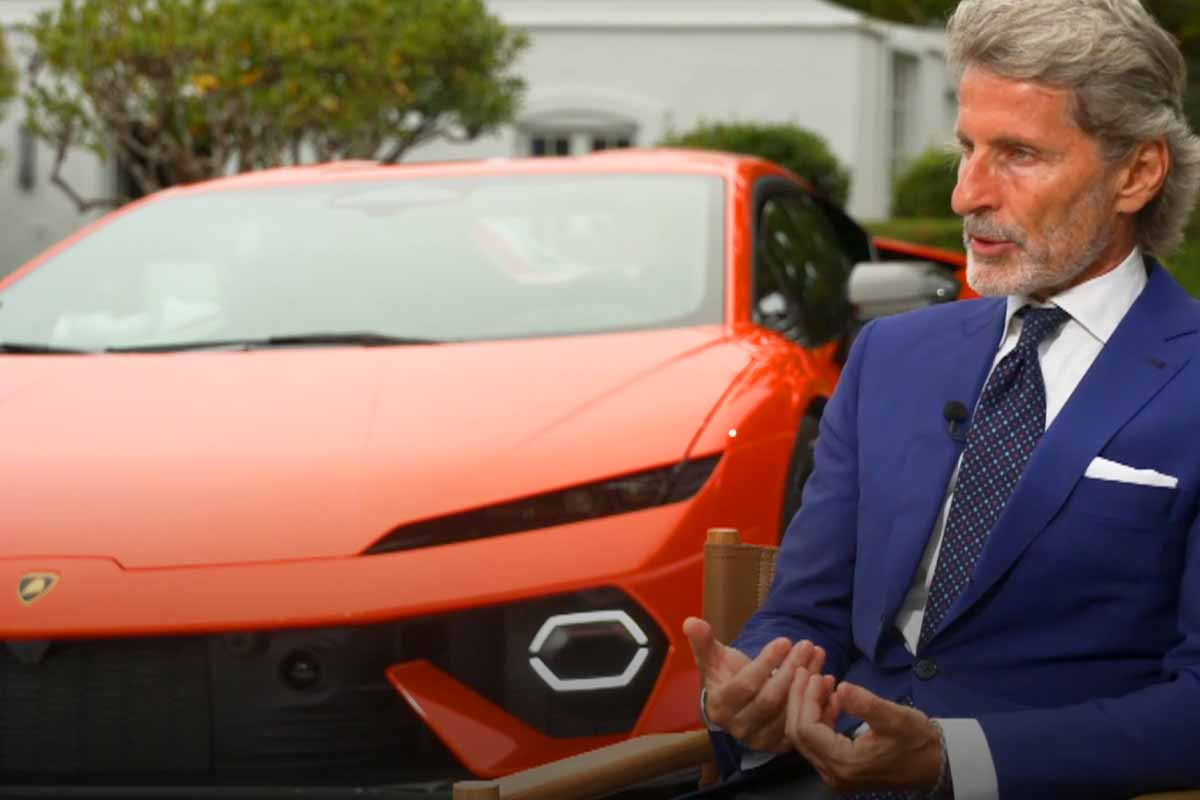
It was one of the most audacious projects of the decade for Lamborghini an electric crossover with over 1,300 hp, capable of rivaling combustion hypercars while ushering in a new zero-emission era. Three years after presentation of the Lanzador concept in Monterey, the Italian automaker is doing an about-face. The electric 100 % is no longer on the agenda. And the words used by its CEO are unambiguous: developing an electric Lamborghini risked becoming “an expensive hobby”.
Lanzador's electric dream comes to an end
Unveiled in 2023 at Monterey Car Week, the Lanzador was to embody the automaker's fourth range. This 2+2 Ultra GT electric vehicle promised spectacular performance: more than one megawatt of power, i.e. around 1,340 hp, a 0 to 100 km/h time of just 2.4 seconds and a top speed of around 350 km/h.
Lamborghini described it as a “spaceship for everyday use”. The image was strong. So was the ambition. The model was initially scheduled to arrive in 2028, then 2029. But behind the scenes, doubt set in.
In an interview with the Sunday Times, CEO Stephan Winkelmann admitted that the acceptance curve for electric vehicles among the brand's customers was “close to zero”. For a brand whose DNA is based on emotion, sound and mechanical brutality, the absence of roar poses a problem.
Emotion before decarbonation
At Lamborghini, mechanics aren't just a means of propulsion, they're a sensory signature. The sound of a V10 or V12 is an integral part of the experience. Yet, according to Winkelmann, electric vehicles in their current form struggle to recreate this emotional connection. The brand's wealthy customers are looking not just for numerical performance, but for mechanical intensity, vibration and sound.
The decision to abandon the electric Lanzador was not taken overnight. It was the result of more than a year of internal discussions, exchanges with customers and dealers, and market analyses. According to the brand's CEO, it would have been financially irresponsible to invest heavily in a model that customers were not asking for.
All-hybrid by 2030
But this about-turn does not mean a complete step backwards. Lamborghini confirms its electrification strategy... but only via plug-in hybrids.
By 2030, the entire range will be made up of PHEVs. This is already the case for the Lamborghini Revuelto, the brand's first plug-in hybrid model, which combines a 6.5-liter naturally-aspirated V12 with three electric motors for a combined output of 1,015 hp. Even the future SUV Lamborghini Urus, which currently accounts for around 60 % of sales, will not be switching to 100 % electric power after all. A plug-in hybrid version will replace the original ambitions of an Urus EV. The message is clear: Lamborghini will continue to produce combustion engines “for as long as possible”.
Ferrari goes electric
While Lamborghini takes a step backwards, its historic rival Ferrari continues to move forward. The Maranello-based brand is still preparing its first 100 % electric model, which is expected to be officially presented in the coming months. The contrast is striking. On the one hand, Lamborghini believes that demand is collapsing in the luxury electric supercar segment. On the other, Ferrari seems convinced that its image and positioning will enable it to succeed where others hesitate.
A broader economic context
Lamborghini's choice also fits into a more global context. Several major automotive groups have recently scaled back their electric vehicle programs in the face of lower-than-expected demand and colossal development costs. Lamborghini, an Audi subsidiary within the Volkswagen Group, remains a low-volume manufacturer. By 2025, the brand delivered a record 10,747 cars. A solid performance, but one that demands prudence and profitability in every strategic decision.
Winkelmann summed it up bluntly: if the market isn't ready, forcing the transition would be dangerous.
A cautious “never say never”...
Should we bury the idea of an electric Lamborghini 100 % for good? Not entirely. The CEO leaves the door ajar: “Never say never.” But only when the time is right. For now, the priority is elsewhere. Consolidate the financial base, invest in hybridization, preserve the brand's emotional DNA.
The Lanzador may not disappear altogether. Its name could return on a hybrid version inspired by the technology of the Revuelto or the Temerario. But the era of the electric Lamborghini will have to wait.
 English
  French
  Italian
  Spanish
  Portuguese
  German
  Japanese
  Turkish
  Dutch
Dutch
I think Lamborghini customers are more extreme than Ferrari customers. In short, buyers are probably less sensitive to human considerations.
I believe that Lamborghini's parent company is Audi, and that it is already investing heavily alongside Porsche - whose shareholders largely run the VAG industrial empire - in sporty electric vehicles. Lamborghini doesn't need to invest as much as Ferrari in this field, especially with customers so reluctant to invest, they'll find a good proportion of their necessary components on the group's shelf.
More than two-thirds of Lamborghinis purchased in 2025 will feature a slightly raised body with 4 doors plus a hatchback, as will almost 80% of the world's automobile production.
For Ferrari, this ratio is (auto) limited to 20%.
So, no, I wouldn't say that Lambo customers are more extreme than Ferrari customers.
On the other hand, if we put aside the two purely marketing hiatus of the Urus and the Purosangue and focus on the historical lineage of V12s, it's true that from the Miura to the Revuelto, supercars marked with the bull have always been more «extreme» in their design than their Maranello rivals.