


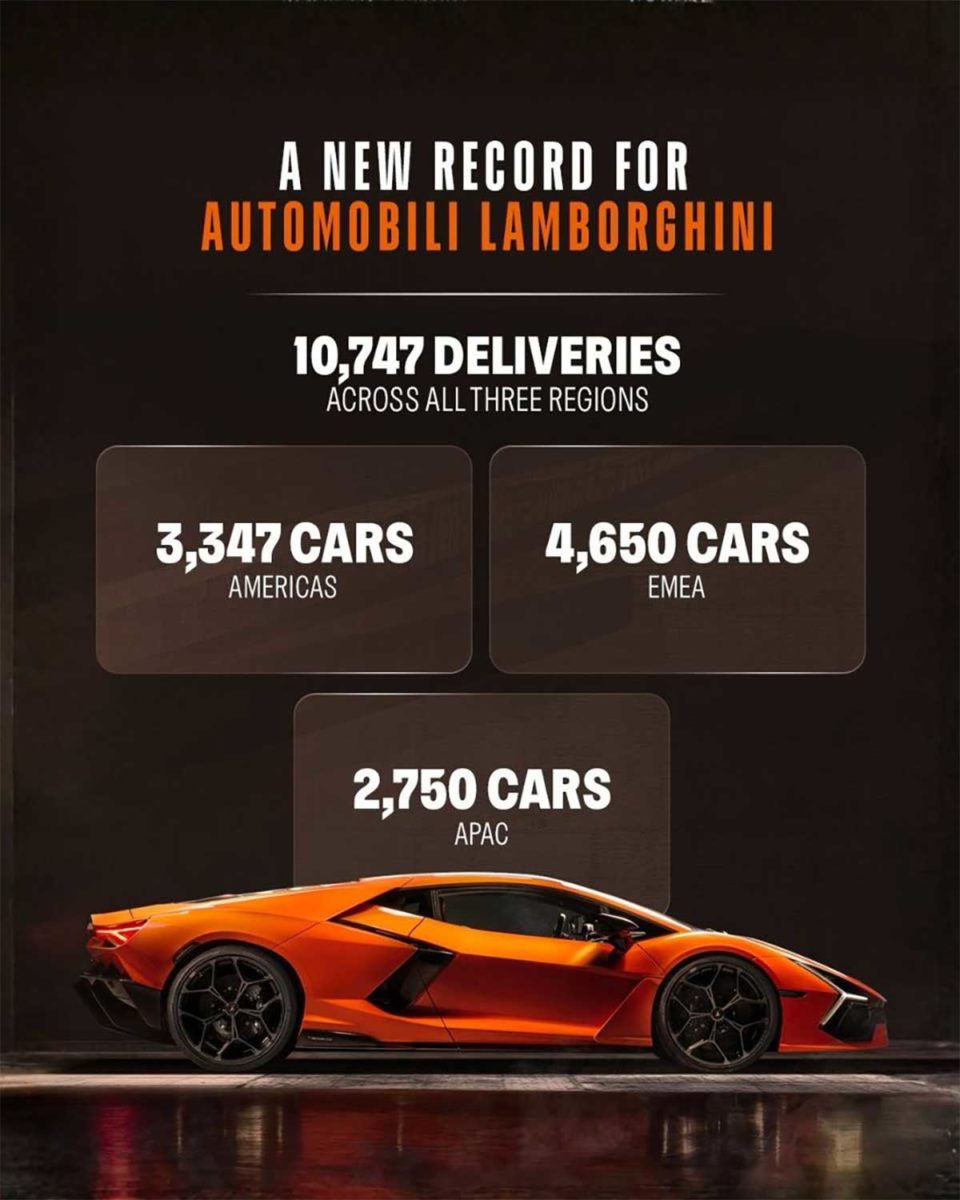
At first glance, the year 2025 in Lamborghini might seem paradoxical. In several key markets, the brand is declining, sometimes sharply. And yet, at the end of the year, the Sant'Agata Bolognese automaker set a new all-time record with 10,747 cars delivered worldwide, compared with 10,687 in 2024. A tiny advance on paper, but a highly symbolic one, as it takes place in a very special context.
Because in 2025, Lamborghini was not really on a level playing field. The year marked the end of the Huracán's career, replaced by the Temerario, whose deliveries began only belatedly. Lamborghini therefore ended the year with almost two models instead of three. Despite this, the brand did better than the previous year.
United States backs off
Lamborghini's biggest market worldwide, the United States ended 2025 with 3,198 registrations, down 9 %. A worrying figure, but one that needs to be put into perspective. Firstly, almost two-thirds of sales were of the Urus, confirming the company's dependence on the SUV. Secondly, because the American decline does not have the same significance for Lamborghini as it does for Ferrari. For Lamborghini, the story is simple: the brand spent the whole year with an incomplete range, with the Temerario only really coming onto the scene at the very end of the year (first delivery in December 2025).
Europe cushions the transition
It is in Europe that Lamborghini is managing to compensate for some of this product constraint. Germany, the brand's second-largest market worldwide, grew by 4 % with 1,153 registrations, confirming the strength of demand. Italy posted an even stronger performance, with 569 cars, an increase of almost 20 % year-on-year. Lamborghini's performance was similar in France, where it increased by 22 % to 145 registrations.
In several smaller markets, growth was spectacular. The Netherlands doubled its volumes to 106 cars, Austria jumped by 152 %, while Spain grew by 51 %. Conversely, the UK suffered a sharp decline to 560 registrations (-30 %), a trend that affects all luxury brands and cannot be attributed to Lamborghini alone.
Asia-Pacific: solid markets
In Asia, Japan confirms its strategic role with 951 registrations, up 16 1TP3Q. Australia also continues to grow, with 272 cars (+6 %). Once again, these results are achieved without the real contribution of the Temerario, reinforcing the idea that structural demand for the brand remains very solid in the region.
Partial figures
Combining only the countries closely monitored by Italpassion, Lamborghini totaled 6,848 registrations, down slightly by 3 %. Taken in isolation, the figure might seem disappointing. But when confronted with the manufacturer's official data, the picture changes radically: 3,347 cars delivered in North America, 4,650 in EMEA and 2,750 in Asia-Pacific, for a worldwide total of 10,747 units, a slight increase of 0.5%.
In other words, Lamborghini manages to balance its local declines with a more efficient geographical spread, while maintaining high volumes with a deliberately restricted range. One of the key points of 2025 lies precisely in this product transition. Lamborghini made the most of its year with the Urus and Revuelto, while the Temerario, the Huracán's replacement, only began European deliveries in the summer of 2025, followed by American deliveries in December. The result is remarkable: despite selling one less model for most of the year, the brand has managed not only to maintain its volumes, but also to increase the average value per car.
A clear path to 2026
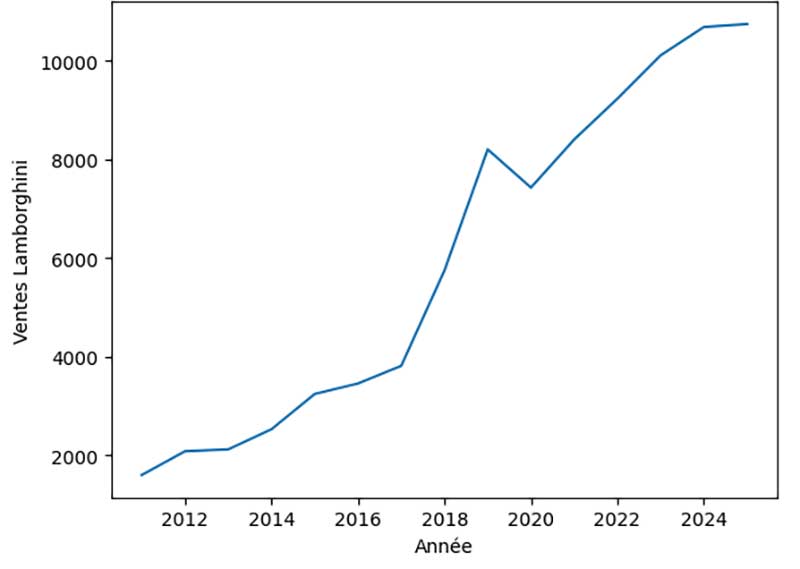
With 10,747 cars delivered by 2025, Lamborghini is slightly ahead of its 2024 target, continuing a spectacular fifteen-year progression from 1,600 cars in 2011 to over 10,000 today. The target of 11,000 annual units is now a realistic one for 2026, with a Temerario finally delivered for a full year. More than ever, Lamborghini is closing in on Ferrari, which produces around 13,000 cars a year. Without seeking to copy its rival, the brand with the bull is demonstrating that it is possible, in the luxury sector, to sell a little more... with fewer cars in the catalog.
 English
  French
  Italian
  Spanish
  Portuguese
  German
  Japanese
  Turkish
  Dutch
Dutch
The earnings of the world's major groups are rising, and so are their dividends. In short, more and more rich people have to spend their money on luxury cars. They have to make the most of it before the planet becomes unliveable.