

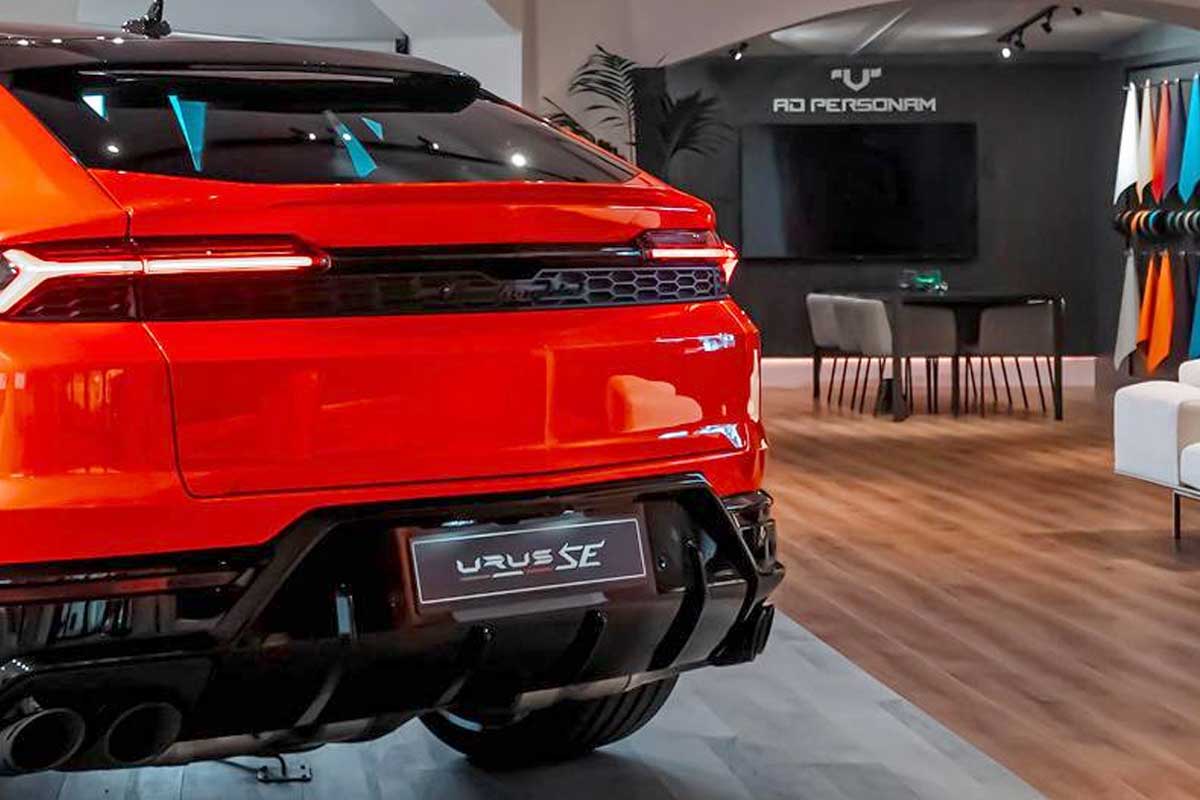
At first glance, the Lamborghini in 2025 could suggest a slight slowdown. In the main markets monitored, the Sant'Agata Bolognese brand posted an overall decline of 3 % over the first eleven months of the year. A moderate decline, almost anecdotal for a manufacturer operating at historically high volume levels. However, behind this average lie two very different realities: on the one hand, a perfectly controlled industrial transition, and on the other, a British political decision that has turned the luxury goods ecosystem upside down.
Worldwide decline largely explained by the end of the Huracán range
In the United States, Lamborghini's biggest market, the facts are clear: the brand remains extremely solid, but mechanically penalized by the discontinuation of the Huracán. In November 2025, Lamborghini registered 240 cars there, compared with 315 a year earlier. Of these 240 units, 185 were Urus, once again confirming the SUV's central role in the automaker's sales performance. A comparison with November 2024 is revealing. Back then, 177 Urus had been delivered, but the Huracán was still fully available. In 2025, the absence of the Huracán is felt, as we await the first deliveries of the Temerario. the very first model has just been delivered to an American customer. All the indications are that, from January 2026, registrations of models other than the Urus and Revuelto will start to rise again. Against this backdrop, the 7 % decline in the United States is nothing to be alarmed about: it's simply a year of transition.

Urus still king in continental Europe
The same pattern can be seen in Germany, Lamborghini's second-largest market. In November 2025, 54 of the 68 Lamborghinis registered were Urus. Despite this dependence on a single model, the brand nevertheless grew by 1 % over the year, proof of the robustness of its customer base. In Italy, November was particularly dynamic, with 44 registrations compared with 24 a year earlier. Growth reached 16 % over January-November, and Lamborghini could approach 600 annual registrations in its home country if December confirms the trend. Japan also confirms the strength of the Lamborghini model. Admittedly, November 2025 is less spectacular than 2024, but over the first eleven months of the year, the brand has grown by 17 % and is poised to exceed 900 annual registrations for the first time. A symbolic threshold for such a demanding market. The same is true of several secondary markets. France posted an increase of 22 %, the Netherlands recorded a spectacular rise of over 100 %, Austria jumped by 132 % and Spain advanced by 40 %. All signals that Lamborghini continues to win over customers, even with a range reduced to two models until the Temerario is launched.
The United Kingdom, the real black spot of the year
So the real downturn is not in the USA or continental Europe, but in the UK. With a 28 % drop in registrations, Lamborghini suffered exactly the same shock as Ferrari, whose sales collapsed by 27 % in the country. And this parallel is no coincidence.
Since April, the UK has put an end to "non-domiciled" tax status, a privilege dating back more than two centuries that allowed wealthy residents to avoid being taxed on their foreign income until it was repatriated. This regime had largely contributed to making London a world capital of finance and luxury, attracting business leaders, investors and international fortunes.
In 2023, almost 74,000 people still benefited from this status. Their impact went far beyond the issue of income tax: consumption of luxury goods, high-end real estate, private schools, universities, financial services. By ending this regime, the British government hopes to reap around £3.2 billion in additional tax revenue per year. But the decision has also prompted the departure of many high-net-worth clients... and with them, their Ferraris and Lamborghinis. As a result, the UK, once a key market for Italian supercars, will become a major underperforming factor by 2025.
A misleading snapshot ahead of a new growth cycle
All in all, Lamborghini posted a limited decline of 3 % over January-November 2025. This decline is largely attributable to two very different phenomena. In the United States, it can be explained almost exclusively by the end of the Huracán and the pending delivery of the Temerario. In the UK, it is the direct consequence of a major tax change that has driven away some of the most affluent customers.
For the rest, the dynamic is largely positive. The Urus remains a worldwide bestseller, the Revuelto is gaining momentum and the Temerario is poised to give Lamborghini a third commercial pillar. Under these conditions, the raw numbers can be misleading. Rather than a slowdown, 2025 looks more like a pivotal year, in which Lamborghini is weathering exogenous shocks while preparing for a new cycle of growth.
| Country | January - November 2025 | Evolution |
|---|---|---|
| United States | 2941 | -7% |
| Germany | 1098 | 1% |
| Italy | 546 | 16% |
| Japan | 872 | 17% |
| United Kingdom | 556 | -28% |
| Australia | 248 | 4% |
| France | 131 | 22% |
| Netherlands | 104 | 108% |
| Belgium | 88 | -11% |
| Austria | 72 | 132% |
| Spain | 67 | 40% |
 English
  French
  Italian
  Spanish
  Portuguese
  German
  Japanese
  Turkish
  Dutch
Dutch
Beyond these epiphenomena, there's an impressive figure to remember: the Urus still accounts for over 80 % of Lamborghini sales. This compares with 60% for the Macan/Cayenne pairing in Stuttgart, and less than 20% for the Purosangue in Maranello (in keeping with their commitment).
Lamborghini has become an SUV manufacturer more than any other generalist.
This is not a criticism, just the facts.
Temerario should bring this ratio down slightly, but not significantly.
Yes, I think that with the Temerario they'll be on a 70/30 split between SUVs and supercars.