

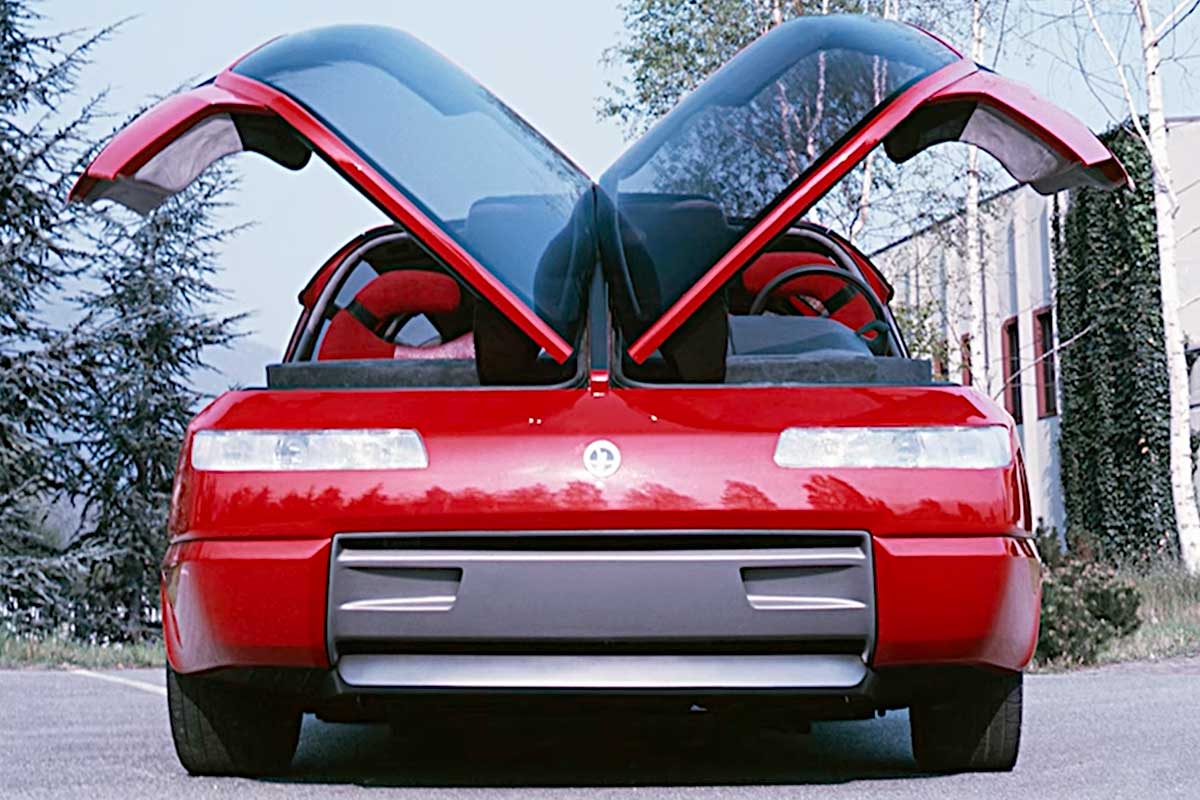
Today, the SUV has become the ultimate weapon for luxury car manufacturers. Lamborghini is booming with the V8-powered Urus, Ferrari has dared the Purosangue powered by an atmospheric V12, and even the history of Sant'Agata Bolognese includes the LM002. But long before this rush to luxury SUVs, one Italian manufacturer dared to go even further. Much further. In 1988, Bertone unveiled an improbable concept: a minivan powered by a 455 hp Lamborghini V12.
When the minivan becomes the new family symbol
At the end of the 1980s, the automotive landscape was in a state of flux. In the USA, the MPV gradually replaced the station wagon as the family vehicle par excellence. Models such as the Dodge Caravan and the Plymouth Voyager redefined the notion of a practical, spacious and versatile car. The phenomenon quickly spread across the Atlantic, and in the years that followed, it also caught on in Europe. At Bertone, we're keeping a close eye on this trend. The Italian design house, founded in 1912 and made legendary by Nuccio Bertone, has always captured the spirit of the times. It has shaped some of the most emblematic Lamborghinis, such as the Miura, Espada, Countach and Jalpa.

Lamborghini and Chrysler
In 1987, Automobili Lamborghini was acquired by Chrysler. A shock to the automotive world. For Bertone, the acquisition was a source of concern: Chrysler had its own design center, and the historic collaboration with Lamborghini seemed under threat. It was against this backdrop that a crazy idea was born. Since minivans were all the rage in the United States, and since Lamborghini had launched the LM002 a few years earlier, why not imagine a Lamborghini minivan, aimed at the American market, combining family practicality with supercar mechanics?
The project began in late 1987 under the direction of Marc Deschamps, then chief designer at Bertone. Contrary to popular belief, Lamborghini was not officially involved. Bertone developed the concept alone, hoping that the visual and technical shock would be enough to arouse the interest of decision-makers. Called Genesis, the concept completely rethinks the aesthetics of the MPV. The proportions remain generous, but the treatment is futuristic.


The rear doors are sliding, as on a conventional MPV, while the front doors open in an elytra shape, incorporating part of the windshield and front fenders. Huge windows bathe the cabin in light, and a body-colored fascia gives visual structure to the whole.


Inside, the Genesis is modular and sophisticated. Two front seats are positioned above the wheel arches, while the rear accommodates three additional places. The center seat can be folded down, and the front passenger seat can be rotated 180 degrees to face the cabin. The whole is upholstered in suede, with headrests subtly reminiscent of the Countach's rear-view mirrors.
A Countach V12 in a minivan
The Bertone Genesis was unveiled to the public at the Turin Motor Show in April 1988. And if its design was intriguing, it was above all its technical specifications that caused a sensation. Under the hood hides a 5.2-liter V12 derived from the Lamborghini Countach Quattrovalvole, developing 455 horsepower and 500 Nm of torque. The concept is technically based on the Lamborghini Espada, from which it takes its 2,650 mm wheelbase. The transmission is a Chrysler-sourced three-speed TorqueFlite automatic, already used on the Espada. A pragmatic choice, but one that clearly limits the engine's potential. At around 1.8 tonnes on the scales, and with gear ratios that are ill-suited to the task, the Genesis obviously doesn't offer supercar performance, even though the 0-100 km/h time was claimed to be 6 seconds, and the top speed 260 km/h.

A forgotten but pioneering concept
Despite the stir it caused in Turin, the Genesis didn't lead to anything concrete. Neither Lamborghini nor Chrysler followed up. For Bertone, the concept was a kind of swan song in its relationship with the Bull brand. The coachbuilder would never again design a production Lamborghini. For decades, the Genesis sank into oblivion. And yet, with hindsight, it appears today as an astonishing precursor. Long before the Urus and Purosangue, Bertone had already understood that there was a market for ultra-exclusive family vehicles capable of combining space, image and exceptional engines. Further proof that, sometimes, the wildest ideas simply come too soon.

 English
  French
  Italian
  Spanish
  Portuguese
  German
  Japanese
  Turkish
  Dutch
Dutch