

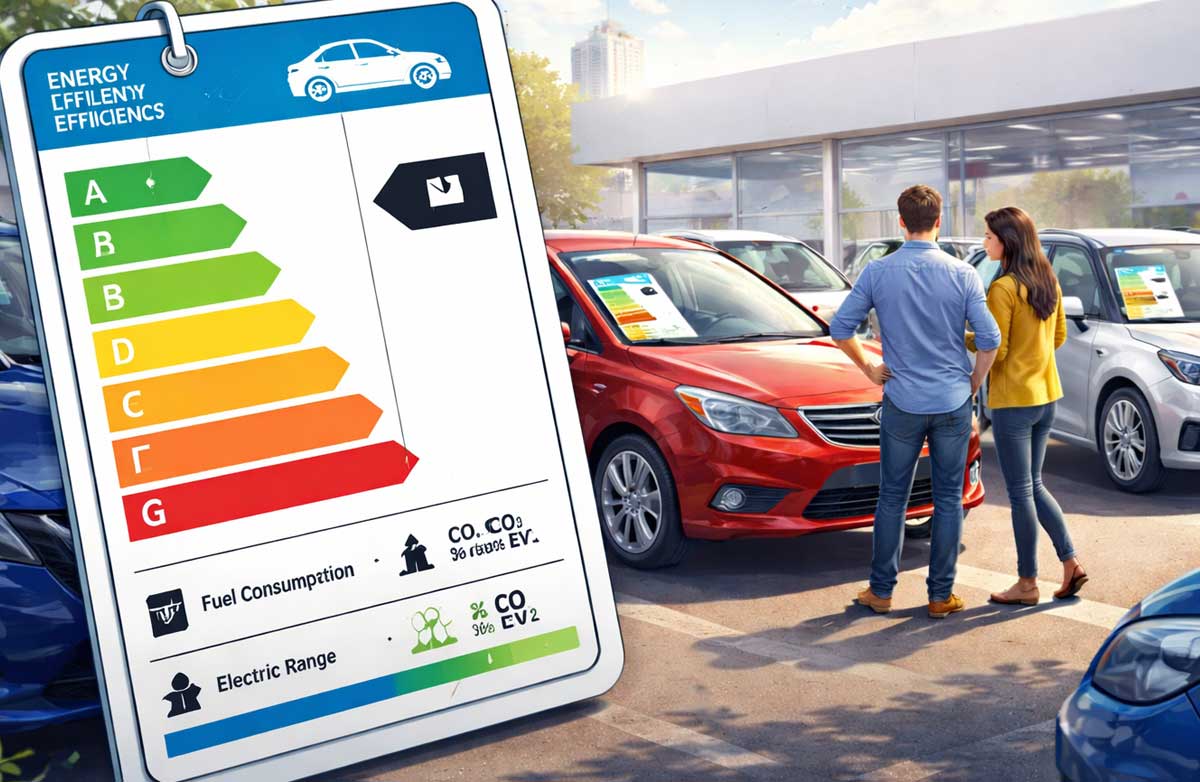
Buying a used car in Europe could soon be like... buying a refrigerator. The European Union is preparing a new regulation that will oblige sellers to display a clear, standardized energy label on vehicles, including on the second-hand market. A small revolution for buyers, who for the first time will have a simple indicator with which to compare the energy efficiency of cars.
A label similar to that on household appliances
For years, consumers have been accustomed to colored labels ranging from A to G on washing machines and refrigerators. The principle will now be extended to automobiles.
Each vehicle will have to display an energy class based on its consumption, with an easy-to-understand visual code. For electric cars and plug-in hybrids, the classification should be based on electricity consumption expressed in kWh/100 km.
The thresholds mentioned in the European discussions are relatively clear: a model consuming less than 14 kWh/100 km could be awarded an A rating, while more fuel-hungry models would progressively drop down to the lower categories. In this system, a small electric city car would naturally be at an advantage, while a large electric SUV could find itself at the bottom of the ranking.
This change marks an important evolution. Until now, automotive energy labels were based primarily on CO₂ exhaust emissions, which automatically placed 100 % electric cars in the best category. Future regulations will now focus on to real energy efficiency, This is a clear indication of the significant differences in fuel consumption between the different models.
Used cars also affected
The great novelty of this regulation is its very broad scope. Unlike the current rules, which apply mainly to new vehicles, used cars will also have to display this label.
Dealers and sales professionals will have to consult a centralized European database to obtain energy data for each model before offering it for sale. This database will bring together technical data supplied by manufacturers, regularly updated to enable buyers to easily compare models available in all European Union countries.
Even older vehicles, sometimes over ten years old, will have to display this information. The aim is clear: to offer greater transparency on fuel consumption and emissions, two elements rarely highlighted in the second-hand market.
Far more comprehensive information for buyers
The future label will not be limited to a simple colored letter. It should include much more information than current labels.
In particular, buyers will be able to consult average fuel or electricity consumption, CO₂ emissions, and also the vehicle's noise level. For electric models, additional data should appear, including estimated range in different weather conditions.
This is an important point, as the actual range of an electric vehicle can vary greatly according to outside temperature or driving style. This information could therefore help consumers to better anticipate the daily use of their car.
A transparency measure... but also a future tax tool?
On paper, Brussels' stated aim is simple: to make the automotive market easier to understand, especially for electric vehicles whose actual performance is sometimes difficult for the general public to interpret.
But this label could also have far-reaching consequences. In several European countries, vehicle taxation is already based on weight, emissions or fuel consumption. Energy rating could therefore become a new criterion used by governments to tax or favor certain models.
As a result, the most fuel-hungry cars could lose some of their advantages, while the most efficient models could be given greater encouragement. For manufacturers, this means that energy efficiency will become even more strategic, especially for electric vehicles, whose consumption varies greatly according to their size and power.
If the regulations are adopted in their current form, they could profoundly transform the way motorists choose their vehicles. Until now, used car buyers have focused mainly on price, mileage or the general condition of the vehicle. Tomorrow, energy class could become as visible and influential a criterion as power or equipment.
For manufacturers and dealers alike, this new label could quickly become a central feature of the European car market. And for buyers, it promises one thing above all: to compare cars more easily... in exactly the same way as we compare a fridge or a washing machine today.
 English
  French
  Italian
  Spanish
  Portuguese
  German
  Japanese
  Turkish
  Dutch
Dutch