

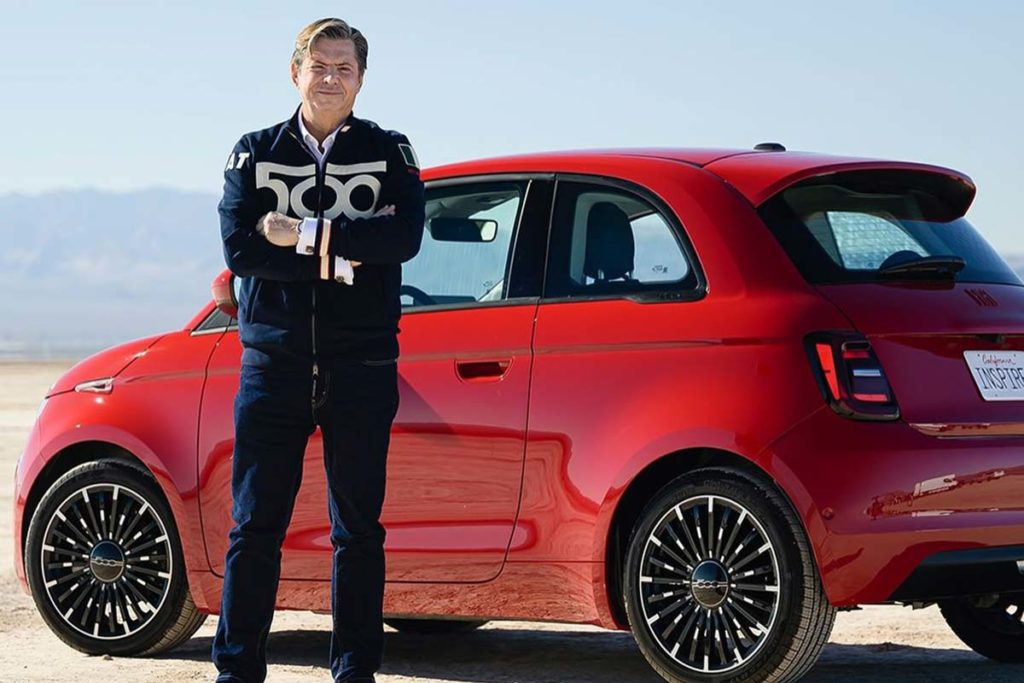
What if the solution to making cars more accessible was to... drive slower? The idea may seem provocative at a time when the automotive industry is multiplying screens, sensors and electronic aids. However, at FiatThis idea is now being taken very seriously. Speaking to Autocar, the company's CEO, Olivier François, does not rule out the possibility that the brand's future city cars will be voluntarily limited to around 120 km/h. A proposal which, behind its apparent simplicity, profoundly questions the recent evolution of the European automobile.
City cars that have become too expensive for their mission
For several years now, small cars have been suffering from a paradox. Originally conceived as simple, affordable, urban vehicles, their average price has skyrocketed. The reason for this is the stacking up of European safety and emissions regulations, requiring the integration of complex and costly systems. For Olivier François, this situation has become absurd. According to him, models like the Fiat 500, Panda or Grande Panda are primarily used in town, at very moderate speeds. Yet today, they have to incorporate technologies designed for motorway or high-speed use. The result: in five or six years, the average price of a city car has risen by around 60 %, with no obvious benefit to the urban user.
Getting back to basics
The Fiat boss's proposal is radical in its logic, but measured in its effects. Rather than over-equipping cars to reach speeds well in excess of legal limits, why not adapt their design to the reality of their use? In Europe, the maximum authorized speed on freeways is around 120 km/h. Anything above this is, by definition, a violation of the law. Anything above this is, in most cases, illegal. Yet it is precisely for these high speeds that most radars, ADAS systems, advanced braking devices and multiple sensors are designed. Voluntarily limiting the maximum speed of a city car would therefore simplify its design, reduce costs and, paradoxically, remain consistent with current regulations.
The new M1E category
This thinking is particularly relevant to current discussions at European level. The European Union is working on a new vehicle category called M1E, designed for small urban cars. These shorter models (less than 4.2 metres) could be subject to less stringent rules, precisely because they are mainly used in urban areas and at low speeds. For Fiat, this development is essential. It marks official recognition of the fact that not all cars have the same mission, nor the same constraints. To apply the same requirements to a city car as to a top-of-the-range sedan is, according to François, too uniform a vision of the automobile.
An idea that doesn't apply to big cars
Rest assured: there's no question of restricting BMWs, Audis or other European sports cars to 120 km/h. Fiat's approach is strictly targeted at small city cars, those whose vocation has never been to drive at very high speeds. Indeed, even today, none of Fiat's city cars is capable of reaching 160 km/h under realistic conditions. The electric Grande Panda, for example, is already limited to around 132 km/h. The manufacturer's proposal would simply make official a reality that is already there.
"Let's take a step back
"Let's take a step back from overloading cars with expensive equipment." The phrase perfectly sums up the mindset championed by Olivier François. Let's go back, not for nostalgia's sake, but to rediscover a form of industrial coherence. The city cars of 2018 or 2019 were not dangerous cars," he reminds us. They were simply better aligned with their actual use. A debate that has clearly only just begun.
 English
  French
  Italian
  Spanish
  Portuguese
  German
  Japanese
  Turkish
  Dutch
Dutch