

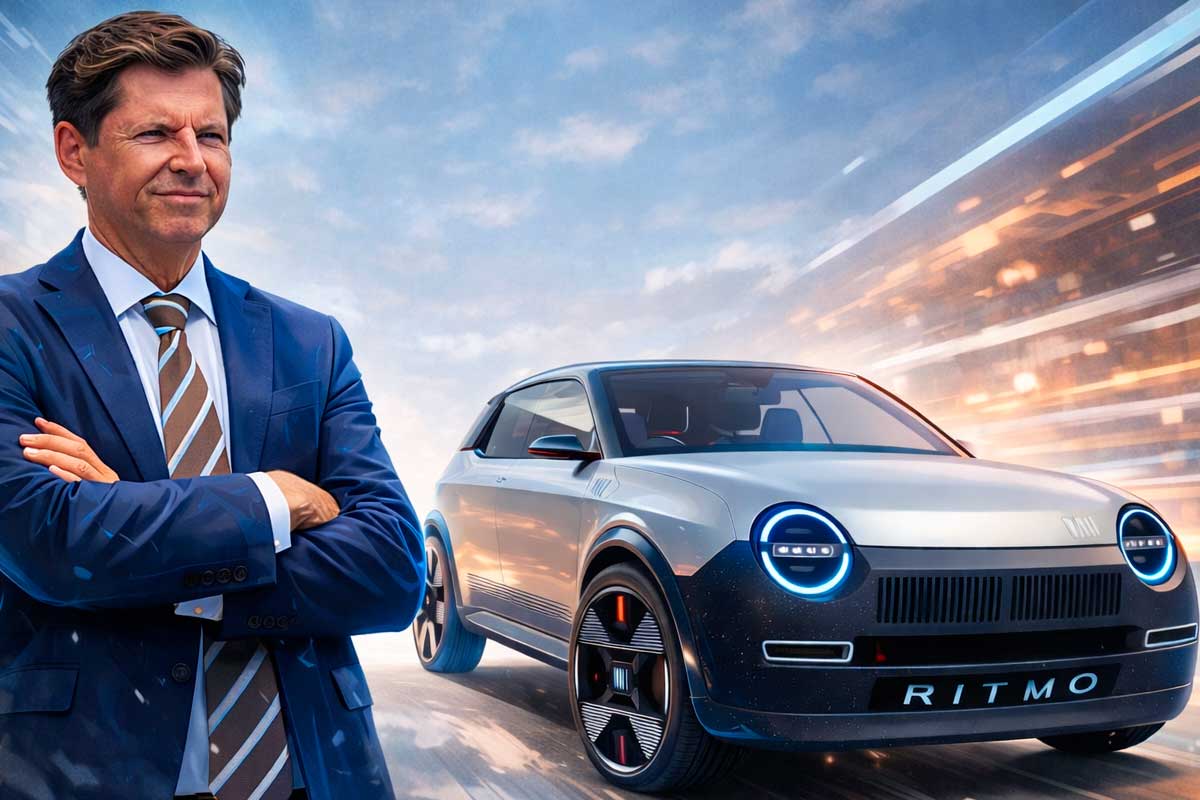
In recent days, an illustration has been circulating on social networks, as regularly happens in automotive communities. But this one was not insignificant.
Designer Antonino Barone has imagined a modern reinterpretation of the Fiat Ritmo, the iconic compact launched in 1978. At the time, this car marked Fiat's entry into the modern era of compact tractors: bold lines, integrated bumpers and a strong personality. Produced in excess of two million units over ten years, it passed the baton to the Fiat Tipo in 1988, closing an important chapter in the Italian C-segment.
So far, nothing unusual: a nostalgic exercise in style, as the Internet is full of them. But this time, the reaction wasn't from the fans. It came from the CEO of Fiat himself.
«Designing a car - and the general public often doesn't know this - is the easiest part.
Of course, there's good design and not-so-good design. But designing a car “out of nowhere”, as an exercise, is not the real challenge.
The real challenge lies elsewhere: understanding whether this design can really be achieved.
- On which platform?
Every modern car is born on a shared platform. This is not a creative compromise: it's the basis of the automotive business case. This is as true for us as it is for any other group. A project is only viable if it is sustainable, and today, industrial sustainability means sharing investments.
Haters will say: “Ah, but this will be a shared platform with other Stellantis brands”.
Of course we do. And that's normal.The real question is: are the proportions we see - width, overhang, habitability - compatible with a real platform?
For example, the Smart Car platform, the one used for the Grande Panda. And let's not forget: this is not “a Citroën”. It was developed together, by four hands. Sharing does not mean copying.
That said, looking at some of the proportions of the rendering, I'm not sure that everything is easily achievable on this technical basis. And that's a concrete question, not an ideological one.
- Is it saleable today?
The original Ritmo was a five-door compact. Today, the market has shifted enormously towards SUVs and UVs.
There is a huge difference between :
- “I like to watch it, driven by others”
and
- I buy it for me, because it meets my needs“.”Needs change, segments change, volumes change: even before aesthetic taste, you have to ask yourself whether the idea is commercially viable.
- With which engines?
The debate is still raging: electric, hybrid, “give us back the Multijet”...
I understand perfectly. I'd like that too.But it's not a brand choice. And often, it's not even a group choice: it's a regulatory, European choice.
With all-electricity in 2035 and a very demanding route already by 2030, imagining a new project with the engines and transmissions “that we Italians still love” is totally unrealistic today.
There's a gap between what Europe asks of us and what we like. And on this point, we are all “victims”, manufacturers and customers alike.
Conclusion
These are the questions to ask before commenting with “magnificent” or “Fiat is not capable”.
Design is just the beginning. The real car is about industrial feasibility, economic sustainability and regulatory compatibility. Not just a rendering.
Final thoughts. Back to design.
Do I like this new Ritmo?
The answer is simple: yes. I think it's a great success. Bravo to Antonino and Quattroruote for an initiative that keeps the debate alive and stimulates vision.
But when resurrecting a design from the past, there's only one real question to ask: why?
In reality, there can be two answers.
- Does the design of yesteryear meet today's needs?
Maybe because history is cyclical. Or because some basic needs are universal and never go away.
That's why, for example, I'm convinced that a contemporary interpretation of Giugiaro's Panda, with its original city-car dimensions and proportions, would still be extraordinarily powerful.
Or the “Multipla” exercise: the radical and intelligent search for new space solutions is still totally relevant today.
In this case, we bring back a design because its “why” is still alive. Because it meets a real need.
- Second possibility - and the two are not mutually exclusive:
We bring back a design because it deeply embodies the brand's DNA.
Because it helps to clarify perception.
Because it defines it.The most obvious example is the 500. Since 2007, it has redefined the brand's stylistic direction: small, Italian, Dolce Vita. Not just a car, but a manifesto. Light, positive, desirable mobility for the world.
These are the questions to ask before any nostalgia operation.
In the case of the Ritmo, I return the question to you:
Is there a market need today for the solutions it once offered?
Or does it offer a stylistic language capable of opening a new chapter in the brand's design journey?If the answer is yes, then it's not nostalgia.
It's evolution.You tell me.»
 English
  French
  Italian
  Spanish
  Portuguese
  German
  Japanese
  Turkish
  Dutch
Dutch
I liked the Ritmo🙂 first series. After that, they did some crap. On the other hand, technically it's a modernized 128.
This said by the man who gave us the new 600 - which is already losing sales (its outsold by the Junior in January!!).........308 works, Astra works, Tipo was successful, but apparently the idea of a Ritmo, which lets be honest will be based on a shared platform so there is an economic case already for it, is not a good one. Can't help but feel that Fiat needs a change - their own management team seem to be holding the brand back, and thats so apparent that they're willing to go on social media to deride an idea.
That's exactly it. After tangling with subcontractors, dealers and customers, Stellantis decides to rant on social networks...
As if they could afford it 😂
Thanks for the lesson for average high school students. I hope everybody within Fiat knows much more.
Wouldn't offering compact cars at a (much) lower price than SUVs revive this category?
Cars have doubled in volume, doubled in weight and doubled in price. I don't know if it's the customers who wanted this or if they're suffering from it. If there's no demand, you can create it, like what's been done for SUVs for 20 years. Nobody was buying them before, for the reasons given above. Except the English lords for their hunting grounds! Lol.
Well, it's just that driving at 80 and having to negotiate all those speed bumps doesn't require a low-slung sedan. Vive les crossover👌.. les 4×4 effectivement on ne en besoin pas 😉. Quand aux SUV c'est comme les hybrides.. il y a bcp de fake ... comme chez Stellantis quoi
"
- Hello Mr Fiat I would like a compact
- sorry we have no demand
- but I'm asking you, and of the 5 best-selling cars, 4 are compacts and city cars.
- don't you prefer an suv? Leasing? It's much more profitable for us.
- Well, no, they're too expensive and ugly too.
- that's because we've invested intelligently, you wouldn't understand.
"
It's not Europe that's forcing them to have only one engine choice on all models. They've deployed their 1.2 puretoc because it's cheap to manufacture, but other groups have the same European constraints.
considering that «drawing a car is the easiest thing in the world», I can see why most cars are so ugly!
What's easy is to accept a mediocre design to make the technical challenge easier. and you end up with a vehicle that just fits an Excel grid! with no character whatsoever. the temperament, character and refinement of a car are decided first, then designed. If you don't start by dreaming... you're not going to sell a dream! or anything else for that matter!
Very fair comment.
In the meantime, VW is bringing out a Polo in the shape of a 1.5-tonne electric compact car, with a 450-litre boot. It's not that the design of the 600 (even if it's less accomplished than that of the 500) or the Grande Panda is bad, it's good. It's just that the execution isn't up to scratch. Charging is too slow, the Grande Panda was buggy when it came out, its battery is too small, the software isn't right (where did the partnership with Samsung go?), etc. I hope they don't intend to release the ’Giga Panda« with 113 horsepower...
Ed è per questo motivo che le auto oggi sono tutte uguali, senza un anima propria, soffocate dal Carry over, dai costi e dai regolamenti.
È un dichiarazione di resa,non ci sono idee, tutto qui.
Non si capisce che questo è l'unico vantaggio.
Le auto cinesi , pur prove di storia da cui attingere, nel loro anonimato sono quantomeno più tecnologiche e più convenienti.
Presto la Ritmo la farà Geely, non disperate
Ich kann nur eins sagen: Stellantis zerstört alle traditionellen Marken in ihrem Konzern. Alfa, Opel, Fiat, Citroen, Lancia, alles nur noch Einheitsbrei aus Peugeot Abfall. Was hat ein Tonale mit Alfa zu tun? NICHTS! Hässlicher Peugeot.
I don't understand why he doesn't launch it on the 208/C4 platform.
They don't have a modern C-segment sedan.
It fitted in perfectly with Fiat's petrol/diesel/Hybrid/VE range.
I agree, with a big upgrade - for example, for an EV in 2026, a 64kWh battery is a minimum and recharging shouldn't exceed 25 minutes. For thermal versions, the Firefly is a prerequisite.
Stellantis!,it's not rocket science, Lancia stratos,lancia delta integrale,lancia fluvia, Fiat x19, You built the best cars had the most wins and you allow other companies to steal your designs while you play around with the ypsillon,Wake up stellantis!!! make the cars of your heritage again in a modern way and we will buy in millions.Lancia 5x world rally champions . Wake up guys and smell the coffee.
Thats great actually, as long as they don't make it as electric only.
After 2 Alfas 156, a 1.8 twin spark sedan and a SW 1.9 Jtdm, a 159 2.4 sedan JTDm and my latest Giulietta QV 1750 TBI.
Finding nothing to my liking under the Stellantis era, and lacking the means for a Giulia or Stelvio, I turned to Mazda, which offers a CX30 with an engine worthy of the old Italian ones, and a design and behavior that are also very similar, for the price of my 2014 Giulietta.
So it's possible, whenever you want, Mr. Director, even while complying with absurd EU rules and standards.
Das ganze mit dem Abstieg von Fiat, Lancia und Alfa begann, als sie mit den Amis zusammen kamen, dort begann der Abstieg der italienischen Automarken. Dann der Zusammenschluss mit den Franzosen gaben ihnen den Rest!
Montate almeno motore 1.4 turbo jet... un bel 2.0 benzina cattivo sarebbe il top... no motori di stellantis!!!