

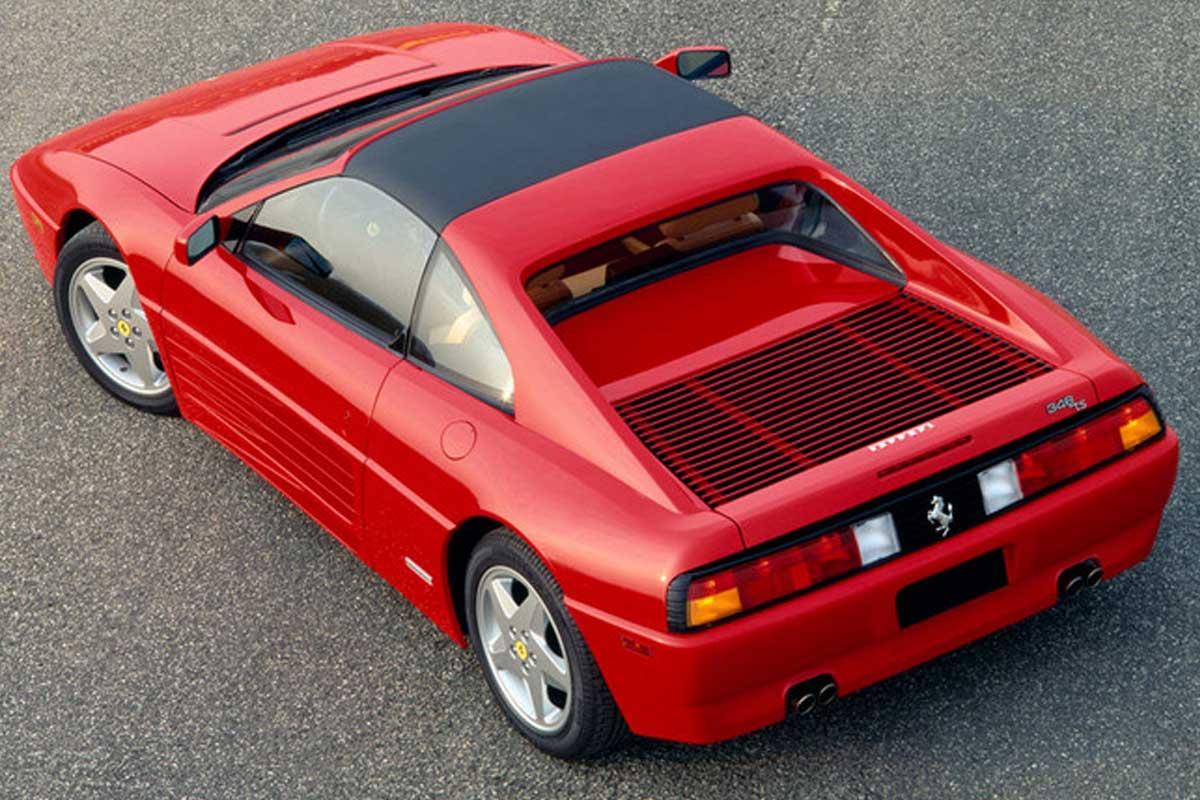
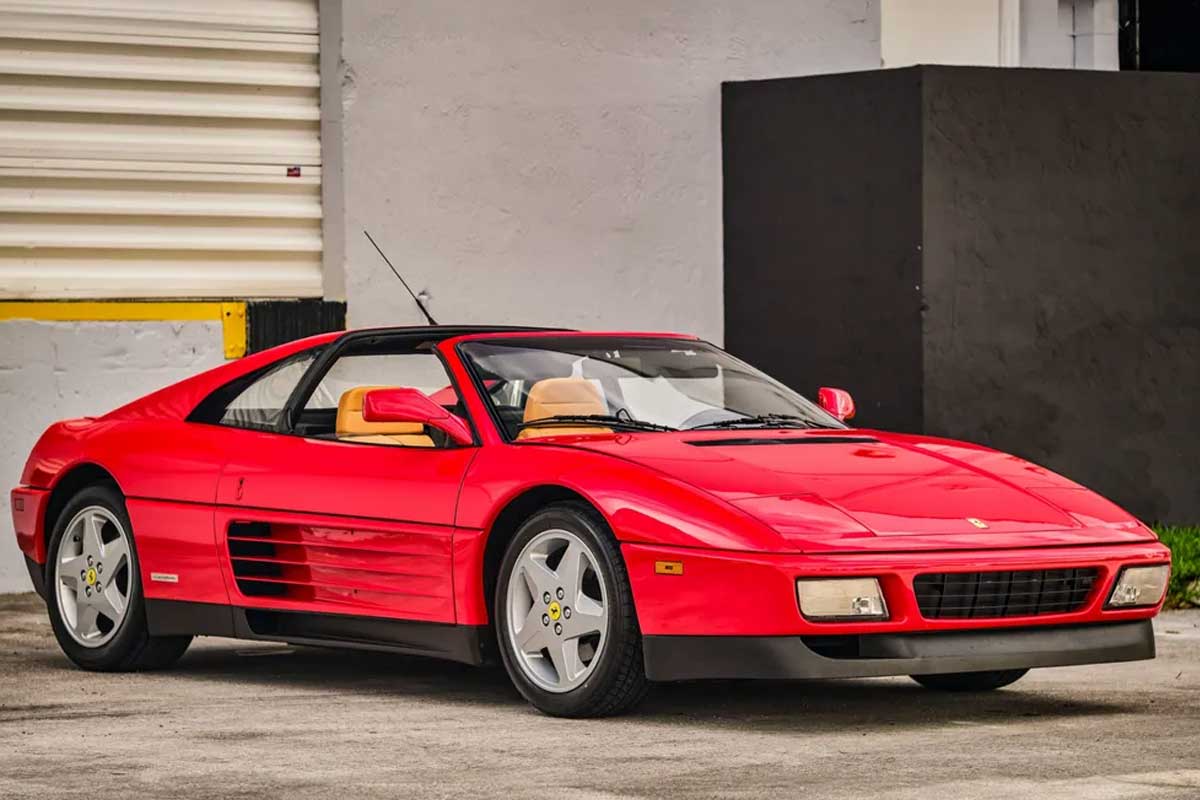
There are Ferrari that immediately become myths. And then there are those that slowly take their revenge, like the Ferrari 348. For a long time caught between the aura of the 308/328 and the cult status of the F355, it lived for years in a gray area: admired, yes... but rarely desired to the point of exploding bids. Except that in 2026, the tide has clearly turned. And among the versions that most crystallize this renewed interest, the 348 TS/GTS, the Targa, is settling on collectors' radar.
A Ferrari without filters
With so many ultra-high-performance, ultra-assisted, ultra-everything supercars on the market, many people are rediscovering what "driving" meant before electronics became everywhere. This is precisely where the 348 scores. Produced between 1989 and 1995, it embodies the end of an era when driving was done with the hands, the feet... and a bit of the stomach too. The recipe is simple, almost provocative today: a naturally-aspirated 3.4-liter V8, a manual gearbox, no turbo, no driving aids to make up for an approximation. The 348 doesn't promise a sanitized experience. It promises a direct, authentic experience. And that's exactly what more and more enthusiasts are looking for, as they tire of "perfect" cars to the point of being cold.
TS: the winning compromise
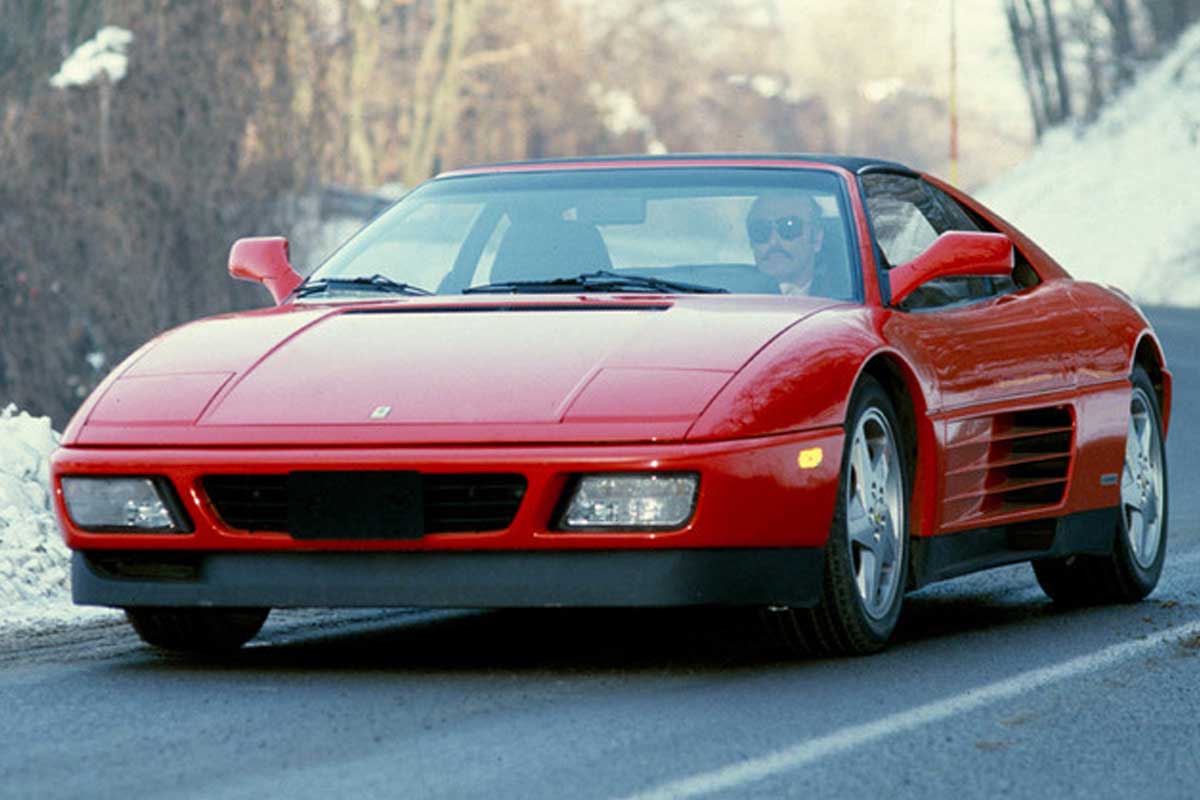
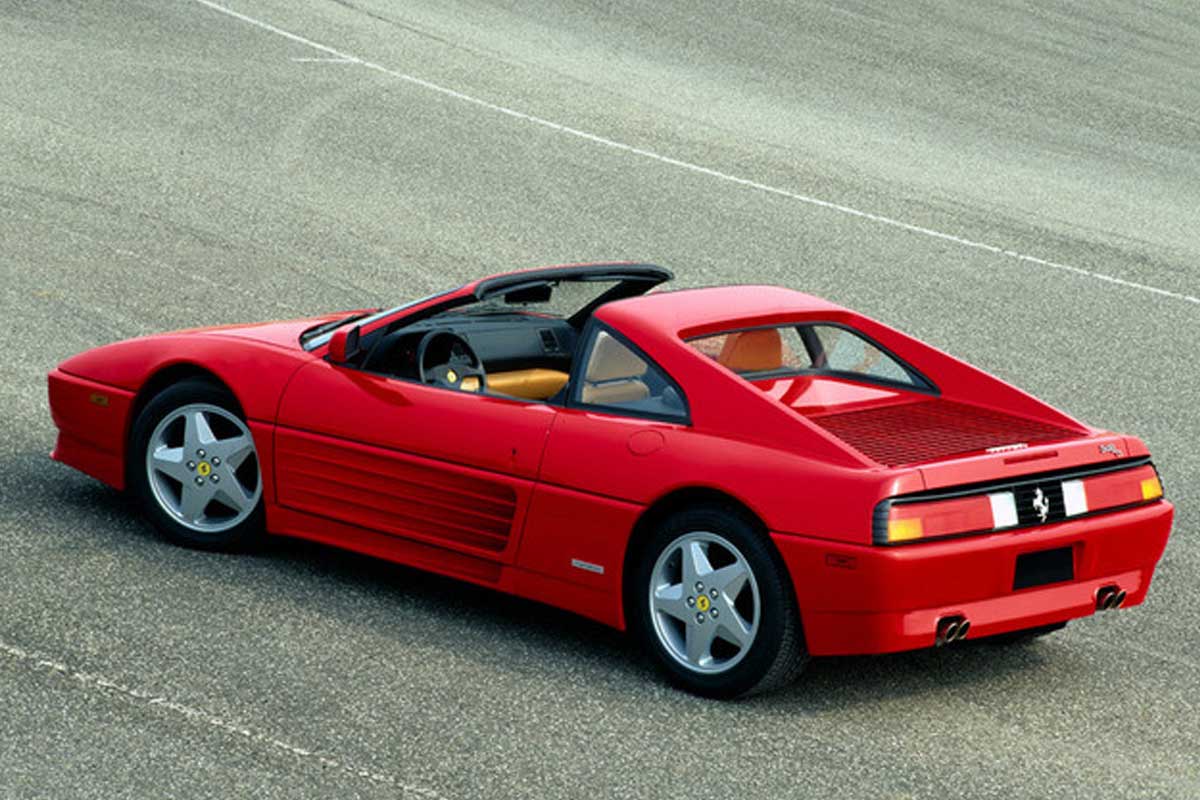
In the Ferrari imagination, the Targa has always had that extra touch of freedom. On the 348 TS/GTS, it adds a much-appreciated nuance: driving "hair in the wind", without totally renouncing the rigor of a sedan. With its 300 hp (320 hp in GTS) sent to the rear wheels alone via a five-speed manual gearbox, the 348 TS/GTS doesn't play the numbers game. It plays the sensations card. The kind of cockpit that doesn't seek to distract, an engine with a strong character, and a chassis that speaks for itself.
A rising star
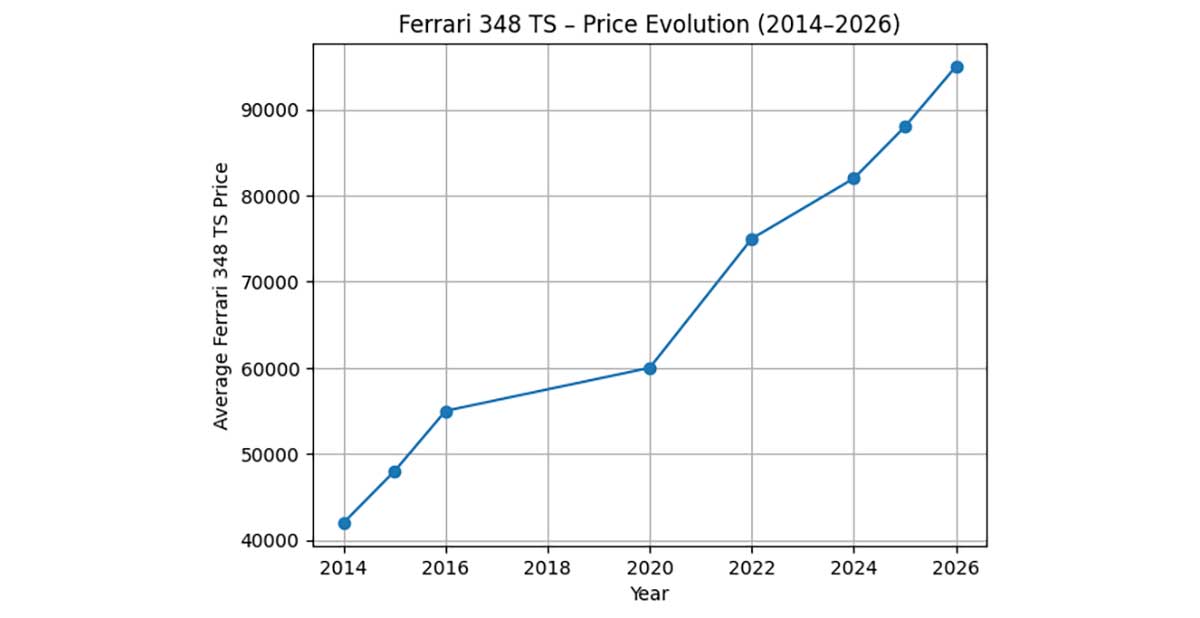
For a long time, the Ferrari 348 TS/GTS occupied a very special place in the market: that of a Ferrari that was still "accessible", sometimes even considered secondary. The figures from the mid-2010s clearly bear this out. Between 2014 and 2016, we find sales regularly between $40,000 and $55,000, with examples sometimes unsold around $34,000 to $45,000. At that time, the 348 was not yet perceived as a future sure thing, but rather as a Ferrari wedged between two more desirable generations.
The change in perspective is gradual, but becomes evident from the 2020s onwards. By 2024, the market has clearly changed dimension: some well-presented 348 TS/GTSs are already selling for over €80,000 in Europe, while in the USA, transactions frequently oscillate between $60,000 and $90,000, depending on condition, mileage and history. The "shunned" Ferrari is starting to become the Ferrari of choice.
By 2025, the trend was confirmed and structured. Sales in the $80,000 to $85,000 range became commonplace, and above all, prices for the finest examples moved up a notch. Cars priced at €89,950 or €99,950 appeared on the European market, a sign that the 348 TS was no longer simply bought to be driven, but to be kept.
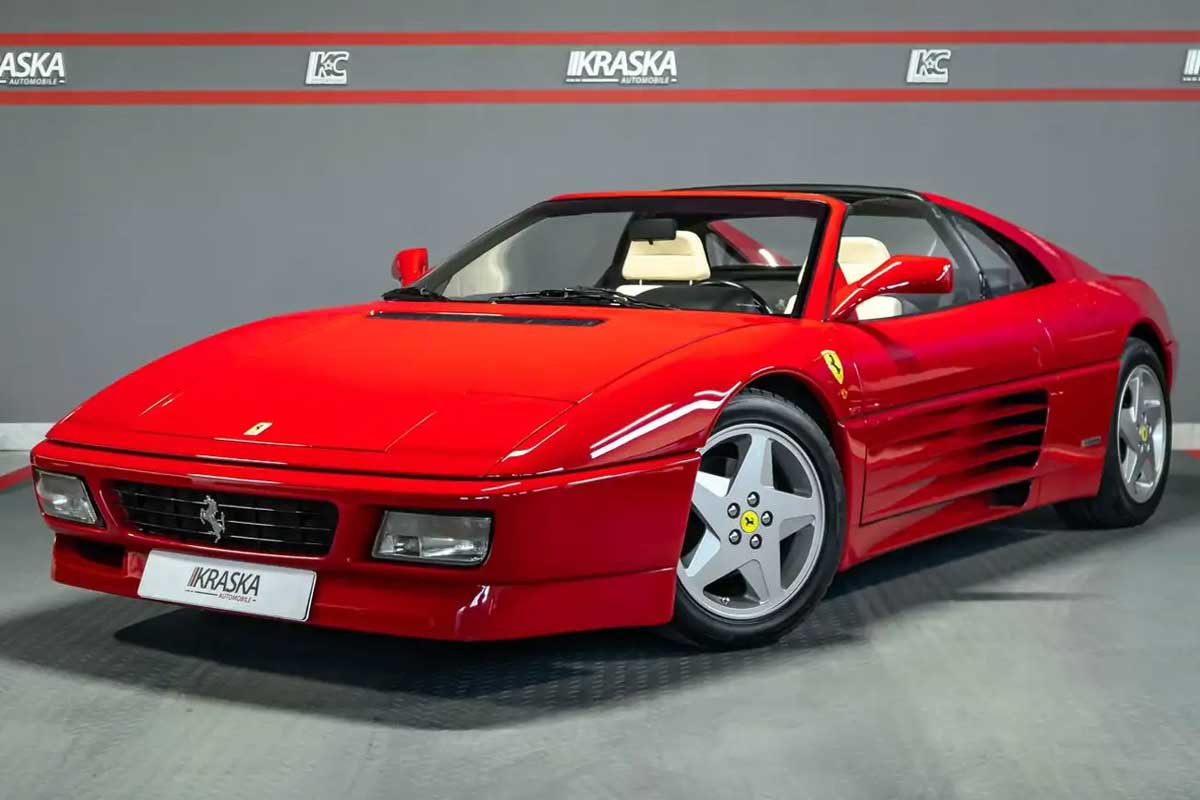
In early 2026, the example of a 1991 348 GTS, with low mileage, clear history and iconic configuration, at €99,950, perfectly sums up this evolution. In the space of a decade, the 348 TS has gone from being an "under-priced" Ferrari to an assumed youngtimer, whose value is now based on a clear collector's rationale: the rarity of fine examples, analog driving pleasure and the end of an era at Ferrari.
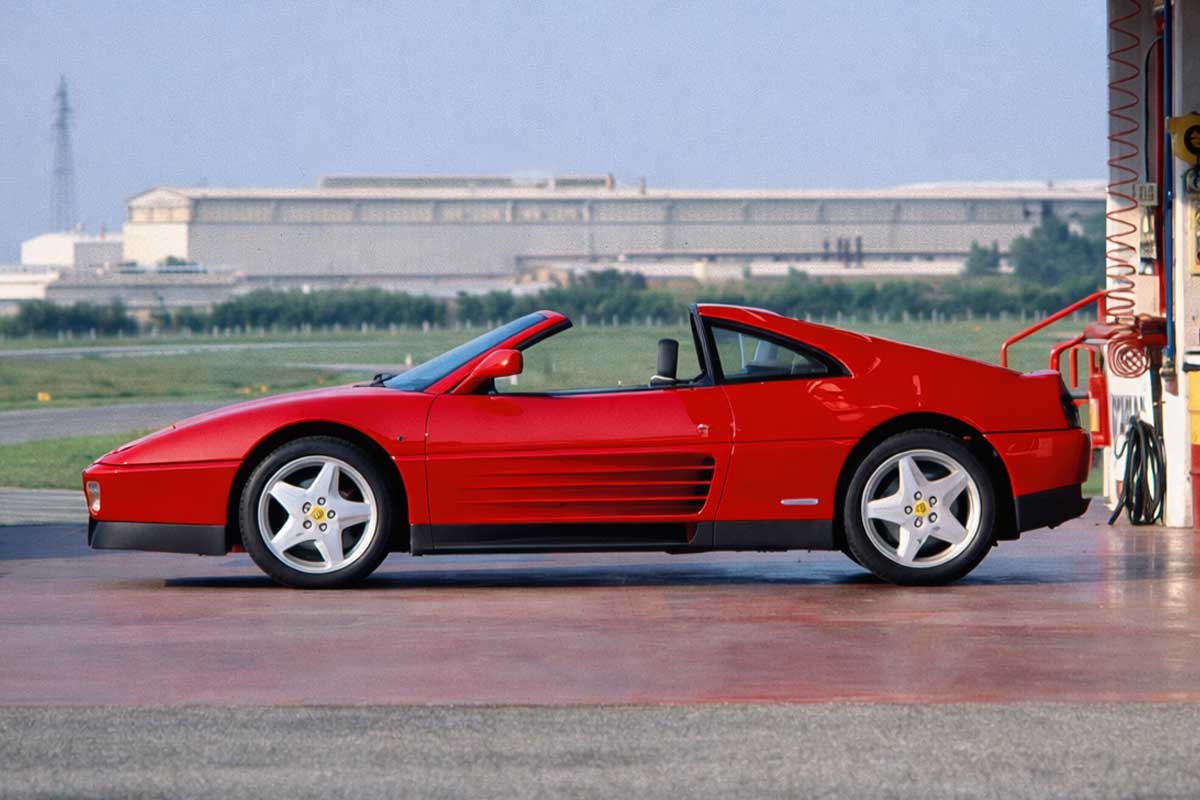
The design has a lot to do with it. Angular, distinctive, very Pininfarina in the spirit of the era, the 348 has those slatted side air intakes that evoke both the Testarossa and the racing Ferraris of the 80s. And then there's that phenomenon the market loves: rediscovery. When a car has long been underestimated, it feels like a "secret" shared among connoisseurs.
The bargain... before it's gone?
The question, inevitably, eventually arises: is it "time"? The 348 TS/GTS still retains a form of relative accessibility in the Ferrari universe, especially when compared to current models and the flamboyance of certain older icons. But accessibility, in collecting, is a window. And a window never stays open indefinitely. As modern Ferraris become more technological, "analog" Ferraris gain in appeal. Not just because they're simpler, but because they offer something we can't really reproduce any more: a direct relationship between driver and car.

 English
  French
  Italian
  Spanish
  Portuguese
  German
  Japanese
  Turkish
  Dutch
Dutch
Also worthy of note is the charm of the mechanical gearbox, which is operated through its inimitable metal grill.
And what was perceived as a flaw at the time, namely delicate handling, has become a charm compared to the clinical perfection of today's supercars.
But what works in its favor even more is the famous generational effect. Yesterday's teenagers (okay, the day before yesterday), who fantasized about this baby testarossa, are now approaching or even over fifty, and some of them have enough left over to afford their share of youthful dreams.
The 348 has room for improvement, to put it mildly.
But that's precisely what makes it so attractive today, compared to the clinical perfection of today's supercars.
Sorry for the repetition, but I can't see if my initial message has been taken into account. Is this a problem on my part or more generally on the site?
In short, like the small sports cars of the late eighties, the 348 is a super "youngtimer" that makes the hearts of young boomers beat faster.