

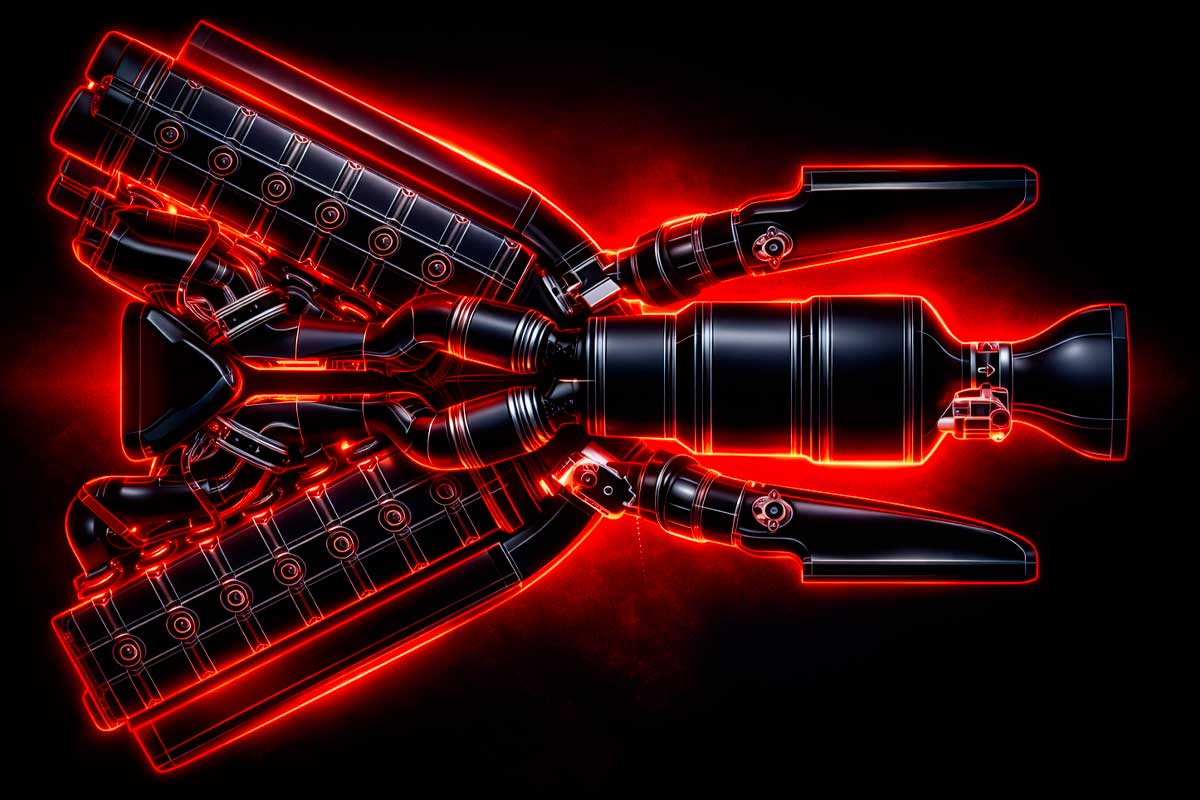
Ferrari never ceases to amaze. After an already astonishing patent for an «active» chassis, the Maranello-based manufacturer is back with an even more disconcerting idea: a totally new V12 engine, which could well redefine the very way combustion engines are conceived in the age of electrification.
Behind this project, recently unveiled through several patents filed with the USPTO and analyzed by CarBuzz, lies a bold vision: to save the V12... by radically transforming it.
A V12 like you've never seen before
On paper, Ferrari is talking about a twelve-cylinder engine. But in reality, it's neither a classic V12 nor a flat-12. The idea is based on the assembly of two in-line six-cylinder engines, arranged in a V-shape. So far, nothing extraordinary... except that this architecture doesn't read in the traditional way.
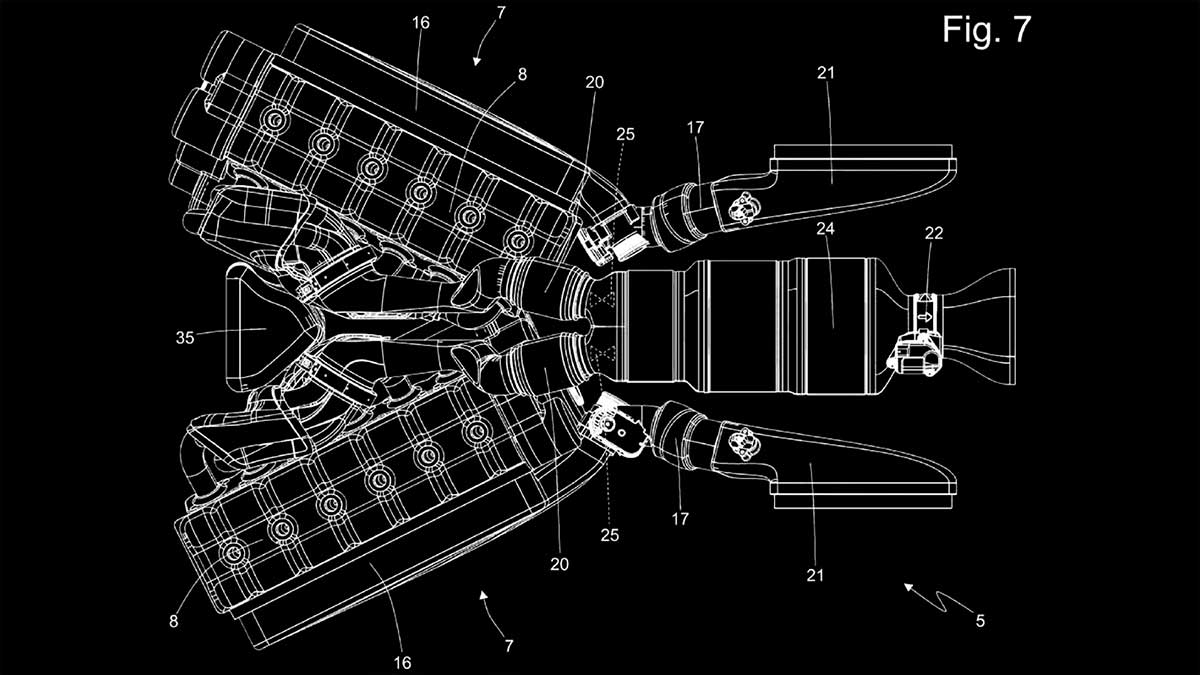
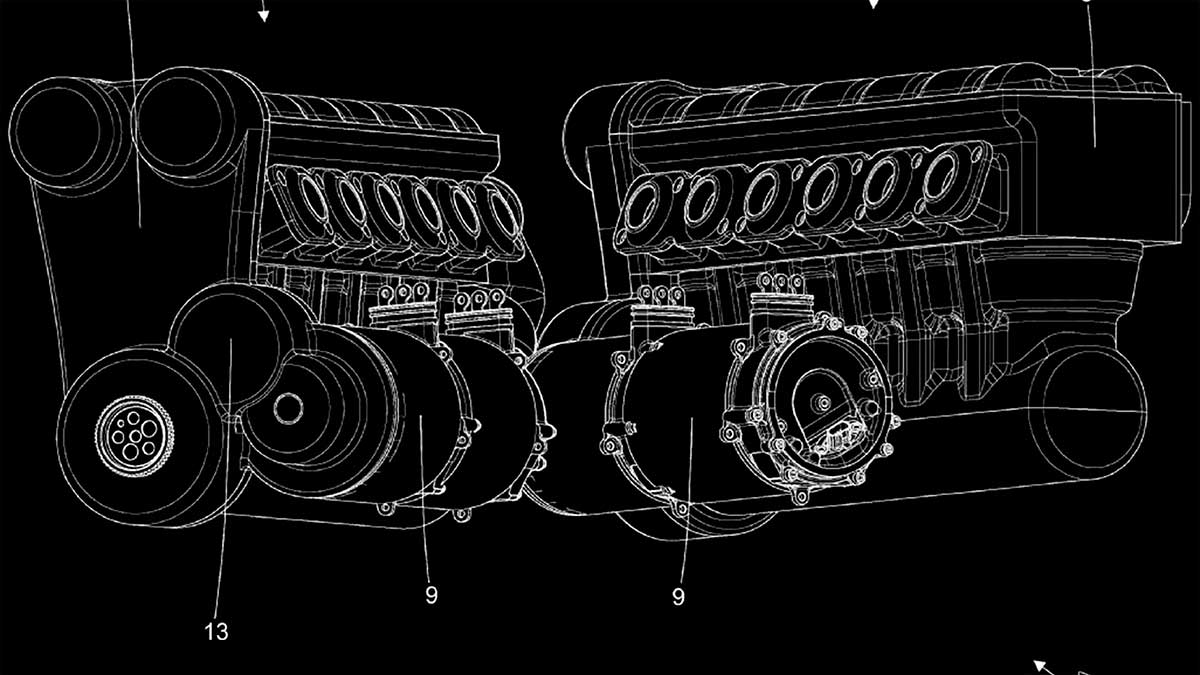
Here, the V is formed not by looking at the engine from the side, but from above. A subtlety that actually conceals a complete break with mechanical conventions. To prevent the components from overlapping, Ferrari imagined an arrangement almost worthy of space engineering: one motor facing forward, the other facing backward, each associated with its own electrical generator, positioned at opposite ends.
A V12... that doesn't drive the wheels
The real revolution doesn't stop at the shape of the engine. This V12 operates according to a series hybrid logic. In concrete terms, the combustion engines are never connected directly to the wheels. Their role is quite different: to generate electricity. This energy then feeds the electric motors responsible for propelling the car. An architecture already known in the industry, but rarely exploited at this level of performance, and never with such sophistication.
In this configuration, Ferrari provides intelligent operation. During phases of low demand, a single combustion engine is sufficient. But as soon as the driver demands full power, both 6-cylinder engines come into action simultaneously. The angle of the V would be between 20 and 30 degrees, with the possibility of opening up to 45 degrees to accommodate a battery or fuel tank.
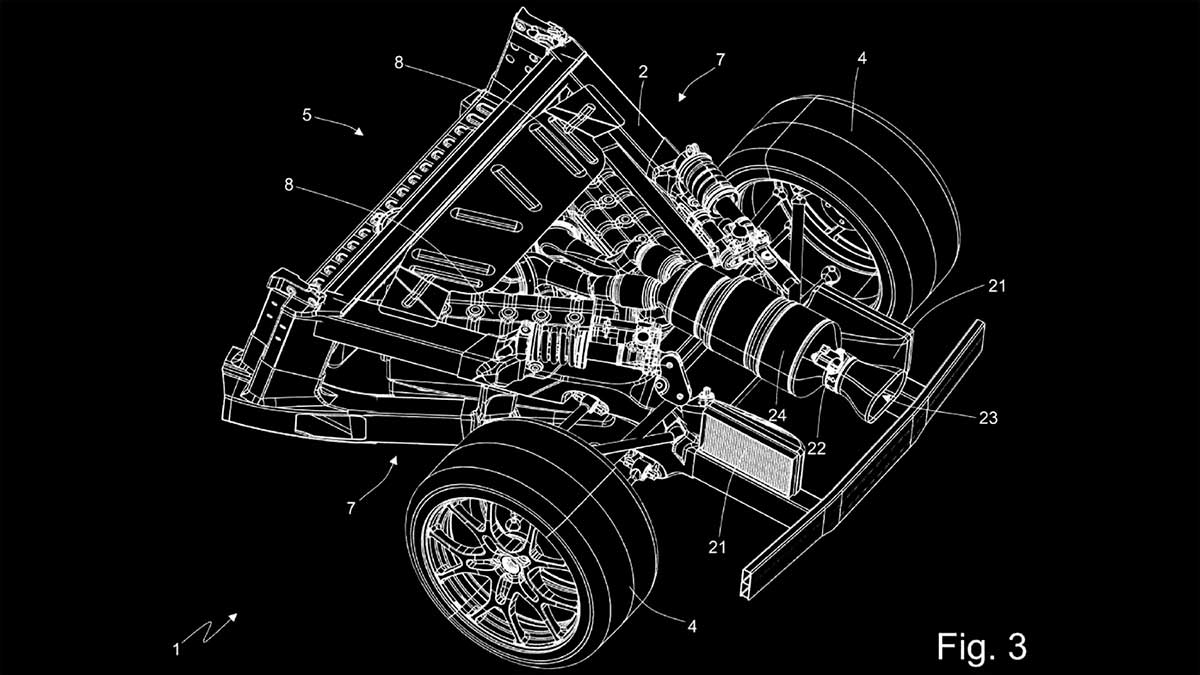
But it's the exhaust system that's most intriguing. The two engines share a common duct, connected by a valve capable of modulating the flow of gases according to the number of active engines. The aim is twofold: to optimize gas evacuation and maintain the ideal temperature of the catalytic converter. Even more surprisingly, Ferrari plans to independently control the ignition phase of the two engines. They could operate in perfect synchronization... or, conversely, in total opposition.
Between heritage and future
Contrary to what one might imagine, this system does not rely on large motors. Instead, Ferrari envisages two small-displacement motors, capable of maintaining the battery's charge and accompanying phases of high demand.
A philosophy that recalls the brand's very origins, with the first 1.5-liter Colombo V12 in the 1940s. A nod to history, but above all proof that Ferrari has never ceased to innovate around this legendary architecture.
This patent is not just an exercise in style. It illustrates just how far a manufacturer like Ferrari is prepared to go to preserve the combustion engine, and in particular the V12. It remains to be seen whether this concept will ever see the road. But one thing is certain: at Maranello, even the electric future can still beat to the rhythm of twelve cylinders.
 English
  French
  Italian
  Spanish
  Portuguese
  German
  Japanese
  Turkish
  Dutch
Dutch