

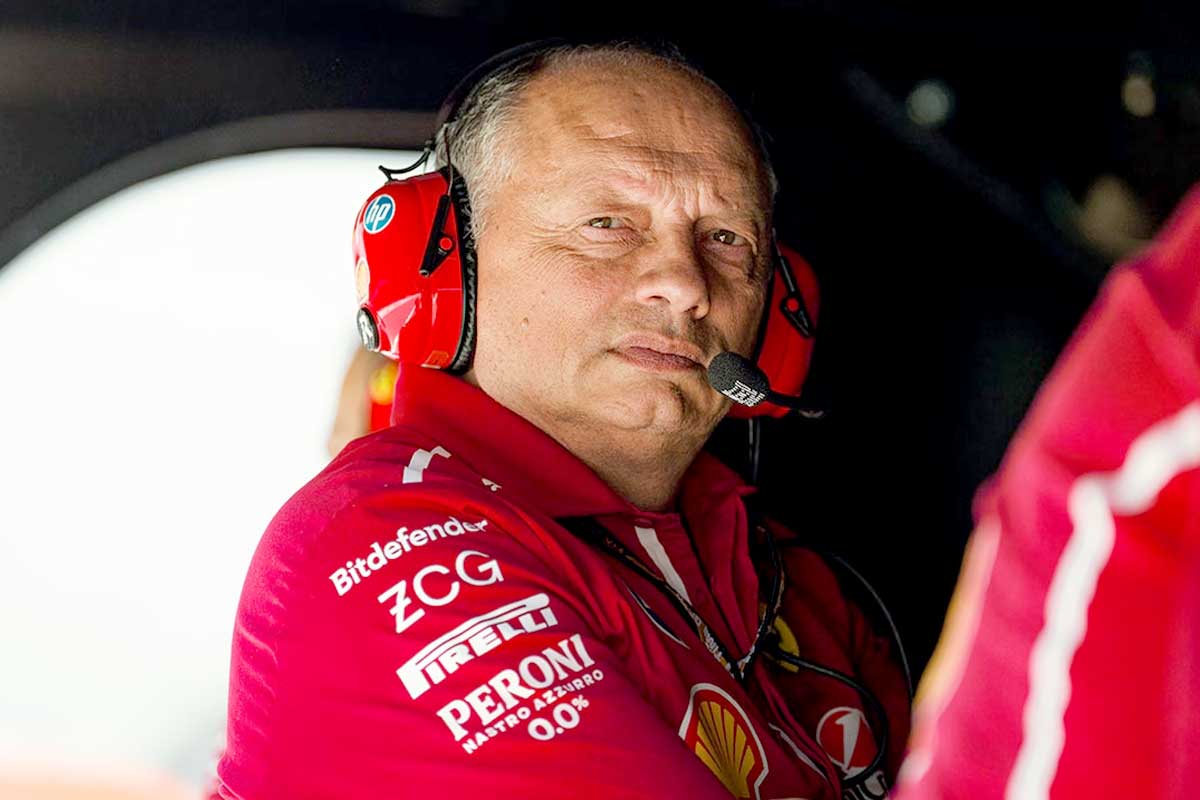
The 2026 season of Formula 1 will mark one of the biggest regulatory upheavals in the sport's recent history. A new generation of single-seaters, profound changes to powertrains, rethought aerodynamics: for Ferrari, as for the rest of the field, the stakes go far beyond the simple result of the first Grand Prix. Frédéric Vasseur is fully aware of this. For the Scuderia boss, the hierarchy observed in Australia will only be a provisional snapshot.
The 2026 season will be a marathon
At Ferrari, the message is clear: 2026 will not be won in Melbourne. Vasseur insists that the coming season will be above all a race for development, far more than an immediate battle for pure performance. With lighter, more compact cars and an increasing proportion of electric power, the teams will be entering largely uncharted territory. The French director believes that it would be a strategic mistake to try to shine in the first race. "The season won't be over in Australia, whether we're first or tenth," he repeats, aware that the ability to understand and develop the car throughout the year will be decisive.
Three winter tests to tame a revolution
A rarity in modern Formula 1, the 2026 season will be preceded by three separate winter test sessions. A decision made necessary by the scale of the technical changes. Ferrari will take to the track in Barcelona at the end of January, for a private test behind closed doors, before two sessions in Bahrain in February. For Vasseur, these nine days of testing represent both an opportunity and a challenge. The primary objective will not be to set a flattering time, but to get the car running as much as possible. Accumulating mileage, checking reliability and understanding the overall behavior of the single-seater are the real priorities, especially after a 2025 season marked by lost references at the start of the year.
Reliability and understanding before pure performance
Frédéric Vasseur is quite clear: in the first test, pure performance will be largely secondary. Ferrari is expected to field a first version of its F1 2026, a "spec A", which will undergo rapid development. The single-seater that will take the start in Melbourne could already be significantly different from the one seen in Spain a month earlier. This process of continuous development is, according to Vasseur, one of the key elements of the new regulatory era. More than grid position in March, it's the ability to react quickly, correct weaknesses and exploit every update that will make the difference over the whole season.
Ferrari under pressure but lucid
The Scuderia enters 2026 with high ambitions. After switching its resources to the new project early on, Ferrari paid a high price in 2025, finishing fourth in the championship without a single victory. The media and political pressure in Italy is real, and Vasseur is well aware of it. However, the Scuderia Ferrari boss points out that Formula 1 remains a sport of constant comparison: even an excellent job can seem insufficient if a competitor does better. With this in mind, Ferrari is concentrating on every pillar of performance, from the engine to aerodynamics, simulation and tuning.
Vasseur freely admits that nobody really knows where Ferrari, McLaren, Red Bull or Alpine will be at the start of the 2026 season. Trying to guess where the other teams will be is, in his view, a waste of time. The most important thing is to make the most of the project's potential and progress faster than the competition.
 English
  French
  Italian
  Spanish
  Portuguese
  German
  Japanese
  Turkish
  Dutch
Dutch
Caution still prevails in Vasseur's speech. While he's perfectly right in principle, we mustn't let this become a position of principle to mitigate any future disillusionment.
In the rich history of F1, Ferrari occupies a special place, obliging it to finish in the top 3 and aim for the top step of the podium as much as possible.
So rather than saying "in Australia, it doesn't matter whether we're first or tenth", it would have been better to say that all the Scuderia teams are working hard to be ready for Melbourne.
It also suggests that the first grand prix is a bit of a cakewalk. But that's just not true.
Ask Lando Norris what he thinks of his victory at Melbourne 2025. Do you think that if he'd finished tenth in that first GP, he would have finished world champion? No, he would have finished behind Max, or even Piastri.
It's all very well saying the day after the first GP that it's too early to establish a hierarchy, but the fact remains that statistically, the winner is the future world champion in over 90 % of cases.
So, no, it's important to be out in front in Melbourne, as a place off the podium means virtually no chance of the title.