

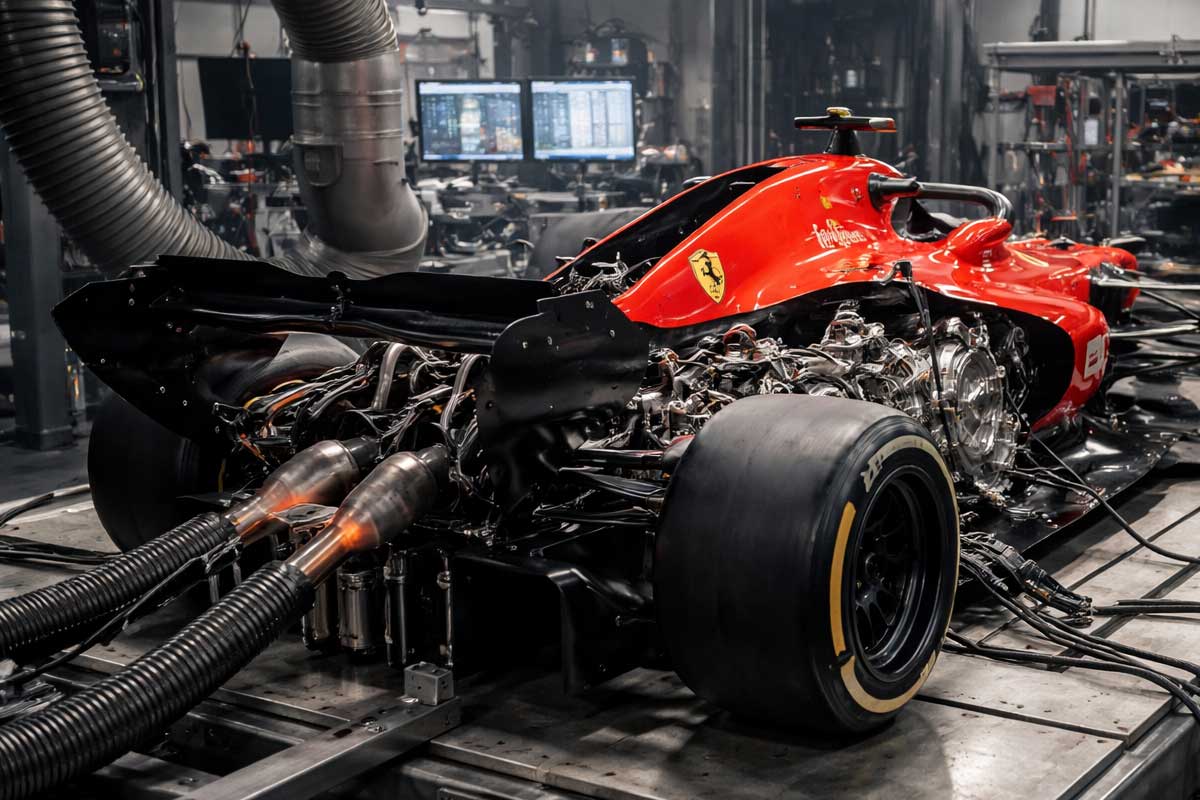
In Maranello, the winter silence is deceptive. Behind the closed doors of the engine department, Ferrari is making measured progress on one of the most decisive projects in its recent history. The future engine for Formula 1 2026, known internally as "Project 678", has just passed a key milestone with a series of intensive tests on a dynamic dyno. And the first signals reported by Motorsport.it concerning this new-generation V6 are far from negative.
A more reassuring test bed than expected
Recent tests at Maranello have validated a number of major technical choices, particularly with regard to energy recovery. In the new 2026 regulations, the balance between combustion and electric power has changed radically. Where the internal combustion engine dominated until now, power will now be divided almost equally between the V6 and the electrics. This evolution is accompanied by a major challenge: the disappearance of the MGU-H. Deprived of exhaust gas energy recovery, the battery must now be recharged solely via the MGU-K during braking phases. A scenario that directly exposes the teams to a sudden loss of electrical power in a straight line. However, according to feedback from the test bench, Ferrari has managed to exceed its initial targets for kinetic energy recovery. A key point, both for pure performance and race consistency.
Ferrari confronts Mercedes' aggressive strategy
While Mercedes and Red Bull-Ford are under suspicion exploit a trick allowing the compression ratio to evolve from 16:1 when cold to around 18:1 under real-world conditions, Ferrari seems to have deliberately chosen a more conventional path. At Maranello, priority was given not to the search for maximum peak power, but to combustion stability and the reduction of internal friction. Cavallino's engineers are focusing on fine-tuning direct injection and pre-chamber ignition to obtain a more exploitable, linear power curve, better suited to the constraints of a highly electrified hybrid engine.
Steel cylinder head
Among the most sensitive technical decisions, that of validating a steel alloy cylinder head was kept secret for a long time. Initially developed in parallel with an aluminum version, this heavier solution was finally chosen after a long deliberation phase led by Enrico Gualtieri, Ferrari's Technical Director for Engines, at the suggestion of Davide Mazzoni. Reviewed and refined by Guido Di Paola, an experienced figure in the engine department who has returned to a central role, this cylinder head incorporates copper and ceramic components. While steel slightly reduces weight, it also offers greater resistance to extreme pressures and temperatures in the combustion chamber. A significant advantage, given that the 2026 power unit will have to weigh 30 kg more than current units.
An engine designed for aerodynamics
One of the most interesting aspects of the new engine is its level of integration with the chassis. The power unit was designed from the outset to offer maximum freedom to the aerodynamicists of the Scuderia Ferrari. Under the direction of Loïc Serra, Diego Tondi and Frank Sanchez will be able to exploit more extreme choices. A more compact motor, a lightweight, densely-packed electric battery and a particularly careful cooling system should enable them to design a slimmer rear axle.
2026, an opportunity not to be missed for Ferrari
After a more than difficult 2025 season, the Scuderia is moving forward with an assumed, almost silent prudence. However, the technical choices made for the 2026 V6 engine suggest a clear, coherent vision, focused above all on the car's overall performance rather than the quest for a one-off advantage.
 English
  French
  Italian
  Spanish
  Portuguese
  German
  Japanese
  Turkish
  Dutch
Dutch
Nice ferrari
エンジンレッドブルパワーユニットできるあります
エンジンレッドブルパワーユニットあります大丈夫OKものすごい
Mercedes e Red bull sono gli eredi di Ron Dennis, emeriti furfanti. Seguono solo strade illegali. E sono protetti dai vertici di F1.
Giustissimo cercano sempre le zone grige
Blah blah blah from all sides We'll see on the track. If Ferrari had used the same trick as Red Bull and Mercedes, it would already have been banned.
In Ferrari business as usual. They never had problem with engines but with aerodynamics and team management.
A Maranello hanno azzardato di fare la testata in acciaio che consentirebbe di gestire valori di pressioni ed efficienza termica nelle camere dei cilindri, più elevati. Allora si potrebbe pareggiare il gap di potenza con Mercedes e Redbull che sfruttano il.maggior rapporto di compressione per tirare fuori 15 CV in più!? Speriamo che ogni tanto gli ingegneri Ferrari ci azzecchino,altrimenti di nuovo ad inseguire!!! E così non se ne esce più!!