

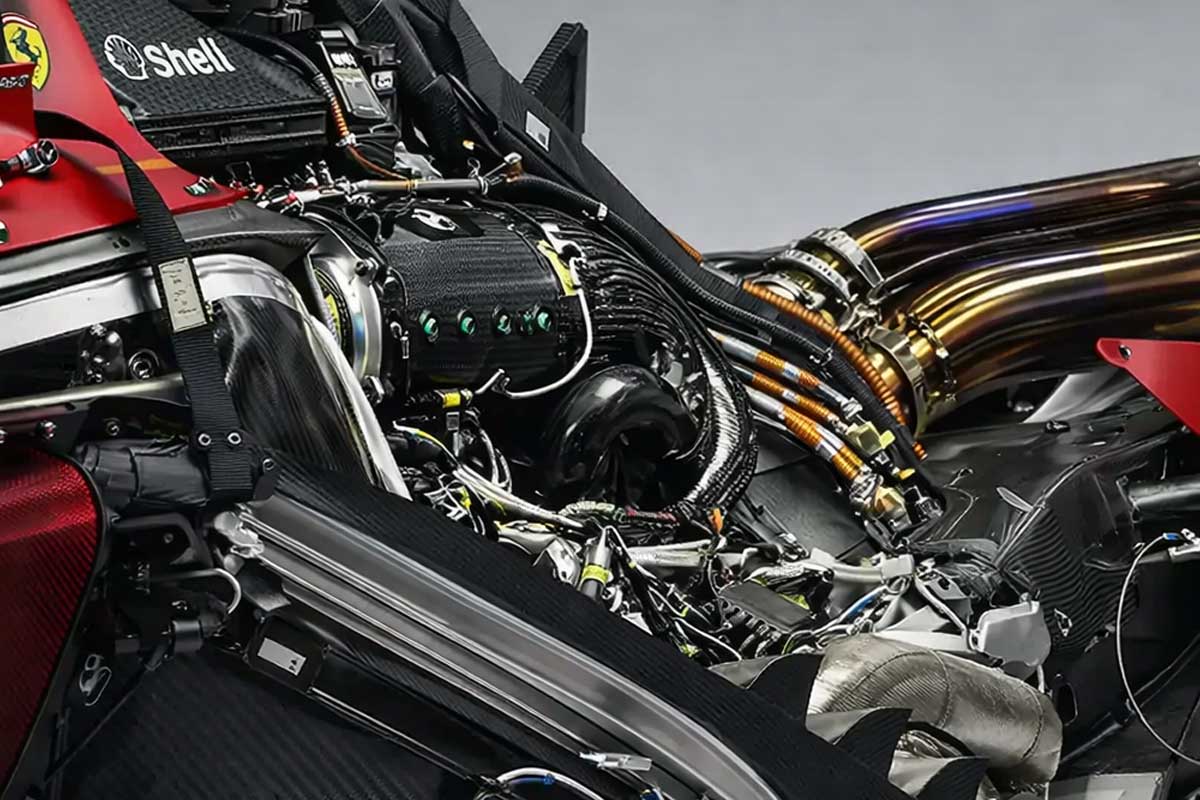
In Maranello, winter is rarely a time for rest. Behind the closed doors of the engine department at Scuderia Ferrarione of the most sensitive projects of the decade continues to mature: the 2026 Formula 1 engine. And if indiscretions remain rare, one specific technical element is now the focus of attention: the choice of a steel alloy cylinder head.
A 2026 engine with a radically new philosophy
The F1 2026 regulations represent a clean break with the current era. The disappearance of the MGU-H and the increased power of the electric system completely reshuffle the deck. From now on, power will be split almost equally between the V6 internal combustion engine and the electrics, with greater reliance on kinetic energy recovery via the MGU-K. The first dynamic dyno tests carried out at Maranello have delivered some rather reassuring signals. According to several Italian sources, Ferrari has exceeded its initial energy recovery targets. This in-depth work on hybrid management seems to confirm a clear direction: to prioritize the overall exploitation of the power unit rather than the search for an isolated performance peak.
While a number of competitors, including Mercedes and Red Bull-Ford, are said to be on the trail of very aggressive solutions around the world. compression ratioFerrari seems to have adopted a more conservative approach. In Maranello, the emphasis would have been on combustion stability, reduced internal friction and fine-tuned management of direct injection combined with pre-chamber ignition.
The steel cylinder head, a bold technical gamble
This is where the subject becomes sensitive. Ferrari is said to have definitively approved a steel alloy cylinder head for its V6 2026, after having long worked in parallel on an aluminum version. The decision was taken by Enrico Gualtieri, with the support of Davide Mazzoni, and refined by Guido Di Paola, who has returned to a central role in the engine department. On paper, steel poses an obvious problem: weight. Placed at the top of the engine, the cylinder head directly influences the center of gravity of the combustion engine, a parameter that every engineer instinctively seeks to lower. But the 2026 regulations also change the situation: the power unit will in any case weigh around 30 kg more than current engines, reducing the relative impact by a few extra kilos.
Why steel can become a key advantage
The benefits of steel go far beyond mere strength. Faced with the much higher pressures and temperatures expected in 2026 combustion chambers, this material offers greater mechanical strength than aluminum. It also has lower thermal conductivity, which helps limit energy losses during combustion. In other words, better heat containment potentially improves the engine's overall thermal efficiency. In a Formula 1 where every percentage of efficiency counts, this detail can make all the difference to the duration of a stint or a Grand Prix.
The real risk: the center of gravity
The main point of vigilance, however, remains the center of mass. A heavier cylinder head, placed high up, can adversely affect the car's dynamic balance. But here again, Ferrari seems to have anticipated the problem well in advance. The overall architecture of the engine, the compactness of the battery and the work on cooling give aerodynamicists more freedom. Under the coordination of Loïc Serra, and with the help of Diego Tondi and Frank Sanchez, engine-chassis integration was conceived as an inseparable whole. The aim was to refine the rear end and make the most of the new aerodynamic freedoms introduced by the 2026 regulations.
Rumors, reversals and the need for caution
The situation is nonetheless paradoxical. In October 2025, there were reports of the abandonment of a steel cylinder head (a solution supported by Wolf Zimmermann, recruited by Audi since) deemed too risky in terms of reliability, in favor of an aluminum solution combined with an intake system. Today, the situation seems to be reversed. Could Ferrari have finally retained a completed version of this initial solution? It's hard to say. At this stage, caution is the order of the day. Maranello has always excelled in the art of muddying the waters, and recent history shows that not all winter "certainties" survive the first Grands Prix.
 English
  French
  Italian
  Spanish
  Portuguese
  German
  Japanese
  Turkish
  Dutch
Dutch
What to think?
In terms of form, the article is a little unsettling, developing the argument for the choice of steel cylinder head only to conclude that this choice is anything but certain.
I don't see the point of Ferrari unveiling such major technical choices.
When you consider the care with which the Scuderia keeps its road models secret, succeeding unlike other manufacturers in unveiling their new products in an unprecedented way, you'd be forgiven for thinking that the Scuderia applies the utmost discretion, even confidentiality, to its communications.
What I found really disturbing is that over the last few days, everyone has been talking about this steel cylinder head as being a conscious choice, and my memory reminded me that back in October, this choice was made by Wolf Zimmermann, a choice that had not been retained and which finally is? In the end, this breech really does exist. Now, will it work as well in practice as it does in theory?
I imagine it must be frustrating to keep this blog going and have to rely on guesswork.
In this case, it's hard to be precise and factual.
This also refers to the already famous deformable pistons from Mercedes and RedBull power train (aka Ford). If the principle, perfectly conceivable and understandable on paper, has been widely debated in the public arena, what about its concrete application, real gains, additional constraints and reliability?
And let's not forget that the thermal unit will only account for 50% of the power, with the remaining 50% coming from the electric motors.
And on this subject, we know very little about each other's technical choices, even if there are fewer differentiating options, with energy recovery and thermal-electric coupling being two key features.
Not to mention aerodynamics, which will be even more important than powertrains, with the abandonment of the relatively unifying ground effect (just look at the qualifying gaps, which have never been as small as they will be in 2025) in favor of active aerodynamics, with movable fins and flaps, which are sure to be far more distinctive.
In short, so many new elements, all of which are undoubtedly closely guarded.
See you in Melbourne in just over two months' time to find out who did the best work!
Of course, we all hope that the Maranello teams will have perfected the right "SF26", making the most of the 6 months of anticipation taken to the detriment of the SF25's evolution.
In any case, all the major innovations in the 2026 regulations: 50-50 hybrid powertrains, active aerodynamics... are areas in which Ferrari has excelled for over ten years with its road cars, the F80 being the latest illustration, and soon four years with its hypercars, in this case the glorious 499 P.
All that remains is to sublimate these skills at the highest level and in front of the other "leaders of the class"!
They will never use a steel cylinder head as it's to heavy for one, Plus they wouldn't be putting out important data like this to the public or the other teams,I think this is just gossip and that's all.Ferrari better deliver this season or they will fall further behind the top 2 teams namely Mercedes and Red Bully.👍
Bald wird es klappen an der Karosserie geben die sich beim Anbremsen auch noch öffnen.