

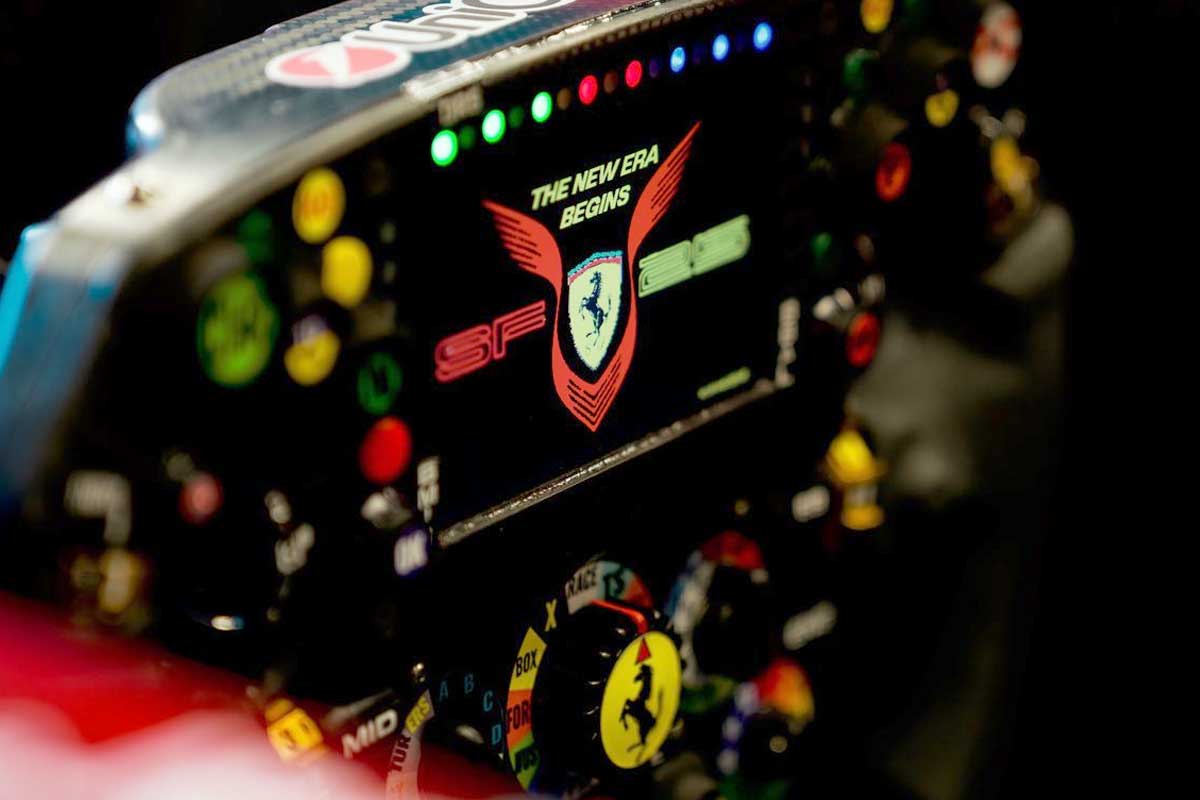
As the debate rages over Mercedes' alleged engine trick for the 2026 seasonFerrari, for its part, is taking a more discreet approach to other equally strategic issues. The Scuderia is taking advantage of the regulatory reset to rethink in depth the interface between driver and machine, an often underestimated but absolutely central element in the world of racing. Formula 1 the steering wheel. The new 2026 rules don't just overhaul aerodynamics and engines. They also redefine the way drivers interact with their single-seaters, lap after lap, sector after sector. And Ferrari has chosen to involve its two drivers, Charles Leclerc and Lewis Hamilton, directly in this transformation.
The steering wheel, the new nerve center of modern F1
Often described as the driver's "office", the F1 steering wheel will undergo a radical overhaul by 2026. With the arrival of active aerodynamics and new rules for managing electrical energy, drivers will have to make more decisions in real time, sometimes on the scale of a few hundred meters. From now on, managing electrical deployment becomes a permanent exercise. It's no longer simply a question of attacking or saving, but of optimizing the available energy almost turn by turn to guarantee maximum power on the straights. Added to this is the manual activation of a low-drag aerodynamic mode at the start of each fast section, an additional gesture to integrate into an already extremely dense routine. Faced with this added complexity, Ferrari has chosen to completely rethink the logic of its steering wheel.
A new steering wheel redesigned to reduce the driver's mental workload
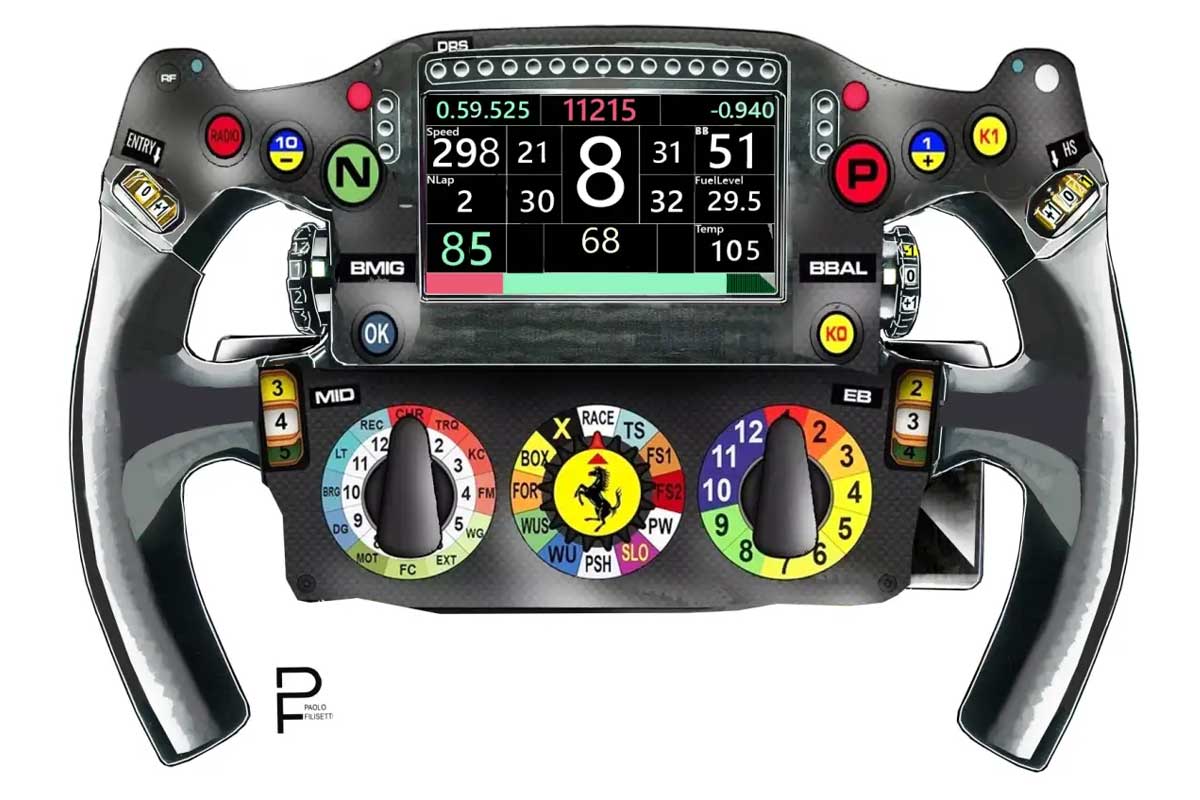
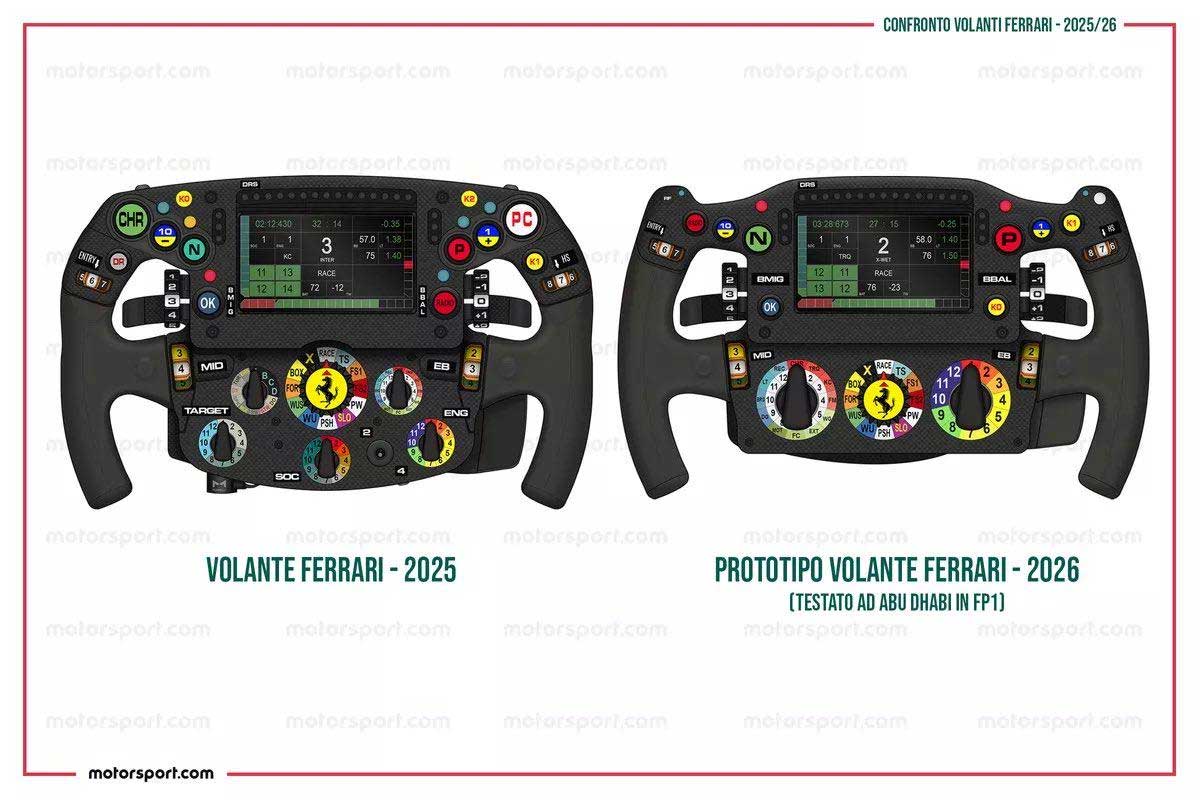
Maranello's engineers have taken a strong decision: simplify without impoverishing. Where previous steering wheels featured up to six knobs spread over a relatively cluttered surface, the 2026 version adopts a more streamlined philosophy. Essential functions relating to energy recovery, electrical deployment and electronic strategies are now grouped around three main knobs, positioned below the central display. The latter retains its key role, permanently displaying vital information such as gear engaged or tire temperature. The steering wheel itself is more compact, with a significantly reduced lower section. The aim is clear: to improve ergonomics, limit parasitic movements and enable the driver to concentrate on the essentials, even at very high speeds.
The central role of Lewis Hamilton and Charles Leclerc
This evolution is not just the result of office engineering. Ferrari insists on one point: the new steering wheel is largely the result of feedback from its drivers. Lewis Hamilton and Charles Leclerc tested the new configuration at length in the Maranello simulator, fine-tuning every detail as they went along. Their contribution focused primarily on ergonomics. Which settings should be instantly accessible? Which buttons should remain usable under heavy lateral load? How can errors be avoided at the most critical moments of a lap? These are just some of the questions to which their feedback provided concrete answers.
Ferrari is cautious, however. The steering wheel presented is not yet set in stone. Further adjustments are expected during pre-season testing, in order to fine-tune the interface before the first Grand Prix of the year, in Australia.
 English
  French
  Italian
  Spanish
  Portuguese
  German
  Japanese
  Turkish
  Dutch
Dutch
I believe and hope that this is nothing more than a very evasive communication on the part of Ferrari, which has otherwise kept the real technical developments of this strategic element well under wraps.