

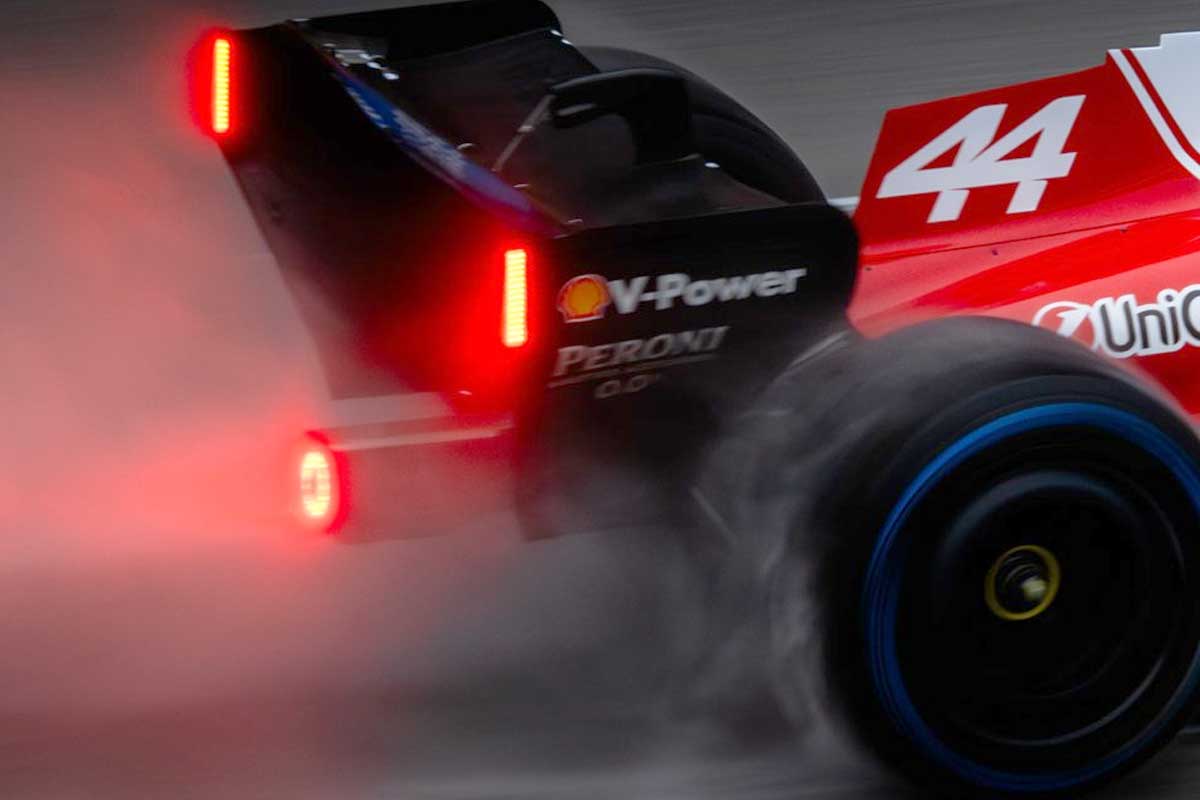
At first glance, choosing Barcelona and a soggy track to launch the first real tests of the Formula 1 SF-26 may seem counter-intuitive. However, for Maranello, the objective was never pure performance. After covering just 15 kilometers in Fiorano during an initial shakedown, the Scuderia took advantage of the first day in Catalonia on January 27 to validate the overall operation of all the car's systems. The 121 laps completed were therefore not aimed at setting a lap time, but at laying the technical foundations for the season. Although data collection was not the main focus, nothing was left to chance: all the information gathered, particularly on the car's behavior in wet conditions, is currently being analyzed at Maranello. It's an in-depth, unobtrusive task, but essential in a pre-season when reliability and understanding the new systems take precedence over everything else.
First run in the rain
The weather conditions finally offered Scuderia Ferrari a rare opportunity: to race very early in the season on a wet track. Perfect for testing solutions recently introduced by the FIA, notably in the field of active aerodynamics. In addition to the now classic "Straight Mode" to reduce straight-line drag and "Corner Mode" to maximize cornering pressure, a third mode has been introduced: "Partial Mode". Designed for low-grip or potentially dangerous situations, this configuration allows only the front wing to open, while keeping the rear wing closed to guarantee stability and traction.
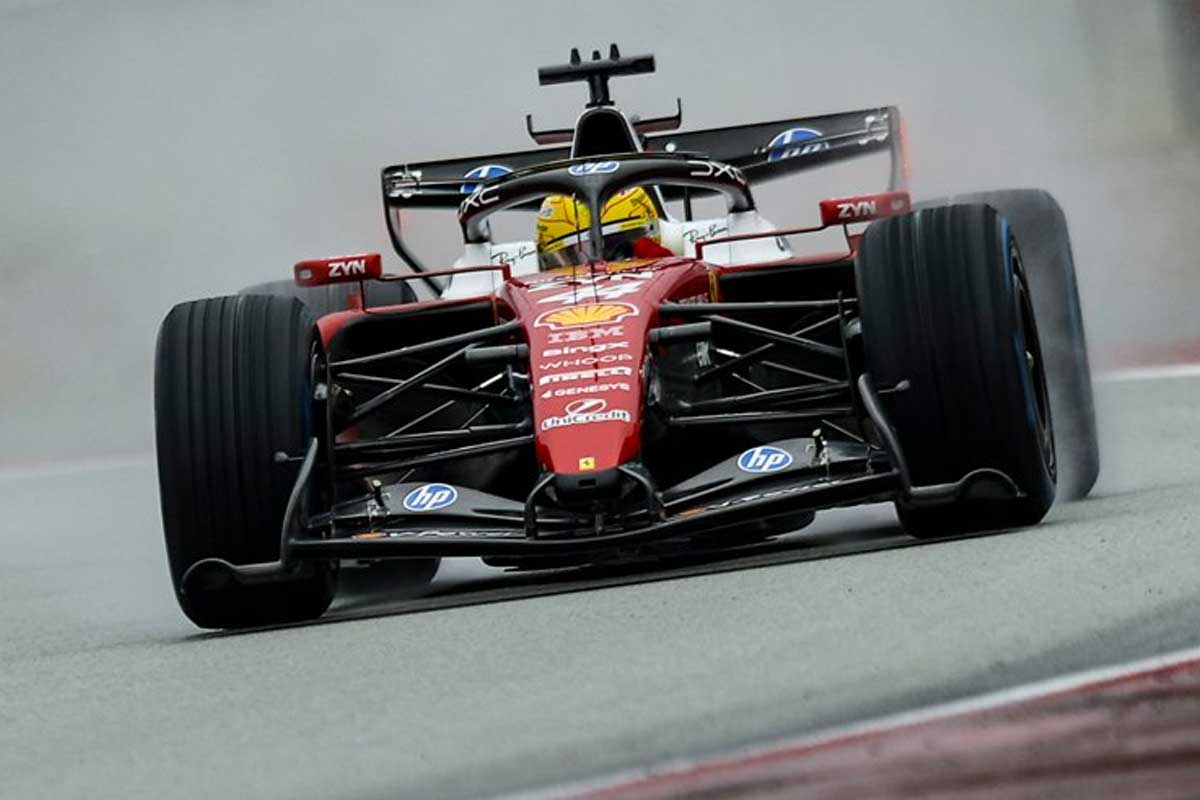
In the few images released on this first day, the SF-26's straight-line behavior is clearly visible. The front wing lowers to limit air resistance, while the rear wing remains loaded, thus avoiding any sudden imbalance of the rear axle. The FIA will define, circuit by circuit, specific zones where partial or complete aerodynamic activation will be authorized.
Charles giving us our first look at the partial active aero mode where only the front wing is opened on straights. This is a mode specific to wet conditions. pic.twitter.com/WVWQZKGVZX
- brakeboosted (@brakeboosted) January 27, 2026
Aileron activation that raises questions
However, it was another, more subtle detail that caught the attention of the most attentive observers, including AutoRacer. As early as Fiorano, and then again in Barcelona, Ferrari was seen to activate the rear wing slightly before the front. A tiny difference, measured in fractions of a second, but visible enough to raise questions. This sequence contrasts with that adopted by other teams, led by Mercedes, who prefer perfectly synchronized activation of the two aerodynamic elements. On a wet track, this time lag could have a precise role to play: preserving the car's stability.
In Fiorano, this peculiarity could still be interpreted as a simple provisional adjustment or unfinished fine-tuning of the systems. But its reappearance in Barcelona changes the interpretation. Everything points to it being a deliberate experiment, part of Ferrari's working strategy for this pre-season phase. The Scuderia is thus exploring a different activation logic.
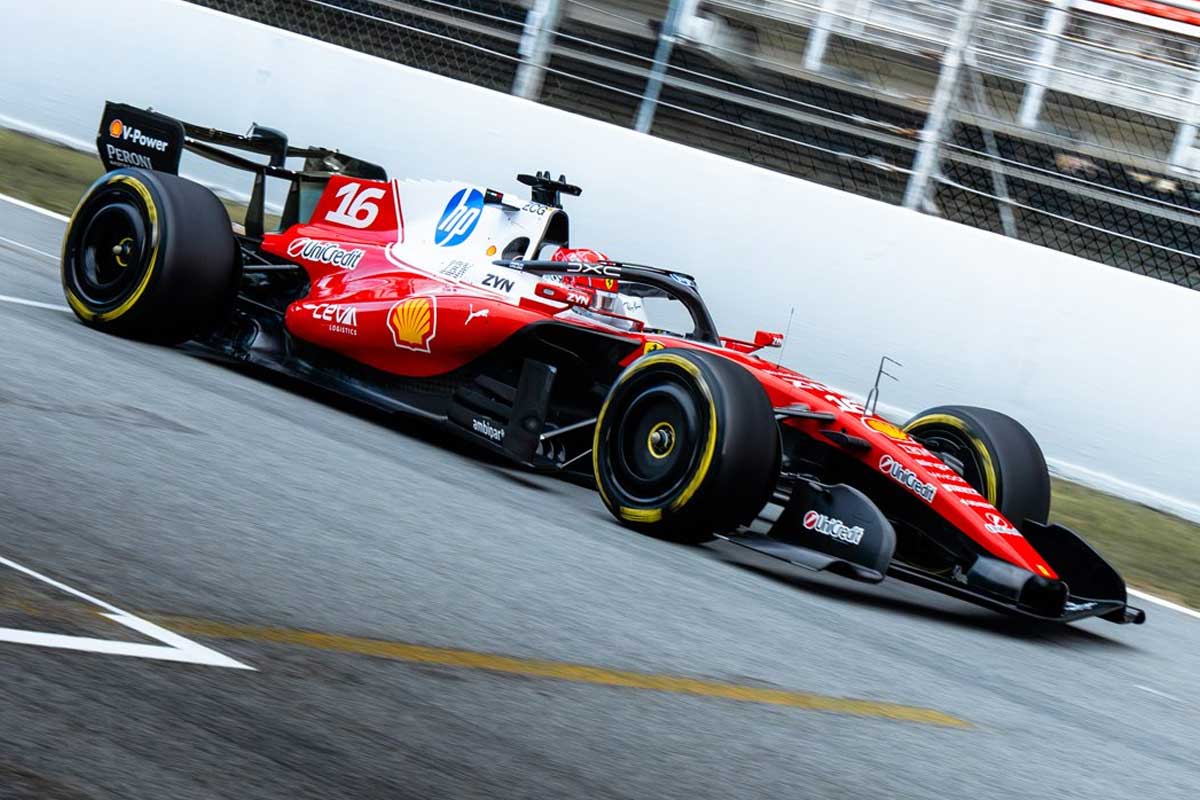
As the second day of testing draws to a close for Scuderia Ferrari, they give no indication as yet of the SF-26's raw potential. On the other hand, they confirm that Ferrari is approaching this new regulatory era methodically, exploiting every kilometer to learn, test and understand.
 English
  French
  Italian
  Spanish
  Portuguese
  German
  Japanese
  Turkish
  Dutch
Dutch