

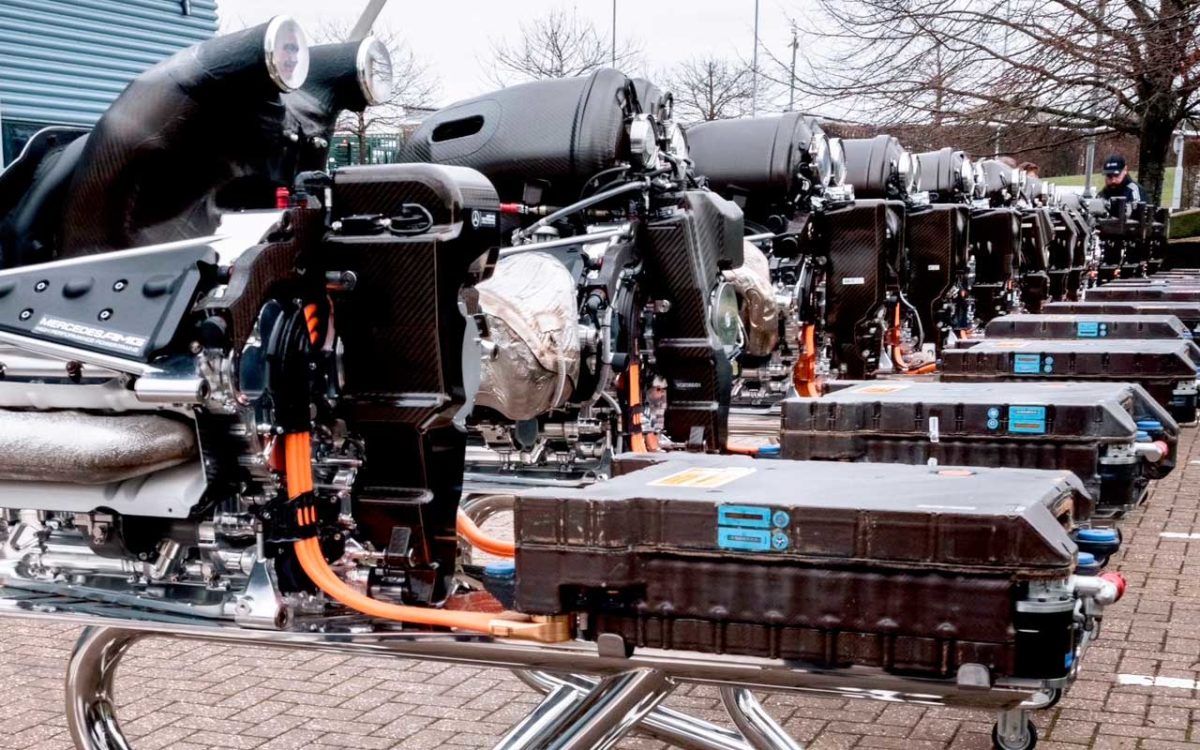
As the controversy surrounding the Mercedes 2026 engine continues to rage in the paddock, a new element has shed new light on the debate. After official letters sent to the FIA, controversial regulatory validation and pressure maintained by Ferrari, Audi and HondaNow it's the voice of an in-house Ferrari engineer who's shedding a light that's as rare as it is invaluable. And against all odds, his verdict is clear: Mercedes' trick is legal. A statement that could well seal, at least temporarily, the fate of this technical battle even before the first Grand Prix of the 2026 season.
At the heart of Maranello
The information is revealed by Leo Turrini on his blog Profondo Rosso, through the testimony of a Scuderia engineer, voluntarily anonymized and nicknamed "Gola Profonda". A conscious choice, given the explosive nature of the subject. For several weeks now, Ferrari has been at the forefront of denouncing what it considers to be a dangerous interpretation of the 2026 engine regulations. Behind the scenes, however, the technical discourse appears far more nuanced. The engineer begins by pointing out an obvious fact often misunderstood in public debate: the compression ratio of an internal combustion engine is nothing more than the ratio between the maximum and minimum volume of the combustion chamber, measured when the piston passes from bottom dead center to top dead center. And, above all, this ratio can only be measured when the engine is cold, at room temperature. This is precisely where Mercedes found its window of opportunity.
Thermal expansion
According to this Ferrari engineer, Mercedes has designed its combustion chamber with materials capable of controlled expansion at high temperatures. When cold, during FIA testing, the engine complies strictly with the required 16:1 ratio. But under real operating conditions, the internal geometry evolves, increasing the maximum volume of the chamber to the equivalent of a ratio close to 18:1. In other words, the engine remains compliant where it is controlled... while becoming more efficient where it is used.
"They've come up with a clever solution", the engineer soberly sums up. A phrase that carries a lot of weight, especially when it comes from Maranello. He also stresses a fundamental point: measuring a compression ratio when hot is simply impossible with current regulatory tools. Mercedes has therefore simply exploited a structural constraint in the regulations, without ever formally violating them.
Ferrari lucid, but trapped by the calendar
Perhaps the most striking aspect of this testimony is what it reveals about Ferrari's real position. Unlike Mercedes, Ferrari's 067/6 and 067/7 engines, which will equip the Scuderia for the entire 2026 season, do not incorporate this solution. Neither for the first half of the championship, nor after the summer break. This choice is not the result of an oversight, but of a more conservative reading of the regulations, shared with Audi and Honda. An approach that seemed reasonable until the FIA officially validated Mercedes' interpretation. Now the facts are stark: if the German solution works as planned, the advantage could last the whole season. The figures quoted in the paddock confirm the scale of the problem. Around 10 to 15 extra horsepower, or almost three tenths per lap on certain configurations.
ADUO, Maranello's last hope
Ferrari's engineer is realistic about the situation. Reproducing such a solution during the season is virtually impossible without starting from scratch, with long and costly validation cycles. The only credible way of catching up is through the ADUO (Additional Development and Upgrade Opportunities) introduced by the FIA for 2026. This mechanism will enable engine manufacturers in difficulty to benefit from additional hours on the test bench, budgetary flexibility and, potentially, partial new homologation. Every six Grands Prix, the FIA will analyze the performance gaps between engines. Should Ferrari fall significantly behind, it could then obtain the regulatory means to attempt to close the gap.
Mercedes, still ahead of its time?
This latest episode is eerily reminiscent of the start of the hybrid era in 2014, when Mercedes took everyone by surprise with a conceptual lead that was irrecoverable in the short term. Ten years on, the scenario seems to be repeating itself. Even if validated in regulatory terms, the 2026 engine trick raises a broader question: that of the spirit of the regulations versus the letter. Ferrari knows this. In public, the Scuderia continues to keep up the pressure on the FIA. In private, the engineers recognize the reality: Mercedes has played with the rules... and won this round.
 English
  French
  Italian
  Spanish
  Portuguese
  German
  Japanese
  Turkish
  Dutch
Dutch
Bij VW werd iets soortgelijks sjoemeldiesel genoemd. Gelijke monniken gelijke kappen? Als dit goed gaat is het over één jaar in personenautos ingebouwd. Moet je wel Willen.
.
Io non capisco a cosa serve aumentare la potenza del motore se si parla che dovrebbe diminuire. Mentre dovrebbe aumentare la potenza il motore elettrico?
Hello everyone, I'm not a macanisue scholar but just a great F1 enthusiast for 45 years. I can understand between the lines that we can't control the compression when the car is hot, I guess when it's running; but could this compression ratio when the car is stationary but has just completed testing in a short space of time be higher than required? I understand that materials that expand more than the original ones will be used, and that Mercedes must have planned for this, but my question is mainly based on hot static mode.
Compression is measured by an external instrument. This has to fit between the exhaust and the cylinders at several hundred degrees. A hot-measurement solution would mean installing a sensor on each cylinder to continuously measure this compression... at the strategic point where injection, ignition and exhaust struggle to find their optimum position.
So what?
Le regole sono chiare se poi non si vogliono applicare è una altro discorso: le regole fia dicono che la macchina deve essere legale (seguire le linee guida) durante ogni momento del gran premio.
Se il motore è deliberatamente progettato per non rispettare le linee guida una volta caldo è in violazione del regolamento. L'unica cosa è introdurre un nuovo controllo per fare effettivamente rispettare le regole, come hanno fatto (troppo tardi secondo me) durante la stagione passata per i vari mini drs McLaren
Non sono un ingegnere, ma vorrei capire come Ferrari, Audi e Honda abbiano la certezza del vantaggio del motore Mercedes. A questo punto se ci sono documenti ufficiali che certificano la scorrettezza presentateli, pubblicateli! Se la Fia non può fare le sue verifiche a motore caldo, mi chiedo come hanno fatto i contestatori ad avere queste certezze. Se di certezza si tratta, se si tratta di dati oggettivi allora la FIA dovrà per forza prendere provvedimenti altrimenti si tratta semplicemente di fuffa, compreso l'articolo di cui sopra.
Perdonate la franchezza ma chi ha scritto l'articolo non ha le idee molto chiare. La dilatazione termica porta a un aumento delle distante e a una riduzione del rapporto di compressione. Mercedes utilizza un materiale innovativo che si contrae con il calore e riduce il volume della camera di combustione ed è così che si spiega l'aumento del rapporto di compressione da 1:16 a 1:18.
Potrebbe anche essere che é solo la testa del pistone ad espandersi in modo controllato aumentando così la compressione.
Il tutto si baserebbe sulla variazione di lunghezza delle bielle.
Però la loro lunghezza non influisce perché opera nella stessa direzione in quanto alza allo stesso modo punto morto superiore ed inferiore.
Viceversa l'allungamento dell'albero a gomito abbassa l'inferiore ed alza il superiore aumentando così il rapporto di compressione
Die Kompression erhöht sich bei Hitze. Finde ein gelungener Trick den Gegner zu verunsichern.
La Ferrari recupererà potenza dalla testata in acciaio, anche se leggermente, più pesante dell' alluminio! Questo permetterà di avere più compressione nelle camere di scoppio con maggior efficienza energetica...