

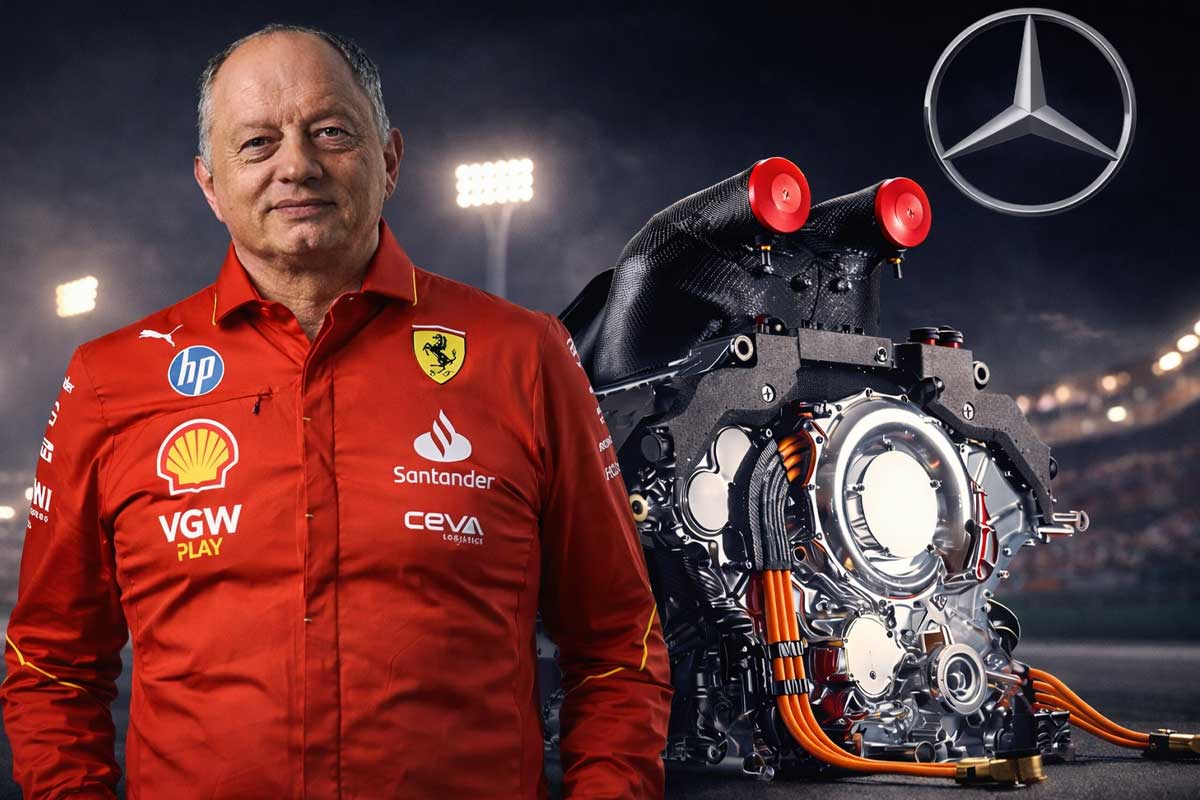
Just a few days before the final tests in Bahrain and two weeks before the Australian Grand Prix, the winter's great technical controversy has reached a major turning point. After weeks of suspicions, official letters and political tensions, the FIA is said to have finally validated Mercedes' engine solution. But far from extinguishing the fire, this decision rekindles the debate... and puts Ferrari in the front line.
Mercedes takes the heat test
According to reports now circulating openly in the paddock, the FIA went to Brixworth, headquarters of Mercedes AMG High Performance Powertrains, to carry out an unprecedented test: measuring the compression ratio of the 2026 V6 hybrid under so-called “hot” conditions.
The M17 E Performance engine was heated to 115°C before being disassembled and measured at around 95°C. Verdict: the compression ratio remains within the regulatory limit of 16:1. In other words, the controversial technical solution is legal.
This validation has far-reaching consequences, since four teams - Mercedes, McLaren, Williams and Alpine - will be using this engine. If its performance advantage is confirmed on the track, the very balance of the new 2026 era could be shaken.
The famous micro-chamber
The crux of the controversy is now well known. Mercedes is said to have integrated a micro-chamber of around 2 cm³ into the cylinder head of each cylinder. When cold, this cavity fills up and enables the engine to perfectly respect the compression limit. But once warmed up, the internal pressure would close the tiny duct connecting this chamber to the cylinder, altering the actual volume of combustion and therefore the effective compression.
Ferrari, Honda, Audi and Red Bull consider that the engine no longer complies with the rule requiring conformity “at any time during the event”. Mercedes, on the other hand, defends an interpretation that strictly complies with the text. The FIA, for its part, has not spoken of cheating. It spoke of interpretation.
A validation... that doesn't convince everyone
Even when validated, the test raises new questions. Does the temperature used really correspond to the on-track conditions of a F1 ? Nothing is less certain. A number of engine manufacturers believe that the higher pressure and temperature experienced during a race could alter the behavior of the famous micro-chamber.
The subject will be discussed at the F1 Commission and Power Unit Advisory Committee meeting in Bahrain. A compromise is already circulating: install a sensor to measure the compression ratio in real time, or give Mercedes six Grands Prix to adapt its cylinder head if necessary. In other words, the solution has been validated... but the file is far from closed.
Frédéric Vasseur stalls but calls for clarification
On the Ferrari side, the tone is measured. In an interview with Auto Hebdo, Frédéric Vasseur refuses to make any direct accusations.
“I believe in Mercedes” good faith. Everyone has their own reading of the regulations and defends their own project."
But the Scuderia boss insists that Formula 1 cannot start the season with several technical interpretations.
“If we come to the first race with different readings of the regulations, there are bound to be performance gaps. And that's not good for the sport.”
Ferrari is not planning a protest in Australia, but is demanding rapid clarification. Vasseur also points out that it's easier to reduce a compression ratio than to increase it. A subtle way of saying that a late correction would still be acceptable.
The FIA wants to avoid a legal war
In reality, everyone shares the same objective: to prevent the 2026 season from starting in the courts. Liberty Media fears a new era dominated by appeals rather than the track. The FIA is therefore seeking a delicate balance: validating innovation without suggesting a structural advantage. A technical directive, a mandatory sensor or a temporary tolerance could serve as a political as well as a technical solution.
The decision that emerges from Bahrain could well define the history of the championship even before the first start. For today, one thing is certain: Mercedes has won the first regulatory battle of 2026. Whether it has already won the season remains to be seen.
 English
  French
  Italian
  Spanish
  Portuguese
  German
  Japanese
  Turkish
  Dutch
Dutch