

Buying a used car is one of the best ways to save money... but also one of the riskiest. Behind the shiny bodywork and seemingly impeccable service history lies a widespread fraud: the tampered odometer. A discreet practice, difficult to detect, but with very real consequences for the buyer.
A study carried out for the whole of 2025 by the carVertical platform, which specializes in analyzing vehicle data via registration, today reveals which models are most concerned in Italy, a market very close to the rest of Europe, where cars circulate extensively between countries.
A Frenchwoman tops the fraud charts
First observation: not all cars are equal when it comes to mileage manipulation.
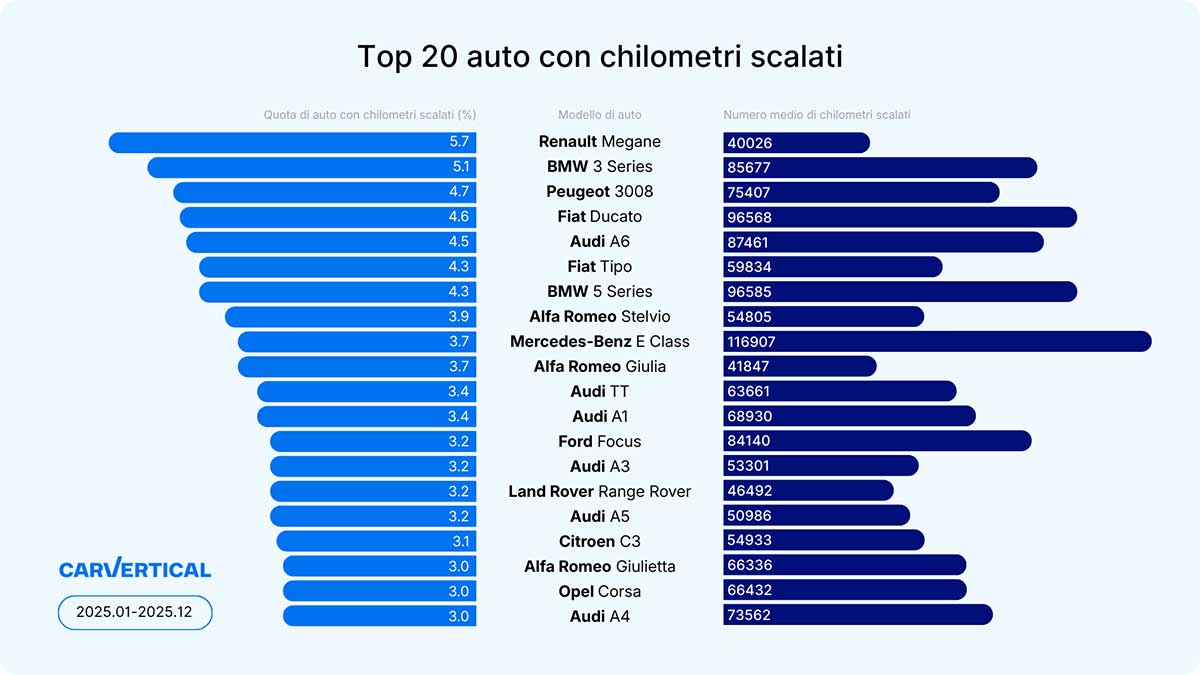
The model most affected in 2025 is the Renault Mégane. In Italy, 5.7 % of the vehicles checked had a modified speedometer. On average, more than 40,000 kilometers were lost from the vehicle's actual history. Behind it, the BMW 3 Series reached 5.1 % of suspect cases, with an impressive average deletion of almost 86,000 km. The Peugeot 3008 completes the podium at 4.7 %, with over 75,000 km removed.
There's nothing random about this trio. These are widely distributed cars, sought-after on the second-hand market and easy to resell quickly. Their popularity makes them an ideal target: the more a car is in demand, the greater the temptation to “rejuvenate” it artificially. For the buyer, the double penalty is obvious: pay more than the real value, then suffer mechanical wear and tear more quickly.
Not all models are affected as often, but some are much more heavily. The Mercedes E-Class holds the record for deleted mileage, with an average of 116,907 km. The BMW 5 Series follows with 96,585 km, almost on a par with the Fiat Ducato with 96,568 km.
The reason is simple: these vehicles are driven a lot, often in fleets or for professional use. When they arrive on the second-hand market, they sometimes have very high mileage. Reducing the mileage on the odometer can turn a well-worn car into a “bargain”. The problem is mechanical: a car with 140,000 km on the odometer but 260,000 on the road will obviously behave very differently. Breakdowns, worn parts and heavy maintenance happen much more quickly.
The Italians are well represented in the ranking
The study also shows that Italian models are not spared. The Alfa Romeo Stelvio and Giulia are among the cars regularly modified, as is the Giulietta.
The reason is simple: these are cars valued for their premium or sporty image. Low mileage immediately enhances their attractiveness in advertisements. Conversely, the least risky model in the ranking remains the Audi A4, with around 3 % of cases detected.
A phenomenon difficult to control
Why is this problem so persistent? Mainly because of imports. Many cars move from one country to another. But national databases don't systematically communicate with each other. As a result, a vehicle can lose tens of thousands of kilometers between two registrations, without any authorities noticing.
According to industry specialists, tampering with the meter represents massive economic losses for European motorists every year, while at the same time making the vehicle fleet more dangerous because the true condition of the vehicle is no longer known.
How to avoid unpleasant surprises
Today, checking a car's history has become indispensable. Specialized reports allow you to see how mileage has evolved over time, and to identify inconsistencies between two records. Without this type of control, the risk remains high, especially on popular and sought-after models. A car that looks too good for its age, or displays abnormally low mileage, should immediately arouse suspicion.
Modifying an odometer is no small commercial trick: legally, it's a swindle that can land you in court. But for the buyer, the damage is already done: overpaying for a tired vehicle and having to pay for repairs.
 English
  French
  Italian
  Spanish
  Portuguese
  German
  Japanese
  Turkish
  Dutch
Dutch
The article doesn't say how mileage is modified with digital meters. I thought it was impossible?
I think there must be machines on the parallel market that do this very well, since everything is electronic.
I'm thinking of going for a 335d but I'm very wary... between that and the reprogramming...