

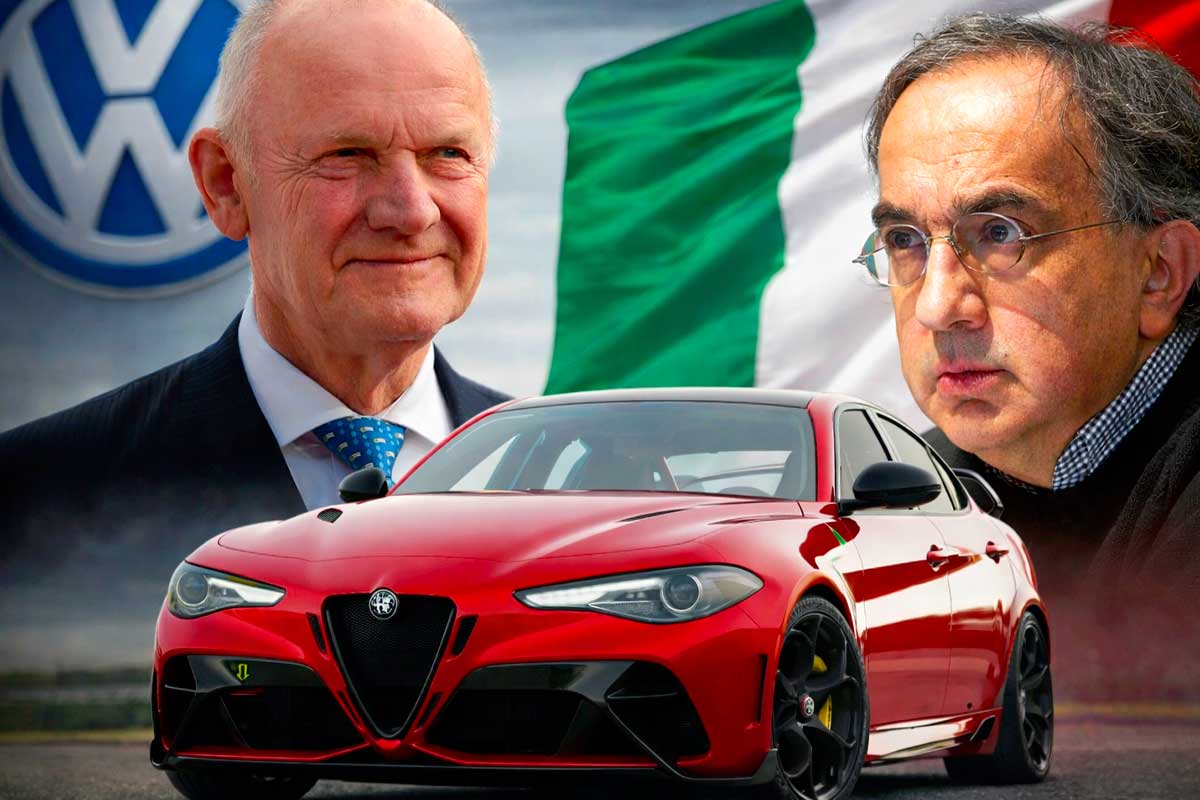
Today, Alfa Romeo sells around 60,000 to 70,000 cars a year. A modest figure for a brand with such an immense past, which has long fuelled an almost obsessive question among enthusiasts: what if history had been different? For more than a decade, another giant dreamed of reclaiming the Biscione: Volkswagen Group. And not just once... but at least twice.
Ferdinand Piëch's dream: to turn Alfa into the popular anti-Porsche
In the early 2010s, Volkswagen patriarch Ferdinand Piëch made no secret of his admiration for Alfa Romeo. At car shows, he repeated that the Italian brand could "thrive under the Volkswagen roof". He goes even further: according to him, sales could be multiplied by four in five years.
At the time, Alfa was selling around 100,000 cars a year. Piëch imagined a clear future: an Alfa positioned under Porsche, with German technology but Italian styling. In this scenario, the Milanese sports cars could have received the new four-cylinder turbochargers of the Boxster and Cayman, while the brand would have become a more emotional and accessible alternative to the Zuffenhausen models.
The Italian response was immediate and brutal. At Fiat Chrysler Automobiles, the door was shut without discussion. Sergio Marchionne was even quoted as saying that as long as he was in charge, Alfa Romeo would never be sold to Volkswagen. The psychological game is on.
2018: the second attempt
Time passes, Piëch leaves the helm, but his idea continues to haunt Wolfsburg. In 2018, the year of Sergion Marchionne's death, Volkswagen boss Herbert Diess meets new FCA head Mike Manley. According to several concordant sources, Diess considers it his duty to fulfill Piëch's project. The question is simple: is Alfa Romeo for sale?
The answer is just as clear: no. Once again, the Italian brand remains untouchable. A few months later, the PSA-FCA merger gave birth to Stellantis, which promised to invest in all its brands and confirmed that none would be sold. The German dream ends here.
What if Alfa Romeo had become a Volkswagen Group brand?
This is where the real automotive fantasy begins. Volkswagen has already proved its ability to revive prestigious brands: Lamborghini, Bentley or Bugatti (and even Ducati) have all prospered thanks to colossal industrial resources while retaining a strong identity.
In this context, Alfa Romeo would probably have occupied a very special place: an emotional sports car positioned between Audi and Porsche, with shared platforms but a Latin character. A Giulia, the technical cousin of an Audi, an SUV close to a Macan, high-performance engines and, perhaps above all, a complete range. With the German group's industrial strength, 300,000 to 400,000 annual sales would no longer seem unrealistic.
The essential question remains: would a German-controlled Alfa Romeo still be an Alfa? Automotive history shows that technical rationalization improves quality, but sometimes standardizes sensations. Some believe that Lamborghini gained in efficiency but lost some of its craziness after its move to Audi. Yet Lamborghini's cars are well developed and produced in Italy, and the brand has never been in better financial and sales shape. And Alfa Romeo's technical pooling is well established, first with Fiat (Alfa Romeo Giulietta, Mito, Tonale), then with Peugeot (Alfa Romeo Junior). Would Alfa Romeo, a deeply emotional brand, have retained the character that still makes its reputation with Volkswagen platforms? A recent example is Cupra, which achieved its highest sales figures to date in 2025, with 328,800 vehicles delivered.
A still uncertain future
Today, under Stellantis, Alfa Romeo is preparing its second transformation. Initially, it was to be transformed into a 100 % electric brand. In the end, the new Stelvio and Giulia were postponed, the current Tonale, Giulia and Stelvio models were extended and the brand continued to survive with a reduced range. Between postponed projects and global ambitions, history has been repeating itself for almost two decades.
That's precisely what makes this story so fascinating. The Volkswagen Group may have missed a major strategic acquisition... or avoided transforming a Latin symbol into a perfectly calibrated industrial product. We'll never know what Alfa Romeo would have been like in this parallel universe. But one thing is certain: rarely has a brand made a competitor dream so much... without ever agreeing to belong to it.
 English
  French
  Italian
  Spanish
  Portuguese
  German
  Japanese
  Turkish
  Dutch
Dutch
It's all very well to refuse to belong to VW, but if you're going to end up with a PureToc under the hood... it's no better, it's even worse.
That would mean that the 8C, 4C, Giulia and Stelvio would never have existed...so thank goodness they never did.
Genau so siehts aus. Ich fahr seit ich denken kann (1982) nur Italiener. Fiat, Alfa - Was die Italiener können, ist Leidenschaft vermitteln. Jede deutsche Karre versprüht nur driste Langeweile.
Wenn ich in unserem (meine Tochter und ich teilen uns das Fzg.) 4C Spider unterwegs bin, ist man nur permanent am Grinsen. Da ich in einem Fiat - Alfa - Autohaus seit fast 28 Jahren beschäftigt bin, gibt es für mich nichts schöneres wie diese Tradition zu spüren.
Wenn VW den Laden übernehmen sollte, reiche ich den Vorruhestand ein.(:-)
With vw engines, they won't sell any more alfa's, again perched managers who know nothing about history and customers.
Nicht nur die simplen VAG Motoren, die zusätzlichb durch zahlreiche frühe Motorschäden glänzen( Steuerkette) sondern welches VW Modell kann annähernd die Fahrdynamik von Alfas auch nur annähernd erreichen.
Das sportlichste Modell, Audi, fährt sich gegen eine Giulia/ Stelvio u.auch BMW wie ein LKW.Stellantis soll endlich das Marketing verbessern, TV Werbung, Printmedien,ifüGiulia/ Stelvio sah man keinen Tag TV Werbung in irgendeinem deutschen Kanal, detto für Junior u. Tonale.Wenn nur Alfa Kunden über neue Modelle Bescheid wisseb, kann sich der Absatz nicht vergrössern.
Ein sehr großer Fehler der Alfa Romeo- Vorstandes, nur unter der Führung von VW könnte diese Marke eine sichere Zukunft haben.
Was ein Bullshit... Fahr mal den neuen Passat, der hat die Qualität eines Fiesta's der 90'er im Innenraum, sogar die Franzosen und Italiener haben den überholt und zum Motor 1,5 Benziner bei VW der ist ein Chinese der unteranderem auch im MG3 drin sitzt... Die VAG-Karren sind inzwischen minderwertige Qualität mit extrem viel Plastik, sogar Dacia überholt die grade... Von den Phantasiepreisen reden wir lieber nicht... Fahr leider jeden Tag den Schrott in der Firma... Und bevor ich mir den neuen Caddy oder Vw-Bus hole, kaufe ich lieber das Original von Ford... 🤦🏼🤣
Well, I don't know if Alfa would have been better off under the VW umbrella, but one thing's for sure: there it would have been entitled to substantial investment and development, something it never had and never will have with Fiat or Stellantis. Alfa didn't even have the means to bring the Kamal project to fruition in its day, even though it was unanimously acclaimed!
The Giorgio and the 2.0L petrol and 2.2L diesel blocks are not dss investments???
Not to mention the News V6 2.9!
VAG will never have the means to bring you a product as great as the 4C, 8C, Giulia or Stelvio, just another made-in-VAG clone that's no better than Stellantis.
Yes, and it's the only investment - that's what's so unfortunate. Here's a list of projects that never came to fruition...Kamal, Mito GTA and cabrio, Brera faithful to the concept, sedan from seg E, station wagon absent, SUV from seg E, no replacement for the Giulietta, Mito, spider, 4C, 8C etc...In my opinion, to relaunch Alfa VW would have done exactly as they did to relaunch a moribund Audi! 😉
Even when VAG took over NSU, Audi didn't exist. They brought Lamborghini back up on a short-term basis because the value of their used product is like Maserati or Aston Martin, they're collapsing, not to mention reliability, which is no better than it was under Lamborghini at the time.
We can see the result of what Alfa would have given under VAG, like Seat in 2030... forget it!
VAG has never been able to produce a platform as efficient as the Giorgio, but FCA has.
Audi was created by VAG on the heads of NSU, and when you see how Porsche and Audi are today, there's nothing to be proud of.
The Giorgio reference platform was born under FCA, not VAG
Brittany's design is faithful to the concept, but it's the whole concept that should have been taken up.
The 159, Brera has all the features of a Lancia Thema version 2.0 (shared engine and chassis) and could have lived under Lancia with a 4-door Brera to boot. In this case, it's FCA that has once again screwed up its branding, as in the case of Maserati, which has a Ghibli that could have been seen as a Thesis and a Grecale as a Phedra.
Einfach nur nein!
Unterm Blech VW, auf keinen Fall, dann lieber liquidieren!
Wirklich, was für ein Albtraum!
Noch mehr Badge Engineering braucht die Welt einfach nicht!
I hope Filosa will give Alfa the means to take off, that's all I wish for this Italian brand which deserves better.
Surely Alfa would have been much better off under the ownership of anyone else but Fiat Group/FCA/Stellantis, who have shown time & time again they simply haven't a clue.
An Alfa Romeo with a TSI engine? Not great, but surely better than a PureTech under the hood of an Alfa Romeo. Maybe Volkswagen would have allowed Alfa Romeo to invest.
Sergio Marchionne didn't want an alliance with PSA, and the facts prove that he was right.
We'll never know what Volkswagen could have done with Alfa Romeo.
Sehr guter Bericht!!!! Weiter so!
Ein sehr großer Fehler der Alfa Romeo- Vorstandes, nur unter der Führung von VW könnte diese Marke eine sichere Zukunft haben.
Fahr mal den neuen Passat, der hat die Qualität eines Fiesta's der 90'er im Innenraum, sogar die Franzosen und Italiener haben den überholt und zum Motor 1,5 Benziner bei VW der ist ein Chinese der unteranderem auch im MG3 drin sitzt... Die VAG-Karren sind inzwischen minderwertige Qualität mit extrem viel Plastik, sogar Dacia überholt die grade... Von den Phantasiepreisen reden wir lieber nicht...
Fahr mal den neuen Passat, der hat die Qualität eines Fiesta's der 90'er im Innenraum, sogar die Franzosen und Italiener haben den überholt und zum Motor 1,5 Benziner bei VW der ist ein Chinese der unteranderem auch im MG3 drin sitzt...
アルファロメオはそこまでして売れなくてもけっこうです。
それが我等アルフェスタの考え方では。
例えそれでアルファロメオが滅びてもかまいませんよ。
Fahr mal den neuen Passat, der hat die Qualität eines Fiesta's der 90'er im Innenraum und zum Motor 1,5 Benziner bei VW der ist ein Chinese der unteranderem auch im MG3 drin sitzt... Nur viel günstiger 😄
Unter VW wäre es Alfa Romeo sicher gut gegangen, was die Verkäufe angeht. Da hätte es so eine schlampige Modellplanung wie jetzt nicht gegeben. Jedoch hätte es auch niemals Gulia und Stelvio gegeben, sondern irgendein frontlastigen Passat Re-Badge.
Der Werdegang mit Stellantis ist keineswegs besser. Aber falls man jetzt mit der neuen Generation Stelvio/Giulia die Giorgio-Evo Plattform gut nutzt und das Design nicht versaut, landet man bei allen Fans der Marke voll im Herz.
Zum Glück ist es nicht passiert. Dann haben wir zumindest noch die Giorgio Plattform in der Giulia/ stelvio erleben können, bevor stellantis jetzt alles niederreisst.
VW wollte alfa nur kaufen um an die multi air Technik zu kommen. Die variable Ventil Steuerung die mit scheffler zusammen entwickelt wurde, auf das alfa bzw. FCA das patent recht hatte. Das war der Hintergrund. Das erste Mal als VW es versuchte war als sie dadurch an die common rail Technologie kommen wollten. Auch ein patent von alfa das erstmals 1997 im 156-er rauskam.
Bist du ein Vollidiot oder was?!
Der VW-Konzern produziert alles von Ducatis über Bugattis bis hin zu Nutzfahrzeugen.
VW ist eine marke für's Volk (für die Masse).