

Alfa Romeo has just sprung a surprise. Just when many thought that the most radical versions would quietly disappear from the European catalog, the marque au Biscione has announced that orders for the Alfa Romeo Giulia Quadrifoglio and Alfa Romeo Stelvio Quadrifoglio will reopen in March 2026. Excellent news for pure performance enthusiasts. Much less so for the group's accountants.
A return dictated by passion
Alfa Romeo confirms that it will continue to produce the Giulia and Stelvio in Europe until 2027. Santo Ficili, the brand's Managing Director, makes no bones about it: it's a question of keeping a promise made to the customers most attached to the extreme performance and historic DNA of the Quadrifoglio.
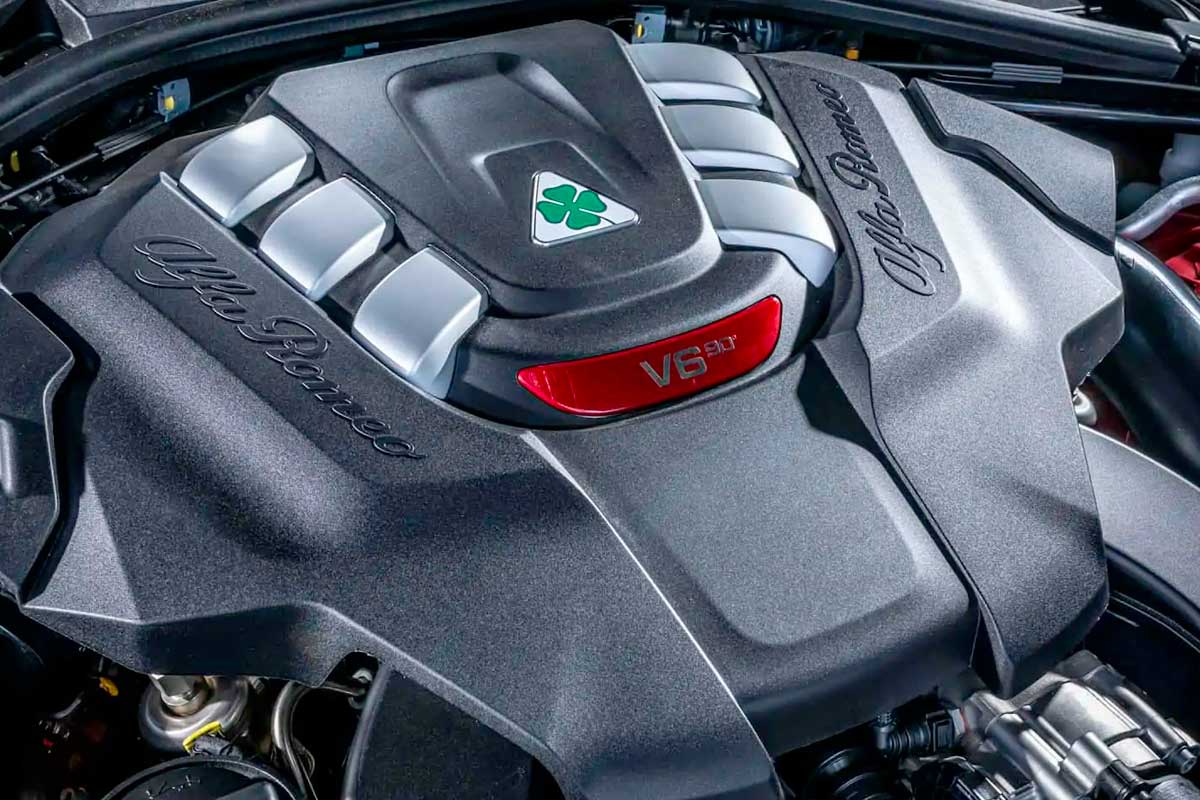
Under the hood, nothing has changed. The 520 hp 2.9-liter twin-turbo V6 is still there, accompanied by its mechanical limited-slip differential. Rear-wheel drive on the Giulia, Q4 all-wheel drive on the Stelvio. Carbon fiber galore, active front splitter on the sedan, deep-tone Akrapovič exhaust... in short, Alfa Romeo as purists like it. But in 2026, reviving a 520 hp V6 petrol engine in Europe is no longer a simple marketing choice. It's a financial gamble.
The brutal reality of the CAFE law
Since 2021, the European Union has been imposing strict average CO₂ emission targets on manufacturers. The initial threshold of 95 g/km has already been lowered to 81 g/km in 2025, and the target will drop to 50 g/km in 2030.
The year is 2026. And every gram over the threshold costs the manufacturer €95, for every car sold. The Alfa Romeo Giulia Quadrifoglio now boasts 228 g/km of CO₂. Even after a slight improvement on the previous 237 g/km, it still exceeds the European threshold of 147 grams. Result: a theoretical penalty of €13,965 per unit sold.
The situation is even more spectacular for the Alfa Romeo Stelvio Quadrifoglio. At 267 g/km of CO₂, the SUV exceeds the limit by 186 grams. The penalty then climbs to €17,670 per vehicle. At these levels, every sale becomes almost a militant act.
Selling at a loss to preserve DNA?
Of course, in reality, these models are part of an average, and hybrid or electrified models from the Group's other brands go some way to offsetting these excesses. But the calculation remains brutal: every Quadrifoglio sold in 2026 weighs heavily in the CAFE equation.
This means that Alfa Romeo knowingly accepts to increase its exposure to penalties in order to keep its sporting emblem alive. The extension to 2027 looks like a last window for those who still want a new Alfa Romeo twin-turbo V6 in Europe. In a context where targets will fall to 50 g/km in 2030, the future of such powertrains on the Old Continent seems extremely compromised, unless high-performance hybrid versions are offered. Passion, in 2026, is expensive.

 English
  French
  Italian
  Spanish
  Portuguese
  German
  Japanese
  Turkish
  Dutch
Dutch
Alfa Romeo's task is to offer electric 100% models with performance levels as close as possible to those of its internal combustion models. This means choosing propulsion by default, the lightest possible weight with specific platforms, and an analog rather than digital experience (in complete contrast to what Ferrari and Jony Ive have recently presented). Above all, we're not going to do away with the steering column, for example. This is essential to offset sales of these V6-equipped models.
Electrics don't work, customers don't want them, even if an electric Alfa is close to a combustion engine.
Alfa didn't decide to postpone the launch of the Stelvio for nothing. .
If Alfa decided to postpone the launch of the Stelvio, it's because the policy of mutualization with the rest of the Group was pushed to the limit, whereas Alfa Romeo needs exclusivity and a stronger partnership with Maserati, at least in the D and E segments. This was obvious, but it took years for the board to understand it. As for the rest, CAFE standards exist, and Alfa is above all a European brand, so we have to take them into account. Meanwhile, BMW is making progress on the M3.
It's not a matter of the group's policy being pushed too far, it's because Tavares hasn't taken into account the reality of the car market, which isn't ready for electric cars, so that's why Filosa decided to postpone the Stelvio/Giulia in order to adapt it to hybrid combustion.
Of course, but what you need to know is that around 3,000 engines already produced (and paid for) are there... in short, from an accounting point of view, it probably doesn't cost that much... and it's a big plus for the image, on the other hand. Alfa still exists beyond Junior!