

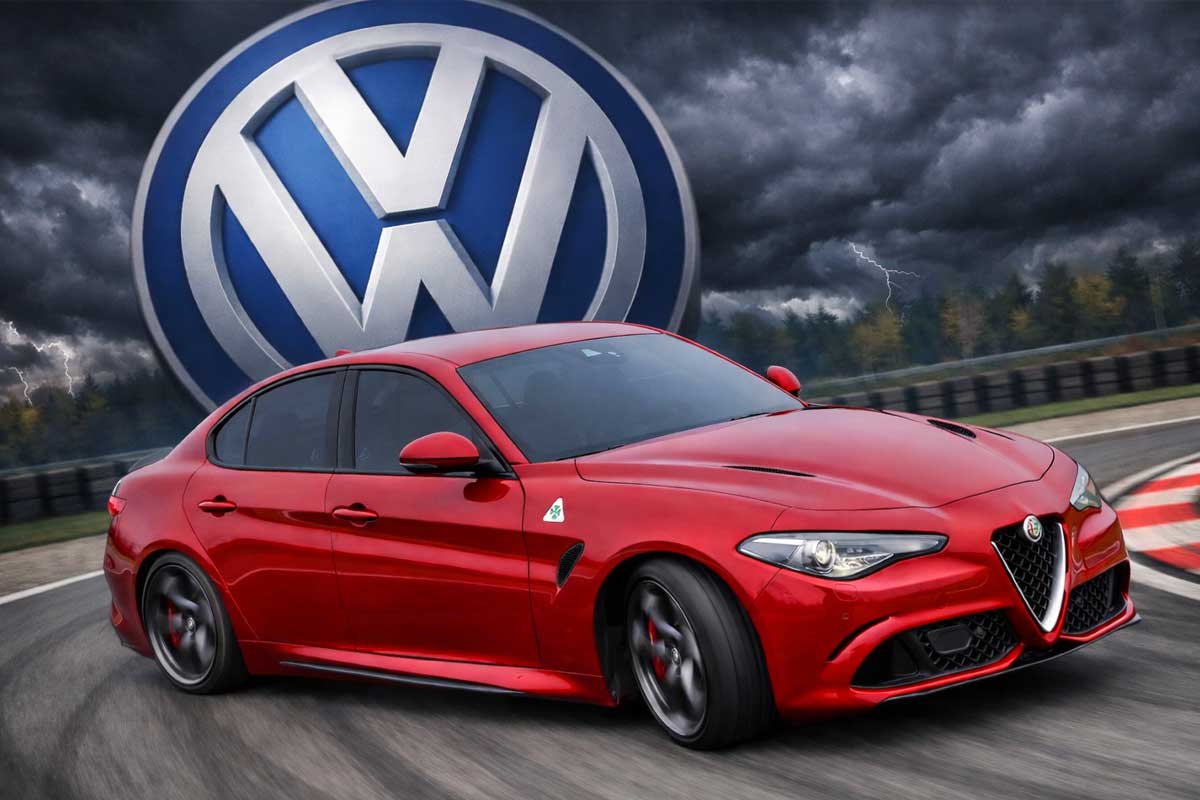
A few days ago, I published a scenario that still makes purists wince and pragmatists salivate: what if Alfa Romeo was bought by the Volkswagen Group ? The article, published a few days ago, recalled this double “dream” on the Wolfsburg side: that of Ferdinand Piëch, in the early 2010s, then a second approach in 2018. Two rejections, and in the middle a promise that comes back like a refrain: to multiply Alfa Romeo's sales by four by transforming it into a popular Porsche.
But the story didn't stop with the story. It continued... in the comments. And here's where something becomes obvious: depending on whether you read from France, Italy or Germany, you don't hear the same music. Not the same fear. Not the same hope. Not the same trial.
In France: “They would have managed better”... but at what price?
On the French side, the debate splits into two very recognizable camps.
On the one hand, there are those who look coldly at the current situation and conclude that, manager against manager, Volkswagen would probably have done better. We read some very concrete regrets: a wider range, more frequent renewals, a presence in competition, a more stable trajectory. Some sum up the idea in no uncertain terms: Alfa Romeo would have “grown up”.
And when the shadow of Stellantis passes over the discussion, the comparison becomes brutal: “today it's worse because they offer Peugeot duplicates”, “Alfa will die under the Stellantis era”, “lousy PSA engines”. Here, the reasoning is simple: if Italianness is to be “diluted”, it might as well be with a group perceived as powerful, wealthy and structured.
But alongside this, another group rejects the idea on principle, almost viscerally. There's a cultural distrust of the German car, considered too cold, too uniform. The image that keeps coming back is that of cloning: “a Giulietta based on a Golf”, “a Giulia based on a Passat”, and above all this fear of the badge stuck on a generic platform. Several comments say the same thing in different words: an Alfa Romeo under Volkswagen could have become an Audi/Volkswagen in disguise, without that little something that sometimes makes us forgive Alfa Romeo what we don't forgive others.
Between the two, there are the “nuanced” ones: those who admit that Volkswagen knows how to build a brand (Cupra example, Lamborghini example), while doubting that Alfa Romeo can be industrialized without transformation.
In Italy: pride, anger... and the Stellantis trial
In Italy, you don't just read about an industrial debate. It's almost a matter of identity. First of all, there's a very Italian, almost bitter weariness in the face of the national paradox: “in Italy, there are more Audis than Alfa's on the road”, “if you want to see a lot of Alfa Romeo's... buy them!”. As if the question were not just “who manages better?” but “who really supports the brand?”. Some point to this reflex: we defend Alfa Romeo as a symbol, but we don't always choose it when we sign the order form.
And then there's the anti-Stellantis explosion, even more frontal than on the French side. The word “Peugeot” comes back like a slap in the face. There's talk of mistaken strategic decisions, postponed models, a brand lost in a group that's too large, incoherent management. Here, Volkswagen almost becomes a comfortable “alternative universe”: at least, they say, the means would have been there, and production might have been preserved “like Ducati and Lamborghini”.
But even in Italy, not everyone dreams of the German savior. Some reply that Volkswagen wouldn't have worked miracles: the image of reliability has long stuck with Italian brands, and a shareholder isn't going to erase that in five years. Others point out one thing above all: without Marchionne and the Giorgio project, the Giulia and Stelvio might never have existed. For this camp, a “German-style” Alfa Romeo would above all have meant... an Alfa Romeo that was no longer Alfa Romeo.
Basically, Italy is the country where you find the most extreme positions: either “better with them than now”, or “rather die than become German”. It's also the country where the discussion most quickly slides towards politics, taxes, the role of the State, or the figure of John Elkann. As if, behind Volkswagen, it were above all the trauma of an Italian industry that sometimes feels dispossessed.
In Germany: “no thanks”... but not for the same reasons
The German case is fascinating, because it breaks a cliché. You'd think Germans would have applauded the idea of a Volkswagen takeover. However, a large proportion of reactions say exactly the opposite: “Don't touch Alfa Romeo”, “For heaven's sake, not with Volkswagen”, “German sadness in Alfa Romeo”.
Why? Firstly because, for many, Volkswagen does not represent the German automotive dream, but the mass-produced automobile, and sometimes even suspicion: dieselgate, “rigged” engines, criticized DSGs... In some comments, Volkswagen is described as the symbol of the standardized product, of uniformity.
Secondly, because some German enthusiasts clearly recognize that Alfa Romeo can make cars that Volkswagen cannot. We even read statements that turn the usual hierarchy on its head: the idea that a Giulia Quadrifoglio, in its philosophy, couldn't have come out of a VAG specification.
But Germany also has its pragmatic camp, similar to that seen in France and Italy: “With VAG, Alfa Romeo would have better chances”, “better than with Peugeot now”. These people aren't talking about romance, they're talking about survival. And they often add an important clarification: it's not “Volkswagen” that saves the day, it's the group structure, the ability to lift Skoda, to transform Seat into Cupra, to maintain a clear identity despite shared platforms.
The real bone of contention: “management” or “transformation”?
As you read the comments, you'd think you were debating a simple question: “Would Volkswagen have managed Alfa better?” But in reality, not everyone puts the same thing behind the word “manage”.
For some, good management means building volume, occupying the market, renewing the range, investing, securing budgets and stabilizing product plans. In this definition, Volkswagen is naturally credible, and Stellantis often appears as a group where Alfa Romeo has to fight to exist.
For others, good management means preserving a singularity, maintaining a road feel, a mechanical personality, an aesthetic, a character. And in this definition, Volkswagen becomes a risk: that of the “standardized Alfa Romeo”, too clean, too rational, too interchangeable.
What's striking is that all three countries share exactly the same fear... but they project it onto different targets. The French and Italians project a lot onto Stellantis (the painful present). The Germans project a lot onto Volkswagen (the doubtful emotion and recent technical reputation). And Italy projects on everyone at once, because the subject goes far beyond the automobile.
Cupra, Lamborghini, Ducati... the proof that everyone chooses
In this discussion, three names serve as “proof”, and everyone uses them in the way that suits them best. Lamborghini and Ducati are brandished to say: “Volkswagen knows how to keep an Italian identity.” But these examples are also turned around: “yes, technically better, but less crazy”, “the Urus is a supercharged Q8”, “interiors too Audi”. Clearly: even when Volkswagen succeeds, some see it as a cold success.
And then there's Cupra, the example that keeps coming back like a cruel mirror: a young brand, with a sporty storytelling, that sells a lot, and proves that with a common technical base, you can create a strong image... provided you have a stable, aggressive strategy. For some, Cupra is proof that Volkswagen could have made Alfa Romeo a modern success. For others, Cupra is exactly what they don't want: a Golf that thinks it's something else.
Could Volkswagen have managed Alfa Romeo better?
This wave of reactions makes one thing very clear: Alfa Romeo is a brand on which everyone projects their own definition of the automobile. In France, the debate oscillates between romanticism and efficiency. In Italy, it's mixed with pride, politics and anger at the present. In Germany, it runs up against a mistrust of Volkswagen... while acknowledging that Alfa Romeo has something that the Wolfsburg group does not.
Ultimately, the question may not be “who would have managed Alfa better?”. The real question, the one that divides so many, is: what are we willing to lose to save a brand? And on this precise point, the Germans, Italians and French aren't just talking about Alfa Romeo. They're talking about themselves.
 English
  French
  Italian
  Spanish
  Portuguese
  German
  Japanese
  Turkish
  Dutch
Dutch
Of course, Alfa would have developed better under VW than it did under FCA and is now under Stellantis. Just look at the Giulia and Stelvio, a bland Tonale and a Peugeot-based Junior, no station wagons, coupes, spiders, cabrios, large 164-type sedans....etc! 🤔
Let's call a spade a spade: for 4 years, Stellantis was nothing but an enlarged PSA. I hope Filosa will wipe the slate clean very, very soon...
Junior is still the best-selling esparto!
Normal, compare the price of a Junior with a Giulia! Do you think BMW sells more 5 Series or 1 Series? ....compare the low sales of the Junior with the MiTo in its day, without going as far as the Alfa Sud, where the difference is 1 to 20 in favor of the Sud! 🤔
Yes, and Junior saves the Alfa brand... And that's a fact!
No, the junior doesn't save anything, it's a flop because it's nowhere to be seen!
Scudric... Well, stay in your imagination
Sorry for me, it's not the Giulia or the Stelvio or the Tonale/Jeep that are saving the brand ... but the Junior for the past 2 years.
What you see, what value!?
Selling better doesn't mean selling well, and to whom? Junior's customers are those who destroy a brand's identity by buying a trendy car! Let's not forget that fiat destroyed technological creators such as Lancia and Maserati (the AM479 Maserati V8 became the F129B of the F355). As for Alfa: the destruction of Arese and the end of r&d on the V6 busso, they killed Alfa to turn it into a pretty fiat, while killing Maserati and throwing away technical know-how.
Well lets be honest, could VW do a worse job than Stellantis?? That would be hard to imagine. Look what they've done with Audi, with Skoda - at this stage I'd be willing to allow anyone to take over Alfa!
Whether it's «well-managed» in the sense of making volume or in the sense of «preserving a singularity», with PSA it's bound to be worse than with the VW group. That said, I don't want that either.
Why worse, the only Alfa from the Stellantis era is the Junior, which is the brand's best-seller. Stelvio and Giulia are good cars, but they don't sell!
Vorrei ricordare ai più giovani e a chi non ha un passato automobilistico alle spalle del tentativo degli anni sessanta di Alfa Romeo dell'accordo con Renault.Tale accordo avrebbe dovuto permettere alla casa italiana di saturare le linee di montaggio producendo una vettura francese in Italia (l'orribile Dauphine)oltre al fatto di evitare i dazi doganali che sono esistiti fino agli anni novanta.Oltre al fatto di incrementare le vendite Alfa Romeo su un mercato aggiuntivo.Buone intenzioni naufragate perché i francesi non digerivano di vendere vetture sicuramente migliori delle loro.Detto questo non credo ci sia bisogno di aggiungere altro.
Stellantis is just 5 years old.
Junior is a success!
What were Alfa's previous successes before the Stellantis era?
How long has it been?
If only to see rebadged Audis and Cupras....
It's already been 5 years and it's a disaster, just as many predicted!
Junior is a fiasco!
The 147, 156, GT, Giulietta were a success, and the Giulia/Stelvio put Alfa back where it belongs.
so when we see the sales of Italian brands under Stellantis, it's a total fiasco!
Scudric, 5 years in industry when you get behind FCA's totally empty new project plan is just yesterday!
You have to understand what you're talking about!
147 production in 2000.
the 156 ... 1997
the GT... 2003
the Giulietta, finally in 2010! 481,060 units over 12 years of production!
That's what I'm saying, what are Alfa's latest successes over the last 16 years?
At some point, you have to stop spitting in the soup!
The automotive world is in a bad way.
Because when I buy a car, I don't give a damn whether other people buy it or not. I'm only interested in its intrinsic qualities, otherwise you'd just be buying a simple mover (hello Junior).
For this Junior, you've got to stop acting like a bourvil for 2 seconds: it's the best-selling model in the range, because it's the least expensive. ITEM.
Compare that to the launch figures for the MiTo or Giulietta, or even the Giulia and Stelvio LOL. With FCA underpinnings, it might have sold twice as much...
We can talk about Junior, but I haven't seen one circulating once or three times since it came out, so where are they in France????
The Junior is therefore more expensive than the MiTo, which was an improved Punto.
It's a different time.
The automotive world is in crisis at the time of the Junior's launch, of course... You're deliberately forgetting!?
«With FCA underpinnings it might have sold for twice as much...»
But of course!
«If my aunt had any»
With FCA underpinnings, it would have sold a thousand times better, just like the Abarths. The Junior is a fiasco, and only the pro-PSA crowd refuses to see it.
They're nowhere to be seen.
The facts prove you wrong!
You're an FCA lunatic, Scudric.
Leider ist es zu spät darüber nachzudenken. Die Marke hätte von einer Übernahme durch VW sehr profitiert. Ich denke auch sportlich. Das teure F1 Projekt wäre vielleicht in ein GT3 Projekt gemündet. ALFA ROMEO als reine Elektromarke zu etablieren, war der größte Irrtum und Fehlentscheidung.
Wenn bei Stellantis nichts mehr geht, steht China bereit...
Unfortunately, Alfa hasn't been around for a long time! It's no longer their engine or their platform, the only thing left is the design. Personally, I have a 159 with a badly stepped gearbox, a Mito and a 147. However, none of them has an Alfa powertrain. Too bad!!!
The Busso and TS are Alfa engines, as is the 1.75 on the 4C or Giulietta. The latest V6 is of Ferrari origin, but Ferrari started out with Alfa .... and the Giorgio chassis is indeed from Alfa... in short, apart from the 159 error, it's precisely the opposite. Audi is just VAG in disguise from the start.
Yes, the classic Alfa V6 was created at its development center (Direzione Tecnica Motori) by Alessandro Piccone's team, while the later 3.2 was developed under the direction of Wilfredo Binda. The four-cylinder TS with four-valve heads was developed at Fiat by Stefano Iacoponi's team; the only Alfa-specific feature was the second side spark plug in the combustion chamber, commissioned by Fiat marketing and, according to Piccone, technically meaningless.
the T.S was the lancia L4 code name: 831.B7.000 ; the V6 alfa code: 936A6.000 is the busso by aluminium specific cast, equilibrium, stucture and ignition order from G. Busso
warum kaufen Italiener keine Italienischen Autos?
Warum sehe ich Italienische Autos nur als Polizei Auto in Italien?
Deutsche kaufen Deutsche Autos?
Meanwhile, Audi is bringing out new S5s, RS5s, RS6s, etc., and Alfa-Romeo has nothing new in its catalog...
Anyway, it's all speculation. Alfa-Romeo is owned by Stellantis and for the moment they have no plan for the brand. Let's hope they find a solution.
They've brought out cars that have been fiascoes at Audi, and that's the key reason why they've closed the factory in Belgium and are going to close a bunch in Germany. Without the propaganda financed by the VAG group among certain journalists, Lexus, Mercedes and BMW would have eaten them alive a long time ago!
When you see what they've done with SEAT, which will disappear in 2030 (official), Bugatti sold off and a number of others in the hot seat, Audi in the red, Porsche with profits approaching zero and plunged into the abyss with electrics that nobody wants, Ducati no better off since its takeover and informed that they'll be up for sale 3 times... where's the progress?
It's odd to blame Stellantis when the key decisions were made by Marchione at Fiat. He failed to secure funding for the timely development of a replacement for the 147, along with the SUV, and did the same for the replacement for the 159, because he believed replacing the Jeep lineup was more profitable at the time. And the mistake of upsizing and increasing the price of the 159 relative to the 156 was made even before him.
Ich fahre seit über 40 Jahren Alfa (alfetta, 75, 156, 164) und seit einem halben Jahr den Junior ibrida. Fährt gut. Macht Spass und ist nicht zu teuer. Daß es den italienischen Freunden weh tut (Polen, stellantis) kann ich gut verstehen. Dennoch ist es ein super auto.ciao
I recently saw an Alfa Romeo Junior and frankly, it's not ugly and has character.
The biggest weakness is the powertrain. Putting a Puretech in an Alfa was a daring move! Tavares' excessive streamlining really hurt Stellantis.
In France, remove the carbon tax and weight tax and these big Alfa Maserati brands could put in real engines and we'd keep the electricity to make espressos.